For education founders in India
Alternative schools in India are schools and learning centres that organise learning around the child instead of the syllabus and the exam: Montessori and Waldorf schools, schools in the Krishnamurti and Tagore traditions, democratic or learner-led communities, and open schooling through NIOS, India’s national open school board. There is no official list or count of them, and the country’s own education policy says it wants more room for alternative models.
Most pages about alternative schools in India are lists of names for parents. This one is written mainly for the person who wants to build one. Where the law is involved, we point you to the official source and do not guess.
In this article
- What is an alternative school? The meaning in India
- Types of alternative schools in India
- Alternative school vs conventional school
- Boards, certificates and NIOS, the open-schooling alternative
- What NEP 2020 says about alternative education
- Why India needs more people who build schools
- How to start an alternative school in India: two routes
- The co-founding route: NIJIN Academy India
- How to choose an alternative school in India: 7 checks
- Questions and answers
What is an alternative school? The meaning in India
An alternative school is a school that organises learning differently from the mainstream textbook-and-exam model: through a philosophy such as Montessori, Waldorf, Krishnamurti or Tagore, a democratic or learner-led community, or open schooling through NIOS. In India, “alternative” describes the approach to learning, not a school only for children with special needs.
There is no legal category called “alternative school” in India. The phrase is used in two different ways, and a founder needs to know both.
The first meaning is the one parents search for: a school built on a philosophy of childhood that differs from the textbook-and-exam model, often with small groups, mixed ages and hands-on work.
The second meaning comes from government documents. The National Education Policy 2020 speaks of “alternative and innovative education centres” for children who have dropped out or whose families migrate for work, and of allowing alternative models of education. Here the word describes a way of reaching children whom the regular system has not kept.
Both meanings point at the same fact: one kind of school does not fit every child.
Types of alternative schools in India
These are the main streams a founder will meet. They are descriptions of approaches, not a ranking of schools, and many schools in India combine more than one.
| Approach | Core idea | What a school day looks like | Background you can check |
|---|---|---|---|
| Montessori | Children educate themselves when the environment is prepared for their stage of development | Mixed-age rooms, long uninterrupted work time, materials the child chooses | The first Children’s House opened in 1907. Maria Montessori came to India in 1939 and, with her son Mario, trained more than 1,500 Indian teachers (Association Montessori Internationale) |
| Waldorf / Steiner | Head, heart and hands are taught together, in step with the child’s age | A main lesson taught in blocks, with art, craft, music and movement through the day | The first Waldorf school was founded in Stuttgart in 1919; about 1,100 schools exist worldwide (Waldorf 100) |
| Krishnamurti schools | Education is about the whole of life, not only academic achievement | Academic study alongside dialogue in which teachers and students examine their own thinking | Krishnamurti Foundation India lists six schools on its website |
| Tagore’s tradition | Learning close to nature, the arts and one’s own language | Classes outdoors, with music, craft and festivals as part of study | Rabindranath Tagore began his school at Santiniketan in December 1901, with classes held in the open air under trees (Visva-Bharati) |
| Democratic / learner-led | Children help decide what they learn and how the community is run | Self-chosen projects, community meetings, adults as mentors | No single body speaks for these schools in India; each sets its own practice |
| Open schooling | Study outside a physical school, at your own pace, and sit recognised examinations | Self-study materials, contact classes at study centres, flexible exams | NIOS was set up in 1989 as the National Open School (NIOS Prospectus 2026–27) |
Open schooling is different from the others. It is not a philosophy of childhood. It is a route to a certificate, and that is why it matters to any school or family that does not follow a Board syllabus from Class 1.
Alternative school vs conventional school
| Question | Conventional school | Alternative school |
|---|---|---|
| What sets the pace? | The Board syllabus and the exam calendar | The child’s readiness, within a planned curriculum |
| How are children grouped? | By age, in Class 1 to Class 12 | Often mixed ages, in small groups |
| How is learning assessed? | Marks, tests and ranks | Observation, portfolios, projects and written feedback, with Board exams later |
| What is the adult’s role? | Teaches the lesson to the whole class | Prepares the environment, guides and observes |
| Hardest part to run | Individual attention at scale | Fees that cover small groups, and a clear route to a certificate |
These are general patterns, not rules. Many conventional schools use projects, and many alternative schools prepare children for Board examinations. For a fuller comparison, see alternative school vs traditional school.
Boards, certificates and NIOS, the open-schooling alternative
Every parent asks sooner or later: what certificate will my child have after Class 10 and Class 12? A founder needs a precise answer before opening.
In India, a school-leaving certificate comes from a Board. The NIOS prospectus describes three national Boards of school education: CBSE, CISCE and NIOS. Each state also has its own State Board. In principle an alternative school has three kinds of route: affiliate to a Board and teach its syllabus in its own way, have children sit examinations as open-school learners, or work with an international curriculum. Which of these is open to your school depends on its legal status and your state, so confirm it with the Board itself.
What NIOS is
NIOS, the National Institute of Open Schooling, is the Board most closely linked with alternative education in India. According to its Prospectus 2026–27, it is an autonomous institution under the Ministry of Education, Government of India, and it has the authority to conduct examinations and award certificates up to pre-degree level through open and distance learning.
Source: NIOS Academic Prospectus 2026–27. Read the current prospectus before advising any family; dates, fees and rules change every year.
The same prospectus states that NIOS certificates are recognised for higher education, government jobs and all other purposes. It also describes credit accumulation (subjects can be passed one at a time until five are complete) and an On Demand Examination System, and it advises learners who plan higher studies to check the subject requirements of the university they are aiming for.
For younger children, NIOS runs Open Basic Education, with levels A, B and C that the Ministry has recognised as equivalent to Classes 3, 5 and 8. Check the current NIOS notice for who is eligible.
The legal line every founder must know. The Right of Children to Free and Compulsory Education Act, 2009 (the RTE Act) covers children aged six to fourteen and Classes 1 to 8. Section 18 says that no school, other than one run by the government or a local authority, may be established or function without a certificate of recognition, and section 19 links recognition to the norms and standards in the Act’s Schedule.
How this applies to a small learning centre or a part-time programme is not something this article can settle. Rules differ by state. Ask your state education department in writing, and take legal advice before you enrol a child.
What NEP 2020 says about alternative education
The National Education Policy 2020 is a policy, not a law. It shows where the central government wants the system to go; it does not by itself change your state’s rules. Four passages matter to anyone building an alternative school.
| Paragraph | What the policy says | What it means for a founder |
|---|---|---|
| 3.2 | Alternative and innovative education centres will be set up with civil society, so that children of migrant labourers and other children who drop out come back into mainstream education | Working with children outside school is named as a shared task, not only a government one |
| 3.5 | School education will be broadened to allow multiple pathways to learning, formal and non-formal. NIOS and State Open Schools will be expanded, with A, B and C levels equivalent to Grades 3, 5 and 8, and programmes equivalent to Grades 10 and 12 | Open schooling is treated as a permanent part of the system |
| 3.6 | To make it easier to build schools and to allow alternative models of education, requirements for schools will be made less restrictive, with less emphasis on inputs and more on learning outcomes | The direction is towards judging schools by what children learn. Check what your state has actually changed |
| 6.15 | Alternative forms of schools will be encouraged to keep their traditions or alternative pedagogical styles, and supported to bring in the subjects of the national curriculum framework so that their students reach higher education | Keeping your pedagogy and giving children a route to Board examinations are expected to go together |
Paragraph 8.8 adds that the heavy emphasis on physical inputs in school regulation, such as land areas and room sizes, is to be made more responsive to realities on the ground. Until your state writes that into its own rules, the existing rules apply.
Alternative education in India’s “education for all” effort
Alternative education in India is not only a private choice made by a few families. NEP 2020 credits the Sarva Shiksha Abhiyan (now the Samagra Shiksha) and the Right to Education Act with near-universal enrolment in elementary education, and then names what is still missing: keeping children in school in the later grades (paragraph 3.1). The policy returns to alternative routes in several places.
- Early years: early childhood care and education is to be introduced in all formats of alternative schooling, in a phased manner (paragraph 1.8).
- Children who have left school: alternative and innovative education centres set up with civil society, and open schooling through NIOS and State Open Schools (paragraphs 3.2 and 3.5, in the table above).
- Help from the community: community members, alumni and volunteers are to support schools with one-on-one tutoring, extra-help sessions, support for teachers, and career guidance and mentoring for students (paragraph 3.7).
- When in-person school is not possible: the policy asks for alternative modes of quality education to be ready (paragraph 24.1).
For a founder, this is a list of possible partners, not a source of funding: volunteers, civil-society centres and the open-schooling route. Whether and how each one applies to your school is decided by your state, so ask the state education department.
Source: National Education Policy 2020 (paragraphs 1.8, 3.1, 3.2, 3.5, 3.7 and 24.1), Ministry of Education, Government of India.
Why India needs more people who build schools
The numbers in NEP 2020 are plain. It reports a Gross Enrolment Ratio of 90.9% for Grades 6 to 8, 79.3% for Grades 9 and 10, and 56.5% for Grades 11 and 12. The policy notes that a significant share of enrolled students drop out after Grade 5 and especially after Grade 8. It then gives the total: 3.22 crore children aged 6 to 17 out of school, according to the NSSO 75th round household survey of 2017–18. The policy calls bringing them back a top priority.
Behind that number are very different children, and no single school design serves all of them. That is why the policy speaks of multiple pathways.
What is missing is not ideas. India has more than a century of them, from Santiniketan onwards. What is missing is people who can turn an idea into an institution that pays its teachers, earns parents’ trust and is still open in ten years. That is a founder’s job.
Want to build an alternative school in India without starting from zero?
NIJIN Academy is an alternative school in Japan, opened in September 2023, for children who do not fit conventional school. NIJIN is looking for one person to start and lead NIJIN Academy India as its business head and its principal. It is not a franchise: you can co-own a local company set up together (for example, 20% of the shares) or start on a service contract.
Two ways to start: co-found the local company and hold shares (for example, 20% for you and 80% for NIJIN), or start on a service contract, even as a side job alongside your current work. Investment is optional. Either way, the compensation guide is the same: 10% of revenue (excluding tax), not a guaranteed income.
How to start an alternative school in India: two routes
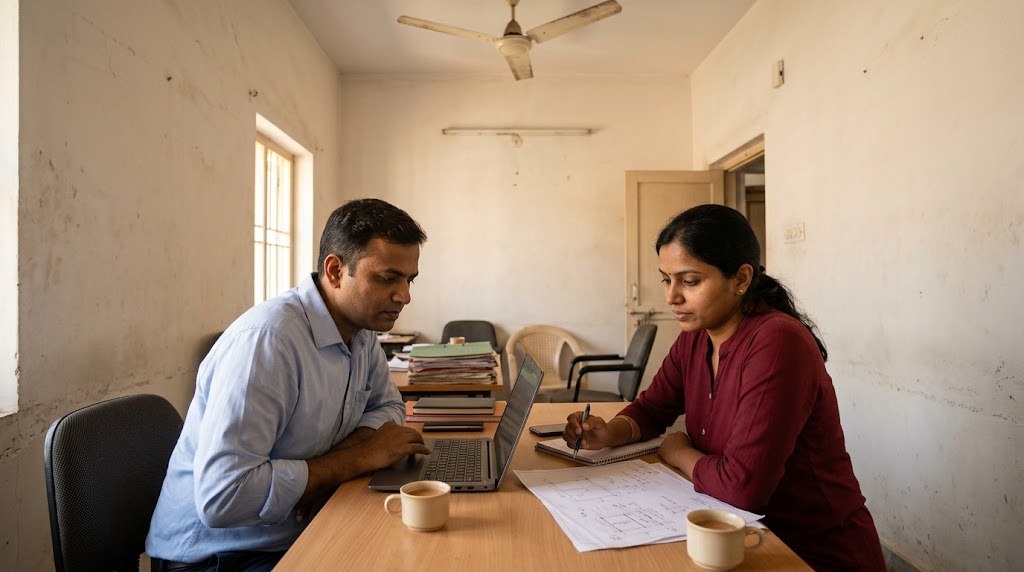
The paperwork (the legal entity, state recognition, Board affiliation) is covered step by step in our companion guide, how to start a school in India. Here is the order of thinking for an alternative school.
- Name the children. Write one sentence a parent recognises at once: children aged 8 to 12 who have stopped attending school, for example, or children in a town with no secondary school nearby.
- Choose the approach you can actually staff. Each approach needs adults trained in it. Do not pick a philosophy your city cannot staff.
- Decide the certificate route first. Board affiliation, NIOS, or another path. Parents will ask on day one.
- Get your legal status in writing. Ask the state education department what your setting is in law and what recognition it needs.
- Find founding families before a building. Ten committed families tell you your age range, location, hours and fee.
- Open small and keep records. Careful records of each child’s learning are what later convince parents and authorities.
Then comes the real choice: whose model, whose money and whose risk.
| From scratch, on your own | Education franchise | Co-founding a company (NIJIN Academy India) | |
|---|---|---|---|
| The model | You design everything | You pay to copy a fixed format | A model built with 1,000+ children in Japan, adapted with you for India |
| Ownership | Yours, in the legal form the law allows | Your own unit; the brand belongs to the franchisor | Your choice: for example, a local company set up together with you 20% and NIJIN 80%, or a service contract with no shares |
| Starting money | All from you and your backers | Franchise fee plus set-up, from you | Optional. If you invest, the guideline is that you invest JPY 1 to 2 million and NIJIN JPY 4 to 8 million; amounts are decided together |
| Your role | Founder of everything | Operator of someone else’s format | Founder, business head and principal |
| Main risk | Slow start, every problem met for the first time | Fees are due whether or not families come | Pay follows revenue; no revenue, no pay under the formula |
The franchise column describes the general form of a franchise agreement, not any particular company. Read the actual contract of any offer you consider.
The co-founding route: NIJIN Academy India
NIJIN Academy is run by NIJIN Inc., an education company founded by Tatsuro Hoshino, who taught at a public elementary school in Japan for seven years. The school is a hybrid. Children attend from home through a metaverse campus, choose from about 100 live online classes a month, and can also go to 52 physical classrooms across Japan (including classrooms due to open). NIJIN describes it as one of the largest alternative schools in Japan.
Figures are those published by NIJIN. “Attendance recognition” means the child’s registered school in Japan counts learning at NIJIN Academy as school attendance.
NIJIN does not assume the Japanese model will work unchanged in India. Deciding which children NIJIN Academy India serves first, in what form, and under which Indian rules is the first real work of its Country Head, done together with NIJIN.
- Who NIJIN is looking for: a founder with leadership, management and business ability and the skills of a principal. Teaching experience is not required.
- Languages: ideally the official language of your country, English and Japanese. English alone is fine.
- Compensation: as a guideline, 10% of revenue excluding tax, up to a cap of JPY 50 million. Revenue of JPY 100 million would give JPY 10 million. This is how the formula works, not a forecast or a promise of income.
- Everything else: location, timing, form of engagement and other terms are to be discussed in the interview.
How to choose an alternative school in India: 7 checks
People who search for the “best alternative schools in India” usually find lists. Lists age quickly, and no official ranking exists. These seven checks work for any school, in any city, and they are the same checks a founder should be ready to pass.
| Check | What to ask | Why it matters |
|---|---|---|
| 1. Recognition | “Can I see your certificate of recognition?” | Under section 18 of the RTE Act, a school needs recognition to function |
| 2. Board and certificate | “Which Board certificate will my child leave with: CBSE, a State Board, NIOS or another?” | It decides what the child can apply for next |
| 3. The approach in practice | “Can I watch an ordinary school day?” | A brochure says Montessori or Waldorf; a normal Tuesday shows what children really do |
| 4. Adults per child | “How many adults work with each group, and how long do they stay?” | Small groups only help if the adults stay |
| 5. Moving on | “Where did children go after leaving, and how did they manage?” | Shows whether the school prepares children for the next step |
| 6. Fees in writing | “What are all the fees for this year, in writing?” | Avoids surprises later |
| 7. Fit for this child | “How does my child feel after a trial day?” | The best school is the one that fits the child, not the one at the top of a list |
If you read this list and thought “the school I would pass all seven checks with does not exist where I live”, you may be the person to build it. See NIJIN Academy India: Country Head.
Best alternative schools in India: check the label at its source
No official ranking of alternative schools exists, but a school’s label can often be checked with the network it names. Several approaches publish their own lists of schools or training centres.
| Approach | Where the network publishes its list | What we found (November 2026) |
|---|---|---|
| Waldorf / Steiner | Waldorf World List, published by Freunde der Erziehungskunst | The June 2026 edition lists 9 Waldorf schools and 14 Waldorf kindergartens in India, in cities including Bangalore, Hyderabad, Mumbai, Pune and New Delhi |
| Krishnamurti | Krishnamurti Foundation India, schools | The foundation lists its own schools on this page |
| Montessori | Association Montessori Internationale, training centres | AMI lists where its teacher training is offered. Ask a school which Montessori training its teachers hold |
Being on a network’s list is not the same as government recognition or a Board affiliation. Check those separately, using checks 1 and 2 above. The recognition rules are explained in school recognition under the RTE Act.
Questions and answers
What is an alternative school?
An alternative school is a school that teaches differently from a conventional, exam-led school: learning is paced to the child, groups are often smaller, and more time goes to projects, play or practical work. Montessori, Waldorf, Krishnamurti and learner-led schools are common examples. “Alternative” describes the approach, not a legal category, so the rules depend on how the school is set up (see the question on recognition below).
What is alternative schooling in India?
It is schooling organised around the child’s development instead of a fixed syllabus and exam calendar. The term covers Montessori, Waldorf, Krishnamurti and learner-led schools as well as open schooling. It is a description, not a legal category.
How do I find an alternative school near me in India?
Start from the approach, not a ranking: decide whether you want Montessori, Waldorf, Krishnamurti, a learner-led school or open schooling through NIOS, then look for schools of that type in your city. Before you choose, run the 7 checks in this guide, ask which board or certificate the school offers, and visit on a normal school day. If no school near you fits, you can also start one (see how to start an alternative school in India).
Which are the best alternative schools in India, or in Bangalore, Pune, Chennai, Delhi or Mumbai?
We do not rank schools, and no official ranking of alternative schools exists. Use the 7 checks above. A better test than any list: visit on an ordinary day, ask which Board certificate children leave with, and ask how the school’s recognition can be verified.
Is NIOS valid for college admission and government jobs?
The NIOS Prospectus 2026–27 states that NIOS is one of three national Boards and that its certificates are recognised for higher education, government jobs and all other purposes. Individual universities and entrance examinations set their own subject requirements, so check those for the course you want.
Are alternative schools in India recognised by the government?
Some are recognised and affiliated to a Board, and some work in other ways. Under section 18 of the RTE Act, a school needs a certificate of recognition to function. Ask any school for its recognition and affiliation details in writing.
Is homeschooling legal in India?
This article cannot give a legal answer. NEP 2020 mentions home-based education as a choice for children with severe and profound disabilities, and NIOS offers examinations to learners who study outside a physical school. For your own situation, ask your state education department. The options are compared in homeschooling vs online school vs alternative school.
How do I start an alternative school in India?
Start with the children you serve, the approach you can staff and the certificate route, then get your legal status confirmed in writing. The registration and Board steps are in how to start a school in India.
How many Waldorf schools are there in India?
The Waldorf World List, June 2026 edition, lists 9 Waldorf schools and 14 Waldorf kindergartens in India. The list is an address directory kept by Freunde der Erziehungskunst, so a school that is missing from it may still follow the approach; ask the school directly. See how to check a school’s label.
Does NIJIN run an online school for children outside Japan?
NIJIN GLOBAL ACADEMY is an online international school for ages 6 to 18 across Asia and Oceania, planned to open in September 2027, and it is looking for founding teachers and mentors. NIJIN also runs Ranius, teacher training with AI in the loop. All roles in English are on careers at NIJIN.
Build the school that is missing where you live
NIJIN is looking for one founder to start and lead NIJIN Academy India, as its business head and its principal. If you have led people, hired people and want to build a school for children who do not fit school, read the role.
Apply now → Want to know more first? Read the Country Head role in India, or see all open roles.Where to go next
The India page has the full terms of the role. The global page covers every other country.
Related guides for founders
- How to start a school in India: entity, recognition and Board
- How to start a microschool: 7 steps for founders
- How to start an online school that children keep attending
- Alternative school vs traditional school: what actually differs
- Out-of-school children: causes and solutions
- How to start a school in the Philippines
- Homeschooling in India: is it legal? NIOS and next steps
Sources
Figures are quoted with the year they refer to. Laws and Board rules change; please check the original for later updates.
- National Education Policy 2020 (paragraphs 3.1, 3.2, 3.5, 3.6, 6.12, 6.15, 8.8): https://static.pib.gov.in/WriteReadData/userfiles/NEP_Final_English_0.pdf
- NIOS Academic Prospectus 2026–27: https://dq4kzxd7fbbni.cloudfront.net/static/dist/images/pdf/academic_prospectus/Academic_Prospectus_2026-27.pdf
- NIOS admission portal: https://sdmis.nios.ac.in/
- Right of Children to Free and Compulsory Education Act, 2009, on the website of the National Commission for Protection of Child Rights: https://ncpcr.gov.in/public/rte-act
- Central Board of Secondary Education, official website: https://www.cbse.gov.in/
- Association Montessori Internationale, biography of Maria Montessori: https://montessori-ami.org/resource-library/facts/biography-maria-montessori
- Waldorf 100, Waldorf education: https://www.waldorf-100.org/en/waldorf-education/
- Krishnamurti Foundation India, schools: https://www.jkrishnamurti.in/schools
- Visva-Bharati, history: https://visvabharati.ac.in/History.html
- https://nijin.co.jp/recruit/nijin-academy-india-country-head/