
For school founders in India
A school business plan in India needs ten sections: the children you serve, the format and board, the market, the legal body that will run the school, approvals and their timeline, revenue lines, cost lines, an enrolment plan, a teacher-hiring plan, and a risk register. Written in that order, the same document works for a trust board, a bank and a co-investor. This guide gives you the template and tells you what goes into each section.
Most searches for a school business plan in India end at a PDF sample with invented rupee figures. A bank or a trust board reads for something else: whether you know the rules, whether your numbers come from real quotes, and whether the school survives well below full enrolment. This article is about the plan itself. For the money side, see the cost to start a school in India and whether a school is a profitable business in India; for the opening steps, see how to start a school in India.
In this article
- What a school business plan in India has to do
- The template: ten sections
- Sections 1 and 2: the children and the format
- Section 3: the market, using official data
- Section 4: the legal body and where the capital comes from
- Section 5: approvals and the timeline
- Sections 6 and 7: revenue lines and cost lines
- Sections 8 and 9: enrolment plan and teacher-hiring plan
- Section 10: the risk register
- Showing the plan to a bank, a board or an investor
- A plan you do not have to write alone
- Questions and answers
What a school business plan in India has to do
A school in India is not an ordinary business, and the plan has to show that you know it. The Right of Children to Free and Compulsory Education Act, 2009 (the RTE Act) says that no school other than a government or local-authority school may be established or run without a certificate of recognition, granted only to a school that meets the norms in the Act’s Schedule. CBSE’s affiliation rules go further for the body that runs the school: clause 9.1 of the Affiliation Bye-Laws 2018 requires the society, trust or company to ensure that the school “is run as a community service and not as a business” and that its funds are spent on the same school and on education.
So the plan has three jobs at once: prove to the education department that the school will meet the norms, prove to a lender that fees will cover costs and repay what is borrowed, and prove to the people who give the capital that the surplus will be reinvested in the school rather than taken out. A plan written for only one of these readers fails with the other two.
The template: ten sections

Use the table as your table of contents. The third column is the test each section must pass before you move on.
| Section | What it contains | The test it must pass |
|---|---|---|
| 1. The children you serve | Age range, location, language, what is not working now | A parent recognises the group in one sentence |
| 2. Format and board | Preschool, Class 1–8, Class 1–12, online or hybrid; board or open-schooling route | You can name the authority that recognises or affiliates it |
| 3. Market | Families in reach, existing schools, fees you observed, demand evidence | Every number has a source or a date |
| 4. Legal body and capital | Society, trust or not-for-profit company; who puts in money, in what form | A chartered accountant has read it |
| 5. Approvals and timeline | State recognition, board affiliation, building and safety clearances, by month | Each step names the issuing office |
| 6. Revenue lines | Every source of money, how often, who pays | No line depends on a grant not yet awarded |
| 7. Cost lines | One-time and recurring, fixed and per child | Quotes, not estimates, for the big lines |
| 8. Enrolment plan | Founding families, intake by class, growth, break-even number | The plan survives at 60% of expected intake |
| 9. Teacher-hiring plan | Roles, qualifications required by law and board, hiring calendar | Staffing meets the Schedule’s ratios from day one |
| 10. Risk register | What could go wrong, how likely, what you do | The three biggest risks have a named owner |
Sections 1 and 2: the children and the format
Start with the children, not the building. “Quality education for all” is not a group; “children aged 10 to 16 who have left school and want to sit the Class 10 examination through open schooling” is. Write down the age range, the area, the home language, what the family does now, and what it would count as success after one year.
The format follows from the group, and in India the format decides which rules apply. The National Education Policy 2020 sets out the 5+3+3+4 structure covering ages 3 to 18, and says the scope of school education will be broadened “to facilitate multiple pathways to learning involving both formal and non-formal education modes”, naming the Open and Distance Learning programmes of the National Institute of Open Schooling (NIOS) and the State Open Schools as routes for young people “who are not able to attend a physical school”. That gives a founder four honest formats: a preschool for ages 3 to 6 (state pre-primary rules, no board); Classes 1 to 8 (RTE recognition and state rules); Classes 1 to 12 with a board (all of that plus affiliation, and capital locked in land for years); or an online or hybrid setting with an open-schooling pathway through NIOS or a State Open School, where the risk is retention rather than approvals. Name the format in Section 2 and the authority that governs it, and confirm what that authority requires before you write it as fact.
Section 3: the market, using official data
A market section built on “India has a huge population” convinces nobody. Build it from two layers: official data, and your own field work, meaning the schools within three kilometres, the fees they actually charge (ask parents, not websites), waiting lists, and thirty conversations with families about what they have tried and left.
Figures from the Ministry of Education’s UDISE+ 2024–25 release (28 August 2025) and the National Education Policy 2020. Add your own district’s numbers from the UDISE+ portal.
The same release reports a secondary-level retention rate of 47.2%, so many children still leave between Class 8 and Class 12. If your school serves them, cite it. Then show the ground: “we spoke to 42 families in three wards; 19 would move their child for a school that does X” is worth more than any national statistic.
Section 4: the legal body and where the capital comes from
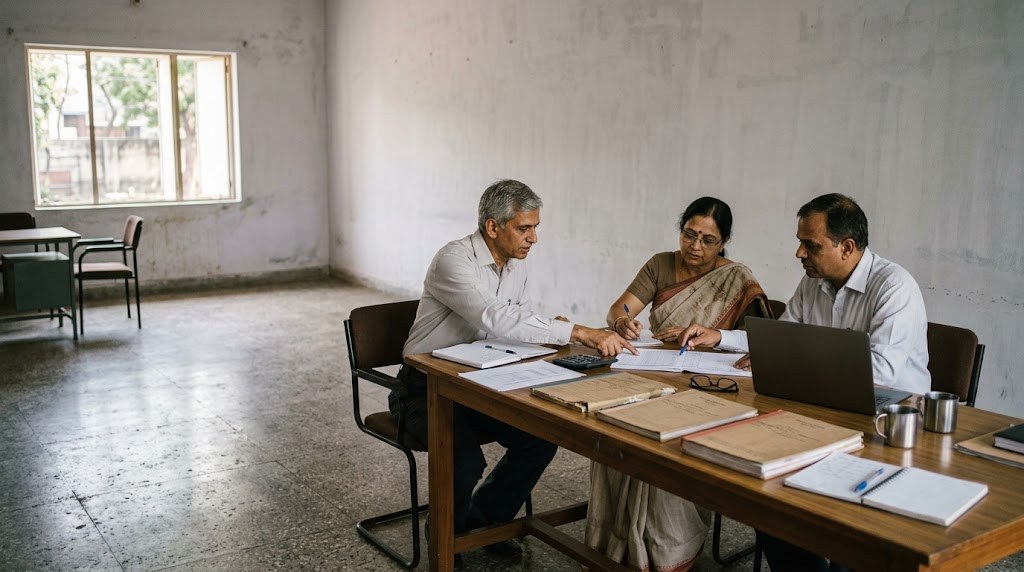
This is the section most sample plans get wrong, because they copy a company structure from another industry. A school seeking CBSE affiliation is run by a society, a trust or a company, and CBSE’s clause 9.1 says what that body must do: provide land, building, library, laboratories and qualified staff; run the school as a community service and not as a business; spend its funds on the same school; and fund its recurring and non-recurring needs. In practice the forms used are a registered society, a public charitable trust and a not-for-profit company (commonly a Section 8 company under the Companies Act, 2013). Which fits you depends on your state and board; settle it with a chartered accountant and a lawyer first.
The NEP 2020 points the same way: all educational institutions “will be held to similar standards of audit and disclosure as a ‘not-for-profit’ entity” and surpluses “will be reinvested in the educational sector”. So explain capital in these terms, not dividends:
- Founders’ and trustees’ own contributions to the body, recorded in its books
- Donations or a corpus from individuals, companies or foundations, with their conditions
- A term loan to the body for land, building or fit-out, repaid from fees, with the security the lender will ask for
- Land or a building on lease or given by a founder, with the terms written down
Write who gives what, when, on what conditions, and what happens if the school needs more.
Section 5: approvals and the timeline
The approvals section is a calendar with the issuing office next to each line. The order below is the common one for a Class 1 to 8 or 1 to 12 school; your state may add or merge steps, and a preschool or an online setting follows a different list. Ask your state education department to correct it.
- Register the body. Society, trust or not-for-profit company, with objects that include running a school. Open its bank account and appoint the auditor.
- Secure the site. Land or building in the body’s name or on lease, checked against the RTE Schedule’s building norms: an all-weather building with a classroom for every teacher, barrier-free access, separate toilets for boys and girls, safe drinking water, a kitchen for mid-day meals, a playground and a boundary wall.
- State recognition. Under Section 18 of the RTE Act a school needs a certificate of recognition from the prescribed authority, and under Section 19 it must meet the Schedule’s norms first. Running without recognition carries a fine of up to one lakh rupees, plus ten thousand rupees a day while it continues. Your state’s own schools act may add stages.
- Building and safety clearances. Fire, structural stability, sanitation and water, from the local bodies your state names.
- Board affiliation or open-schooling pathway. For CBSE, the application is made online on the SARAS portal; the rule on the state No Objection Certificate changed in 2025, so read how to start a CBSE school in India for the current steps. For children who will sit examinations through NIOS or a State Open School, show how your centre relates to that institution.
Put a realistic month against each step, then add a buffer; lenders notice when there is none.
Want to run a school in India with a model that already works, and a team behind you?
NIJIN Academy is a hybrid alternative school in Japan, opened in September 2023: children join from home through a metaverse campus, choose from about 100 live online classes a month, and can also attend 52 physical classrooms across Japan. NIJIN is looking for a Country Head for India, one founder who starts and leads NIJIN Academy India as business head and principal. It is not a franchise, and investment is optional.
See the Country Head role in IndiaSections 6 and 7: revenue lines and cost lines
This article gives no rupee figures, because a figure true in one city is false in the next, and borrowed numbers are the first thing a lender rejects. It gives the list of lines, so nothing is forgotten. Fill each with a quote or a quoted fee from your own town, and date it.
| Revenue lines (Section 6) | Cost lines (Section 7) | Fixed or per child |
|---|---|---|
| Tuition fee by class, with the fee structure you will publish (the RTE Act prohibits any capitation fee beyond the notified fee) | Teachers’ and head’s salaries, provident fund and other statutory contributions, cover for absence | Fixed |
| Admission or one-time fee, where your state allows it | Non-teaching staff: administration, accounts, helpers, security, cleaning | Fixed |
| Transport, meals, after-school care and activity fees, if offered | Land or building: purchase, construction or rent; property tax; insurance | Fixed |
| Donations or corpus income (never counted as recurring revenue) | Fit-out: furniture, laboratories, library, playground, boundary wall | One-time |
| Reimbursement for children admitted under the 25% provision, where it applies, at the rate your state sets | Approvals and compliance: registration, affiliation and inspection fees, audit, legal advice | Fixed and one-time |
| Fees for online or hybrid programmes, by programme | Teaching materials, books, devices, software licences, examination fees | Per child |
| Interest on the body’s reserves | Utilities, internet, maintenance, marketing; transport; loan interest and repayment; contingency reserve | Fixed |
The number that decides everything. Children needed to break even = total fixed costs per year ÷ (annual fee per child − per-child costs per year).
Run it at the enrolment you expect and at 60% of it. If the 60% case does not cover salaries and loan repayments, change the plan before you open: fewer classes in year one, a rented building, a hybrid programme that adds revenue without adding rooms.
Sections 8 and 9: enrolment plan and teacher-hiring plan
An enrolment plan is a table of classes by year, with the children in each and a sentence saying where they will come from. Year one usually opens with a few classes and grows one a year, so the plan must show the body can carry fixed costs while the building is half empty. Say which families are committed in writing, and how many of your thirty conversations became a letter of intent or a deposit.
The teacher-hiring plan is governed by law before it is governed by budget. The RTE Act’s Schedule fixes the number of teachers for Classes 1 to 5 by the children admitted (two teachers for up to sixty children, three for sixty-one to ninety, and so on, with a head teacher above one hundred and fifty), and for Classes 6 to 8 requires at least one teacher per class across science and mathematics, social studies and languages, plus part-time instructors for art, physical education and work education. Section 23 requires the minimum qualifications laid down by the notified academic authority. Build the plan from these, then add what your board requires.
- A staffing table by year that meets the Schedule’s ratios at expected enrolment and at 60% of it
- The qualification each role needs under the Act and your board, and the document you will check
- A hiring calendar that starts before the admissions season, and what you do if teachers in your language of instruction cannot be found
- Who leads the school day to day if you, the founder, are not a trained principal
Section 10: the risk register
A plan without risks reads as written by someone who has not run anything. List the real ones, say how likely each is, and name who owns the response.
| Risk | What it looks like | What the plan says you will do |
|---|---|---|
| Recognition or affiliation delayed | Opening slips past the admissions season | A buffer in the timeline; a pre-primary or bridge programme that can run under rules already met |
| Enrolment below plan | Fixed costs not covered in years one to three | The 60% case in Section 8; a rented building; staged hiring |
| Teachers leave | Classes without a qualified teacher mid-year | A bench of part-time teachers; pay reviewed against neighbouring schools |
| Rule changes | A new state requirement or board circular | One person owns compliance and reads the circulars every term |
| Safety incident | Injury, fire, transport accident | Insurance, drills, trained staff, a written reporting line to the body |
Showing the plan to a bank, a board or an investor
Each reader opens the same document at a different page. A bank goes to Sections 6 and 7 and the loan line: what is borrowed, what secures it, whether fees repay it in the 60% case. The society or trust board goes to Sections 4 and 10: who answers for the money and the children. A co-investor or foundation goes to Sections 1 and 3: which children, and whether anyone asked them.
- A two-page summary at the front: the children, the format, the body, the break-even number, the opening date with its buffer
- Every figure with a date and a source: a quote, a fee you were told, an official release
- Three enrolment cases, with the 60% case shown first
- A page on governance: the body’s members, the auditor, and how the principal’s autonomy is protected (CBSE’s clause 9.1.5)
- A one-line answer to “what if you need more money”, with who provides it
What a serious reader does not want is a projection of profit. Under the rules above, a school’s surplus is reinvested in the school; show the surplus and where it goes.
A plan you do not have to write alone
There is another way to begin: lead the Indian arm of a model that already runs, so that the format and the online classes exist before you write Section 1, and your work is to decide which children in India it should serve first, and in what form.
NIJIN Academy is an alternative school in Japan for children who do not fit conventional school, many of whom had stopped attending altogether. It is run by NIJIN Inc., founded by Tatsuro Hoshino, who taught at a public elementary school for seven years. NIJIN describes it as one of the largest alternative schools in Japan, and it now runs through to high school age.
More than 1,000 children have enrolled since it opened, 400 or more have graduated or returned to school, and there are 52 physical classrooms across Japan, according to NIJIN’s official websites. NIJIN is looking for one Country Head for India, both business head and principal. Teaching experience is not required; what carries over is experience of managing an organisation and hiring people. You can start as a co-owner of a local company set up together (for example, you hold 20% of the shares and NIJIN 80%; if you invest, the guide is JPY 1 to 2 million from you and JPY 4 to 8 million from NIJIN, decided with you), or on a service contract, even as a side job alongside your current work. Investment is optional. Either way the compensation guide is the same: as a guideline, 10% of revenue excluding tax, up to a cap of JPY 50 million. It is a guide, not a fixed pay scale, and no income is guaranteed; with no revenue the formula pays nothing. Location, timing and every other term are discussed in the interview, and India’s rules for schools and open schooling are worked out together with the Country Head.
Questions and answers
Is there a school business plan PDF or template I can download for India?
Use the ten-section table in this article as the template. We do not offer a filled-in PDF because its figures would be wrong for your city, and a bank or trust board sees that at once. The numbers must be yours, with a quote or a source against each.
What should a school business plan sample for India contain?
The children you serve, the format and board, the market, the legal body and capital, the approvals calendar, revenue and cost lines, the enrolment plan with a 60% case, the teacher-hiring plan that meets the RTE Schedule, and a risk register, with a two-page summary in front.
Can a school business in India be run as a for-profit company?
For a CBSE-affiliated school, clause 9.1 of the Affiliation Bye-Laws requires the society, trust or company running it to run the school “as a community service and not as a business”. The NEP 2020 says all educational institutions will be held to the audit and disclosure standards of a not-for-profit entity, with surpluses reinvested. Which legal form fits you is a question for a chartered accountant and your state education department.
Does an online or hybrid school in India need the same plan?
Yes, with the same ten sections. What changes is Section 2 (what the setting legally is in your state, and how children sit examinations, for example through NIOS) and Section 7, where rooms give way to teachers’ hours and platform costs. See how to start an online school in India.
Is the NIJIN Country Head role a job or a business?
Both. The Country Head starts and leads NIJIN Academy India as business head and principal, beginning on a service contract, even alongside current work, or as a co-owner of a local company. Investment is optional; the compensation guide, 10% of revenue as a guideline, is the same either way. Details are discussed in the interview.
Start a school in India, with a team behind you
NIJIN is looking for one founder to start and lead NIJIN Academy India. Teaching experience is not required. If you want to start a company in your own country and solve a problem in education, read the role.
See the Country Head role in IndiaWhere to go next
Related guides for founders in India
- Cost to start a school in India
- Is school a profitable business in India?
- How to start a school in India
- How to start a CBSE school in India
- Education business ideas in India
- How to start an online school in India
Sources
Figures are quoted with the year they refer to; check the original for later updates. Nothing here is legal or tax advice.
- https://static.pib.gov.in/WriteReadData/userfiles/NEP_Final_English_0.pdf
- https://www.pib.gov.in/PressReleasePage.aspx?PRID=2161543
- https://www.cbse.gov.in/cbsenew/mandatory_directions.html
- https://www.cbse.gov.in/cbsenew/board//Role%20of%20Society.pdf
- https://www.cbse.gov.in/cbsenew/affiliation.html
- https://panchayatwiki.lsgkerala.gov.in/THE_RIGHT_OF_CHILDREN_TO_FREE_AND_COMPULSORY_EDUCATION_ACT,_2009
- https://www.education.gov.in/rte
- https://nijin.co.jp/recruit/nijin-academy-india-country-head/
- https://nijin.co.jp/recruit/en/