
For education founders in India
To start a coaching centre in India you need five things in order: a legal form for the business, registration under your state’s coaching law where one exists (and under the 2024 central guidelines as your state adopts them), GST registration once your turnover crosses the threshold, premises that pass fire and safety checks, and advertising that stays inside the CCPA and ASCI rules. Tutors, timetable and fees come after that, and the whole thing can begin from a single room at home.
This guide on how to start a coaching centre in India sticks to what the Ministry of Education, the Central Consumer Protection Authority, the GST Council and two state Acts actually say, with links to each. It does not give legal or tax advice, and it does not quote cost “estimates” that no official source backs.
In this article
- What counts as a coaching centre in India
- The 2024 central guidelines: what they ask of you
- Coaching centre registration: which law applies in your state
- GST and tax: when a coaching centre must register
- How to start a coaching centre in India, step by step
- Premises, use of the building and safety
- Hiring tutors
- Fees, refunds and the student contract
- Advertising rules: what the CCPA and ASCI prohibit
- How to start a coaching centre at home
- What comes after coaching
- Questions and answers
What counts as a coaching centre in India
India has no single national licence for coaching. Education is on the Concurrent List, so the Union government issues guidelines and each state decides whether and how to turn them into law. The first question is therefore “which definition catches me”. These are taken from the documents themselves.
| Document | Who is covered | What is excluded |
|---|---|---|
| CCPA Guidelines for Prevention of Misleading Advertisement in Coaching Sector, 2024 (Union) | A “coaching center” is one run by any person for providing coaching to more than fifty students | Counselling, sports, dance, theatre and other creative activities |
| Goa Coaching Classes (Regulation) Act, 2001 | A “coaching class” is a class conducted for more than five students at a time, by charging fees in a subject | Regular classes of recognised schools, colleges and universities; classical dance, music and similar classical subjects |
| Bihar Coaching Institute (Control & Regulation) Act, 2010 | An institute preparing more than ten students for competitive examinations or giving academic support, as published in the Bihar Gazette (Hindi) | Smaller tuition groups fall below the threshold |
The thresholds are low in some states: six students in Goa is already a coaching class. And your state’s own Act may use different words and numbers from the Union documents, so read your state’s text, not a summary.
The 2024 central guidelines: what they ask of you
On 16 January 2024 the Ministry of Education circulated the Guidelines for Regulation of Coaching Center to all states and union territories “for taking further action by way of appropriate legal framework”. The Ministry’s reasons were the growth in unregulated private centres, “exorbitant fees”, “loss of precious lives due to fire and other accidents”, mental well-being, and “many malpractices”. The guidelines are not themselves a law. They bind you where your state writes them into an Act, rules or a notified policy, and by August 2026 the Ministry listed eleven states and territories that had done so.
According to the Ministry’s statements to Parliament (7 February 2024 and 12 August 2026), the guidelines cover these areas. Check the exact wording in your state’s version.
- A definition of a coaching centre, and the conditions and documents needed for registration
- Rules on fees, with an “easy exit policy” and a “fee refund policy” that must be published
- Infrastructure prerequisites for the premises
- A code of conduct for the centre and its staff
- Mental well-being: the Ministry asks centres to prioritise access to counsellors and psychologists
- No batch segregation, meaning no sorting of students into “top” and “ordinary” batches
- Maintenance of records; a grievance and complaint mechanism; continuous monitoring
- A website with up-to-date details of tutors’ qualifications, courses and their duration, fees, the number of students enrolled, and the number who went on to gain admission to higher education institutions
- Penalties, cancellation of registration and an appeals process
News reports attribute further details to the guidelines, including a minimum enrolment age of 16 and a graduation requirement for tutors. We could not open the original PDF on the Ministry’s site while writing, so we do not repeat them. Your state’s notified text is what binds you.
Coaching centre registration: which law applies in your state
Three states regulated coaching long before 2024: Goa (Goa Coaching Classes (Regulation) Act, 2001), Uttar Pradesh (Uttar Pradesh Regulation of Coaching Act, 2002) and Bihar (Bihar Coaching Institute (Control & Regulation) Act, 2010). Since the central guidelines, the Ministry of Education told the Rajya Sabha in August 2026 that the following had been added.
| State or UT | Instrument named by the Ministry of Education | Year |
|---|---|---|
| Haryana | Haryana Registration and Regulation of Private Coaching Institutes Act | 2024 |
| Rajasthan | Rajasthan Coaching Centres (Control and Regulation) Act | 2025 |
| Jharkhand | Jharkhand Coaching Centre (Control and Regulation) Act | 2025 |
| Assam | Assam Coaching Institutes (Control and Regulation) Act | 2025 |
| Tripura; Nagaland | Guidelines for Registration and Regulation of Coaching Centres | 2025 |
| Andhra Pradesh | Andhra Pradesh Coaching Institutions (Regulation and Control) Rules | 2026 |
| Himachal Pradesh | Himachal Pradesh Private Coaching Centres (Registration and Regulation) Rules | 2026 |
| Tamil Nadu; Puducherry; Andaman & Nicobar Islands | Guidelines or policy for registration and regulation of coaching centres | 2026 |
What a state Act asks for is easiest to see in the two older texts we could read in full:
- Goa (2001). No one may run a coaching class without prior registration with the competent authority. Each branch is a separate coaching class with its own application. Registration is valid up to 31 March of the following year; renewal is applied for two months before expiry. The proprietor undertakes that tutors are not employees of government or government-funded institutions, that the centre calls itself only a “registered coaching class” and never “recognised” or “approved”, that the timetable and fees are displayed on a notice board, and that the premises are not on the campus of a recognised institution.
- Bihar (2010). Registration is through a committee chaired by the District Magistrate, with a prescribed fee, and is valid for three years. The Act sets out tutor qualifications, a prospectus stating fees and course duration, a minimum classroom area per student, and facilities including drinking water, toilets, lighting, fire-fighting arrangements and first aid.
If your state is in neither list, you still need the ordinary registrations any business needs (for example under your state’s Shops and Establishments law or a municipal trade licence). These differ by state and city, so ask the district education office and the municipal corporation in writing before you sign a lease.
GST and tax: when a coaching centre must register
The short answer: coaching is taxable under GST. The GST Council’s own explainer on education services says that “private coaching centres or other unrecognized institutions, though self-styled as educational institutions, would not be treated as educational institutions under GST and thus cannot avail exemptions”. Coaching falls under service code 999293, “Commercial training and coaching services”, and the standard rate for education services that are not exempt is 18%.
When you must register. Under section 22 of the CGST Act, 2017, a supplier must register once aggregate turnover in a financial year exceeds twenty lakh rupees, or ten lakh rupees in the special category states. Section 23 exempts suppliers of only exempt services, but coaching is not exempt. Later notifications may change the position for you, so confirm with a chartered accountant before you set your fee.
The exemption that does exist is for an “educational institution”: pre-school to higher secondary education, education that is part of a curriculum leading to a qualification recognised by law, and approved vocational courses. A coaching centre qualifies only by becoming a different kind of institution.
How to start a coaching centre in India, step by step
- Decide what you teach and for whom. School tuition for Class 9 to 12, board-exam preparation, a competitive exam, a language, or a skill. The CCPA’s definition excludes counselling, sports, dance and theatre, and Goa’s excludes classical arts; the rest is coaching.
- Read your state’s text first. Find out whether your state has an Act, rules or guidelines (table above), what number of students triggers registration, who the competent authority is, and how long registration lasts.
- Choose a legal form. Sole proprietorship, partnership, LLP or company. The form decides how you are taxed and who is liable if something goes wrong on the premises.
- Find premises that pass the checks. Permitted use, fire exits, toilets, drinking water, lighting and first aid appear in the Bihar Act and in the central guidelines. Get the landlord’s written consent to run classes there.
- Apply for coaching registration where required. One application per branch (Goa makes this explicit). Keep the certificate on display.
- Register for GST when you cross the threshold, or earlier if you choose to. Issue receipts for every fee.
- Write your prospectus and refund policy before you take a rupee. Course, duration, fees, exit and refund terms, tutor qualifications: the central guidelines want these on your website, and the CCPA treats hiding them as misleading.
- Hire tutors, then advertise honestly. No guarantees, no “100% selection”, no student photos without written consent after their result.
Premises, use of the building and safety
Fire is one of the reasons the central guidelines exist, in the Ministry’s own words. Whatever your state requires, treat these as the minimum: a second exit from every classroom, serviced fire-fighting equipment, lighting and ventilation, drinking water and toilets for the number of students you enrol, and a first-aid kit with someone trained to use it. Bihar’s Act lists these facilities, plus parking, and sets a minimum classroom area per student.
Check the building’s permitted use with the municipal corporation: a flat in a residential society, a shop in a market and a floor in a commercial complex are treated differently, and the landlord’s permission is not the authority’s. Goa’s Act also bars coaching classes from the campus of a recognised school or college.
Hiring tutors
Two rules recur in the official texts. Goa requires an undertaking that tutors are not employees of government or government-funded institutions; the central guidelines want each tutor’s qualifications published on the centre’s website and kept current. So collect degree certificates, verify them, and keep copies from the first hire.
Beyond compliance, hire for what parents can see: whether a tutor explains the same idea three ways, whether students ask questions, and whether marks are reported honestly. The ASCI guidelines bar you from advertising the “size and qualification of its faculty” unless it is true for the latest academic year, so build the real thing before you print it.
Thinking beyond coaching: a school for the children coaching does not reach
Coaching serves students who are already in school and want more. NIJIN Academy, an alternative school in Japan opened in September 2023, serves children who have stopped going to school altogether, through a metaverse campus, about 100 live online classes a month and 52 physical classrooms across Japan. NIJIN is looking for one person to start and lead NIJIN Academy India as its business head and principal. Teaching experience is not required.
See the Country Head role in IndiaFees, refunds and the student contract
The central guidelines ask for a published fee, an “easy exit policy” and a “fee refund policy”. Bihar’s Act requires a prospectus stating fees and course duration, with the number of lectures and tutorials. Goa’s requires fees to be displayed on a notice board. The CCPA’s 2024 guidelines go further: misstating “fees, and refund policies” is a misleading advertisement, and “unfair contracts” with students are within their scope.
A workable fee page has five lines: the course and its length, the total fee and what it includes, when instalments fall due, what is refunded if a student leaves after one week, one month and three months, and how to complain. Publish it before the first enrolment, and give every student a receipt.
Advertising rules: what the CCPA and ASCI prohibit
Advertising is where coaching centres in India most often get fined. On 13 November 2024 the Central Consumer Protection Authority issued the Guidelines for Prevention of Misleading Advertisement in Coaching Sector, 2024 under the Consumer Protection Act, 2019, and said it had already issued 45 notices and penalised 18 institutes. The Advertising Standards Council of India’s guidelines for educational institutions, programmes and platforms, updated in 2023, apply as a self-regulatory code to the same advertisements.
| You may not | Source | You must |
|---|---|---|
| Promise assured admission, high scores, “guaranteed selections” or jobs | CCPA 2024; ASCI rule 3 | Substantiate any outcome claim and carry the disclaimer “past record is no guarantee of future prospects” in a font no smaller than the claim (ASCI) |
| Claim “100% selection” or “100% placement” for abstract, non-quantifiable outcomes | ASCI rule 4; CCPA 2024 | Give the real total: if you state how many students were placed or selected, state how many passed out (ASCI 5(e)) |
| Use a successful student’s name, photo, testimonial or video without consent | CCPA 2024 | Obtain written consent only after the student’s result, and show their name, rank and course, and whether the course was paid for |
| Hide disclaimers in small print | CCPA 2024 | Display disclaimers in the same font size as the other important details |
| Create false urgency (“only 5 seats left”) or fear of missing out | CCPA 2024; ASCI rule 8 | Partner with the National Consumer Helpline so students can complain |
| Show students skipping sleep or meals, or portray a low scorer as a failure | ASCI rules 6 and 7 | Show only infrastructure that exists at the time the ad runs (ASCI 5(c)) |
The CCPA’s guidelines reach “every person engaged in coaching”, so an endorser or influencer who repeats your claim is liable alongside you.
How to start a coaching centre at home
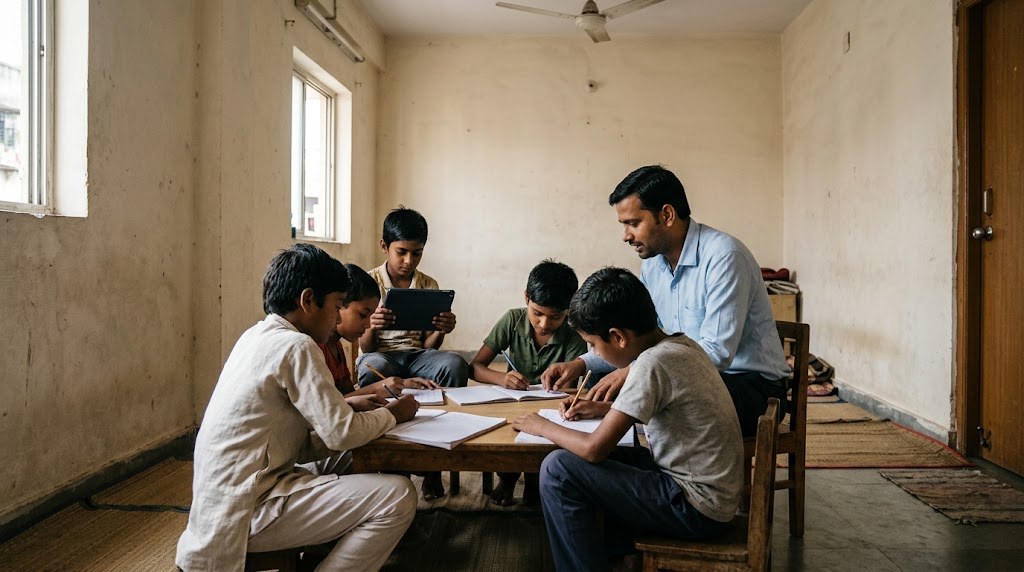
“How to start a coaching centre at home” is the most searched version of this question, and it is the right way to begin: one subject, one batch, one room. Three things change when the room is in your house.
- Thresholds still count. In Goa, six fee-paying students at a time make a coaching class that must be registered; in Bihar the line is more than ten. Count your students against your state’s number, not against your idea of “small”.
- The building’s use. A residential society may restrict commercial activity. Ask the society and the municipal office before parents start arriving at 7 am.
- Tax from day one. GST registration becomes compulsory at the turnover threshold, not at a size of room. Keep receipts and accounts from the first student.
The advantage of starting at home is that you learn what parents in your area actually pay for before you sign a lease.
What comes after coaching: a school for children who do not fit school
Coaching has a built-in ceiling, and India’s own policy says so. The National Education Policy 2020 describes today’s “coaching culture” as “doing much harm”, and states that board and entrance exams “shall be reformed to eliminate the need for undertaking coaching classes”.
The same policy points to the larger gap. Citing the NSSO 75th round survey of 2017–18, it puts the number of out-of-school children aged 6 to 17 at 3.22 crore, and calls bringing them back a top priority. It commits to “multiple pathways to learning involving both formal and non-formal education modes”, and to expanding open and distance learning through the National Institute of Open Schooling (NIOS) and state open schools. Children who have stopped attending school are not coaching customers. They need a place that counts as education, that they will turn up to, and that works with the school they are registered at.
That is a different business, and it is the one NIJIN runs in Japan. NIJIN Academy, opened in September 2023, is an alternative school for elementary and junior high school students who do not fit conventional school; many had stopped attending. Children join from home through a metaverse campus, choose from about 100 live online classes a month, and can also go to physical classrooms across Japan. NIJIN describes it as one of the largest alternative schools in Japan, and it now runs through to high school age with NIJIN High School.
Figures are those published on NIJIN’s official websites. “Attendance recognition” means the child’s registered school counts learning at NIJIN Academy as school attendance.
NIJIN is looking for one person to start and lead NIJIN Academy India as its business head and principal. It is not a franchise: you do not pay to copy a format. You can lead it as a co-owner of a local company set up together (for example, you 20%, NIJIN 80%), or start on a service contract, even as a side job. Investment is optional. As a guide, compensation is 10% of revenue (excluding tax), capped at JPY 50 million; JPY 100 million of revenue would mean JPY 10 million. It is a guide, not a promise of income; with no revenue the formula pays nothing. Which children NIJIN Academy India serves first, in which language and format, is the first real piece of work for its head. Everything else is discussed in the interview.
Questions and answers
Is coaching centre registration compulsory in India?
It depends on your state. Goa, Uttar Pradesh and Bihar have had coaching Acts since 2001, 2002 and 2010, and since January 2024 the Ministry of Education lists Haryana, Rajasthan, Jharkhand, Assam, Andhra Pradesh, Himachal Pradesh and others with new Acts, rules or guidelines. Where there is a law, registration is mandatory above the student threshold it sets. Where there is none yet, ordinary business registrations still apply.
What is the coaching centre registration process and fee?
Under the Goa Act, you apply to the competent authority for your area with the prescribed form, fee and documents, one application per branch, and the authority must decide within three months. Under the Bihar Act, you apply to a committee chaired by the District Magistrate, and registration lasts three years. Fees and forms are set by each state’s rules, so take them from the state’s notification.
Do I need GST registration for a coaching centre?
Coaching is a taxable service. Under section 22 of the CGST Act you must register once aggregate turnover exceeds twenty lakh rupees in a financial year (ten lakh in special category states). The education exemption applies to recognised schools, degree courses and approved vocational courses, not to private coaching, according to the GST Council’s explainer. Confirm your own position with a chartered accountant.
How do I start a coaching centre at home without money?
Start with one subject and one batch below your state’s registration threshold, in a room you already have, and let the first students’ fees pay for the second batch. What you cannot skip even at this size is the building’s permitted use, receipts for every fee, and honest advertising.
Can I advertise my coaching centre’s results?
Yes, if they are true, recent and complete. The CCPA’s 2024 guidelines require the student’s written consent (given after the result) and disclosure of their name, rank, course and whether they paid; the ASCI guidelines require claims from the latest completed academic year and the disclaimer “past record is no guarantee of future prospects”. “100% selection” and “guaranteed rank” are prohibited.
Is the NIJIN Country Head role in India a job or a business?
Both. You can start on a service contract, even alongside your current work, or as a co-owner of a local company. Investment is optional, it is not a franchise, and the compensation guide is the same either way: 10% of revenue, as a guide, in Japanese yen. Details are discussed in the interview.
Build a school in India, not just a coaching centre
NIJIN is looking for one founder to start and lead NIJIN Academy India. Teaching experience is not required. If you have led people, hired people, and want to build a place for children who do not fit school, read the role.
See the Country Head role in IndiaWhere to go next
The India page covers the role in detail; the global page covers every other country.
Related guides for founders in India
- Education business ideas in India
- How to start an online school in India
- How to start a school in India
- Is school a profitable business in India?
- School business plan for India
- How to start an edtech startup in India
Sources
All official documents below were opened while writing this article. Rules change by state and year; check the original before acting.
- https://www.pib.gov.in/PressReleasePage.aspx?PRID=2298513
- https://www.pib.gov.in/PressReleasePage.aspx?PRID=2003661
- https://www.pib.gov.in/PressReleasePage.aspx?PRID=2073013
- https://prsindia.org/files/bills_acts/acts_states/goa/2001/2001GOA27.pdf
- https://prsindia.org/files/bills_acts/acts_states/bihar/2010/2010Bihar17.pdf
- https://gstcouncil.gov.in/sites/default/files/e-version-gst-flyers/GST_Education_Services.pdf
- https://taxinformation.cbic.gov.in/content/html/tax_repository/gst/acts/2017_CGST_act/documents/Central_Goods_and_Services_Tax_Act__2017_28-September-2022.html
- https://www.ascionline.in/wp-content/uploads/2023/05/ASCI-GUIDELINES-FOR-EDUCATIONAL-INSTITUTIONS-PROGRAMMES-AND-PLATFORMS.pdf
- https://static.pib.gov.in/WriteReadData/userfiles/NEP_Final_English_0.pdf
- https://nijin.co.jp/recruit/nijin-academy-india-country-head/
- https://nijin.co.jp/recruit/en/