For education founders in India
You can start a play school without a franchise in India: you set up your own legal entity, find a safe ground-floor space, design a play-based programme for children aged 3 to 6, and apply to the authority your State has named for recognition, which under the NCPCR model guidelines is the district officer in charge of ICDS in the Women and Child Development or Social Justice department, renewed every year. What a franchise would have sold you, a name, a curriculum, training and marketing, you build yourself.
This guide covers the national documents behind the rules, the norms your building and staff must meet, the steps in order, and the cost lines to price. It quotes no rupee budgets, because none could be checked against an official source.
In this article
- What “without franchise” really means
- Who regulates play schools in India
- Preschool licensing requirements: the norms checklist
- How to start a play school, step by step
- Building your own play school brand
- The cost lines to price before you sign
- Franchise vs your own play school vs co-founding
- A third way: co-found a company
- Questions and answers
What “without franchise” really means
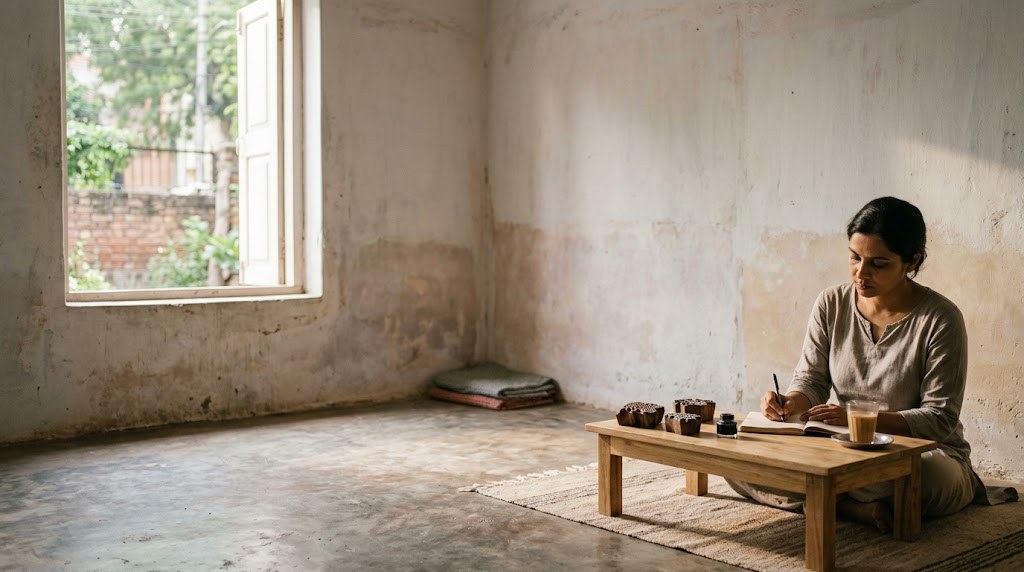
A play school franchise is a package. A brand owner lets you use its name and sells you a programme, kits, training and marketing, usually in exchange for an upfront fee and ongoing payments. “Without franchise” means you leave the package on the shelf and do each part yourself, or buy single parts from suppliers without signing over your name.
You keep all fee income and every decision, and you carry all the work. If you are still weighing a franchise offer, read our guide to education franchise in India first.
| What a franchise usually supplies | What you do instead, on your own brand |
|---|---|
| A known name and logo | Choose a name, check it is free, and decide whether to register it as a trade mark |
| A ready curriculum and kits | Design a play-based programme using the national framework for the Foundational Stage, and buy materials yourself |
| Teacher training | Hire for the right qualifications and arrange training from recognised institutions |
| Site and set-up advice | Check the building yourself against the norms your State applies |
| Marketing and admissions material | Build trust locally: open days, parents’ word of mouth, a simple website |
| Help with paperwork | Deal directly with the recognition authority, your accountant and the landlord |
Who regulates play schools in India
Pre-school sits between two ministries, which is why the rules feel unclear. Four national documents shape the picture.
- National ECCE Policy, 2013. Introduced by the Ministry of Women and Child Development (MWCD), it highlights the educational needs of children aged 3 to 6. The NCPCR guidelines cite it for a daily programme of 3 to 4 hours.
- National Education Policy 2020. Its 5+3+3+4 structure starts with a Foundational Stage: three years of Anganwadi, pre-school or Balvatika (ages 3 to 6) plus Grades 1 and 2. Paragraph 1.4 names “stand-alone pre-schools” as one kind of ECCE institution. Paragraph 8.5(c) says a quality self-regulation or accreditation system will cover all stages “including pre-school education”, private and public.
- National Curriculum Framework for Foundational Stage, 2022 (NCF-FS). NCERT’s framework for ages 3 to 8 treats play as central to learning.
- NCPCR Regulatory Guidelines for Private Play Schools. From the National Commission for Protection of Child Rights, for unaided private play schools teaching ages 3 to 6. They do not cover settings for children under 3, or RTE Act schools with pre-primary classes.
The point most guides skip. The NCPCR guidelines are a model. They say the State “may notify these guidelines or adopt content of these guidelines as legislation”. So whether recognition is compulsory, which form you file and which fee you pay depends on your State. Ask your district WCD (or Social Justice) office and State education department, in writing, before you sign a lease.
Under the guidelines, the “competent authority” is the district nodal officer for the Integrated Child Development Services (ICDS), not the office that recognises primary schools. Adding Class 1 and above means school recognition under the RTE Act, covered in how to start a school in India.
Preschool licensing requirements: the norms checklist
The NCPCR guidelines set out “norms and standards” that a visiting team checks before recognition. Even where your State has not notified them, they are the clearest public list of what to build.
- Staff ratio: one teacher and one caregiver per 20 children, plus hygiene and safety staff.
- Building: all-weather, fenced, ventilated, with barrier-free access.
- Toilets and water: separate child- and disabled-friendly toilets for boys and girls, a low basin, safe drinking water.
- Rest and play: a rest room for children and a play area.
- Safety: CCTV with secure data, fire safety, pest control.
- Hours: 3 to 4 hours a day, non-residential.
- Learning and play materials: teaching aids, an early-years library, play equipment.
- Health: a first aid kit and a quarterly check-up by a registered doctor.
- Affidavits: office bearers and staff declare no convictions under the POCSO Act, the Juvenile Justice Act or child labour laws.
They also set rules for admissions and running the school:
| Area | What the NCPCR guidelines say |
|---|---|
| Age | No child under 3. At 6, a child moves on to primary school. |
| Fees | Regulated by the State, collected monthly or quarterly. No capitation fee, no screening at admission. |
| Assessment | No exam or test. |
| Records | Admission, attendance (children and staff), health, stock and fee registers. |
| Parents | A parents–teacher association each year: 75% parents (half of them mothers), 25% teachers, meeting monthly. |
| Money | Separate accounts, audited yearly; the audit report is filed at renewal. |
| Recognition | Valid for one year and renewed every year. Closing also needs approval. |
This is a summary of a model document, not legal advice. Check the current rule in your State with the authority itself.
How to start a play school, step by step
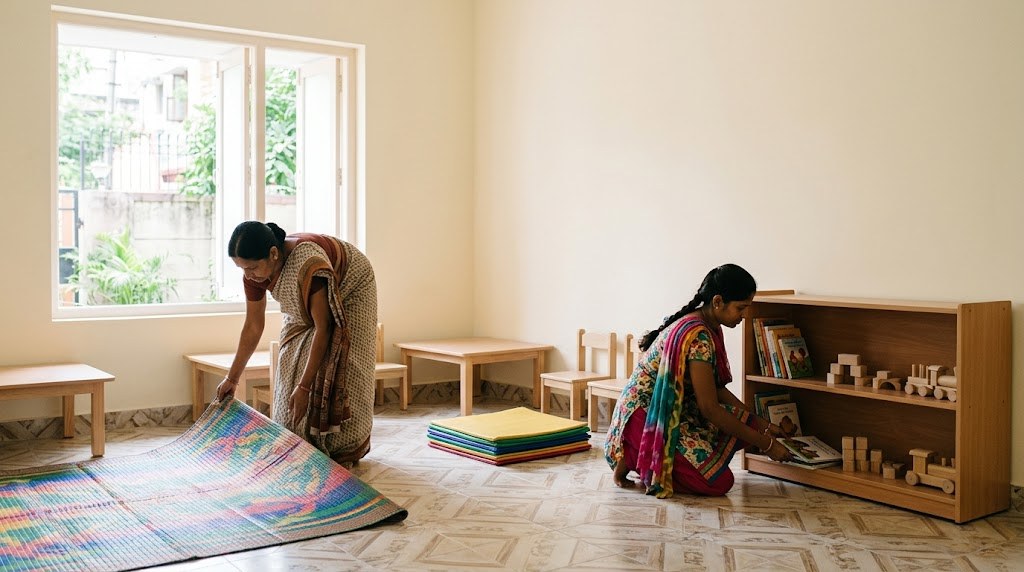
Cheap steps come first; the lease comes only after the authority has told you what it expects.
- Ask what your State requires. Ask the district WCD or Social Justice office whether the NCPCR guidelines or a State rule apply, which form to use and what the fee is.
- Talk to 30 families with young children. Learn how far they will travel, which hours they need and what worries them.
- Choose your legal form. The guidelines describe the applicant as a society, a public trust, or a not-for-profit company under section 25 of the Companies Act, 1956. Ask a chartered accountant which forms your State accepts and how fees are taxed.
- Pick a name and check it on the trade marks register at ipindia.gov.in. The guidelines expect “play school” in the name.
- Find a space against the checklist. Ground floor, fenced, ventilated, room for child toilets, a rest room and a play area.
- Write your programme. A 3 to 4 hour day built from the NCF-FS: play, stories, songs, movement, early language and number, in the home language where you can.
- Hire one teacher and one caregiver per 20 children, with affidavits and training.
- Apply for recognition. A visit team of at least two officials checks the site; the guidelines set one month for issuing the certificate, which states your seats.
- Open small and form the parents–teacher association in the first month.
- Keep the records from day one, so the yearly renewal is simple.
Is your real goal to found and lead a school?
If what you most want is to lead a school for children who do not fit the usual classroom, there is another route. NIJIN Academy, opened in September 2023 by NIJIN Inc., is an alternative school in Japan for school-age children, with about 100 live online classes a month and 52 physical classrooms across Japan. NIJIN is looking for one person to lead NIJIN Academy India as business head and principal. It is not a franchise.
Two ways to start: co-found the local company and hold shares (for example, 20% for you and 80% for NIJIN), or start on a service contract, even as a side job alongside your current work. Investment is optional. Either way, the compensation guide is the same: 10% of revenue (excluding tax), not a guaranteed income.
See the Country Head role in IndiaBuilding your own play school brand
Without a franchise name, trust comes from what parents can see and check.
A name you own
Checked on the trade marks register, short enough for parents to repeat.
A programme you can explain
Point to the national, play-based NCF-FS instead of a brand’s private method.
Safety you can show
Fencing, child toilets, CCTV, first aid, staff affidavits. Show them at every open day.
People parents trust
Let parents meet the teacher before they enrol.
The cost lines to price before you sign
Every rupee figure we found came from franchise brands or lenders, not an official source, so we give none. Collect real local quotes for each line.
| Cost line | What to include | Paid once or every month |
|---|---|---|
| Premises | Deposit, rent, repairs, fencing, child toilets, low basins | Both |
| Recognition and legal | Processing fee set by your State, entity registration, affidavits, professional advice | Once, then yearly renewal |
| Safety | CCTV, fire safety, first aid kit, pest control, quarterly health check-ups | Both |
| Furniture and play material | Mats, low shelves, books for the library, outdoor play equipment | Mostly once |
| Staff | Teachers, caregivers, cleaning and support staff, training | Monthly |
| Accounts | Bookkeeping and the yearly audit | Yearly |
| Brand and admissions | Trade mark filing, signboard, website, open days | Mostly once |
| Franchise fee and royalty | None on your own brand | None |
Break-even, in one line. Children needed = monthly fixed costs ÷ (monthly fee per child − monthly cost per child). Run it at 60% of your seats. If that exceeds your seats, change the plan before opening.
Whether the numbers work in your city is a separate question, answered in is school a profitable business in India.
Franchise vs your own play school vs co-founding
Most guides compare two options. Here is a third.
| Play school franchise | Your own play school | Co-founding a company (NIJIN Academy India) | |
|---|---|---|---|
| Who owns the brand | The franchisor | You | NIJIN Academy, run by a local company you co-own |
| Money you pay in | Upfront fee, often royalty, kits and marketing fees, plus the set-up | The set-up only | As a guide, JPY 1 to 2 million from you and JPY 4 to 8 million from NIJIN, decided together |
| Shares | None in the brand | Your own entity, under your control | 20% for you, 80% for NIJIN |
| Freedom | Limited by the agreement | Full | You lead as founder, with NIJIN in Japan |
| What you start with | A format and a name | A blank page | A running hybrid school model built with more than 1,000 children in Japan |
| Your income | What is left after fees and royalty | What is left after costs | As a guide, 10% of revenue, up to JPY 50 million; not guaranteed |
| Age group | Pre-school (3 to 6 under the guidelines) | Pre-school (3 to 6 under the guidelines) | NIJIN Academy serves school-age children; the first group in India is decided with you |
A third way: co-found a company
Many founders want two things at once: to own what they build, and not to start from zero. A franchise gives the second; starting alone gives the first.
NIJIN offers a different shape. We set up a local company for NIJIN Academy India together. You hold 20% of the shares and NIJIN holds 80%. You are its founder, its business head and its principal. It is not a franchise: you do not pay to copy a format, you co-own the company that runs it.
Figures are those published by NIJIN. “Attendance recognition” means the school a child is registered at counts learning at NIJIN Academy as school attendance.

As a guide, compensation is 10% of revenue excluding tax: JPY 10 million on JPY 100 million, JPY 20 million on JPY 200 million, capped at JPY 50 million. This is not a forecast or a promise of income; anyone you hand work to is paid from your 10%. Teaching experience is not required: leadership, management, business ability and a principal’s skills are. Ideally you work in an official language of India, English and Japanese; English alone is fine. Other terms are discussed in the interview.
Questions and answers
Can I start a play school without franchise in India?
Yes. No national document requires a franchise. You need a legal entity, a building that meets your State’s norms, trained staff, a play-based programme and, where required, yearly recognition.
Does a play school require registration?
Under the NCPCR model guidelines, no private play school should be set up without recognition from the competent authority. They take effect through each State, so ask your district WCD office in writing.
What qualification is needed to start a play school in India?
The guidelines set none for the founder. Teachers need the minimum qualification set by an authority the Government of India notifies; caregivers need training from bodies such as NIPCCD or NSDC.
How to start a play school at home in India?
It depends on your State and your building. The norms ask for a fenced, all-weather building with child toilets, a rest room and a play area, so many homes need changes. Check with the authority, your local body and any housing society first.
What documents are required to open a play school in India?
The list is set by your State, but recognition forms usually ask for the same core set: proof of your legal entity (trust, society or company), proof of ownership or a lease for the building, the safety and sanitation certificates your State lists, qualification records for teachers and caregivers, your programme outline and the recognition application itself. Exact documents differ by State and change, so ask your district WCD office for its written checklist before you fit out the rooms.
How much investment is needed to start a play school?
We could not find an official figure, so we do not give one. Price each line in the cost table with real quotes from your area, then run the break-even line at 60% of your seats.
Is play school a profitable business in India?
It depends on fees, rent and how full you are; the guidelines say fees are State-regulated and bar capitation fees. Our article is school a profitable business in India looks closer.
I am looking for country manager jobs in the education sector. Is the Country Head role a job or a business?
It is closer to a business. You co-own the local company (20% of shares) and lead it as founder, business head and principal. Compensation, as a guide, is 10% of revenue, up to JPY 50 million, and is not guaranteed. Other terms are discussed in the interview.
Build a school in India as a co-owner, not a franchisee
NIJIN is looking for one person to start and lead NIJIN Academy India, as its business head and its principal. If you want to start a company in India and solve a problem in education, read the role.
See the Country Head role in IndiaWhere to go next
NIJIN Academy Country Head pages are open for several countries, and the global page covers every other country.
Related guides for founders
- How to start a school in India: steps, rules and cost
- Education franchise in India: what to check before you sign
- Is school a profitable business in India?
- Alternative schools in India: types, NIOS and how to start
- Edupreneur meaning: what education entrepreneurs really do
- How to start an education business in 6 practical steps
- Cost to start a school in India: a realistic breakdown
- How to start an online school in India
- How to start a Montessori school in India: 5 steps
- How to start a coaching centre in India: rules and steps
Sources
Rules for play schools are set State by State and change. Please check the original documents and your State authority for later updates.
- https://www.ncpcr.gov.in/public/uploads/165753774662cc04d28580b_regulatory-guidelines-for-private-play-schools-by-national-commission-for-protection-of-child-rights-85-kb.pdf
- https://static.pib.gov.in/WriteReadData/userfiles/NEP_Final_English_0.pdf
- https://ncert.nic.in/pdf/NCF_for_Foundational_Stage_20_October_2022.pdf
- https://wcd.gov.in/
- https://www.education.gov.in/rte
- https://ipindia.gov.in/
- https://nijin.co.jp/recruit/nijin-academy-india-country-head/
- https://nijin.co.jp/recruit/nijin-academy-country-head/