
For school founders in India
To start a CBSE school in India, you first set up a non-profit entity (a registered society, a registered trust or a Section 8 company), secure land and a building that meet CBSE’s Chapter 3 and 4 norms, obtain recognition from your state government, and then apply for affiliation online on CBSE’s SARAS 7.0 portal during the window the Board announces, followed by a physical inspection and a grant letter. The state NOC, once compulsory, is now optional under a 2025 amendment.
This guide covers only CBSE affiliation, from the Affiliation Bye-Laws 2018, the SARAS 7.0 Manual and circulars up to October 2026. For opening any kind of school, and budgeting, see how to start a school in India and the cost to start a school in India.
In this article
- Who does what: the state recognises, CBSE affiliates
- Who can apply: the entity behind the school
- CBSE land and building norms (2026)
- The documents checklist
- State NOC: with or without, and the Tamil Nadu example
- The SARAS 7.0 application, step by step
- When to apply, and what CBSE charges
- How to run a CBSE school after the grant
- Is a CBSE school the only route?
- Questions and answers
Who does what: the state recognises, CBSE affiliates
CBSE does not give you permission to run a school. It affiliates a school that already exists and is recognised, so it can follow the CBSE curriculum and present students for the Class 10 and 12 Board examinations. CBSE says more than 24,000 schools are affiliated to it.
| Authority | What it gives you | Where it appears in the CBSE file |
|---|---|---|
| State government (School Education Department) | Permission to establish, then a Recognition Certificate under the RTE Act 2009 and state rules; optionally an NOC for CBSE | Recognition Certificate (mandatory); NOC (optional since session 2026-27) |
| Revenue and local authorities | Land certificate, fire safety, building safety, drinking water and sanitation certificates, built-up area certificate | Mandatory documents uploaded in Part A |
| CBSE | Affiliation, after scrutiny and inspection, for an initial period of three years | Grant letter on the SARAS portal |
The order matters: clause 2.3.4 of the Bye-Laws asks for a prior state Recognition Certificate.
Who can apply: the entity behind the school
For a private school, clause 2.3.1 leaves three options: a registered society, a registered trust, or a Section 8 company under the Companies Act 2013. Clause 2.3.2 adds that the entity must have a “non-proprietary character”, with control not vested in one individual or one family. So an individual or an ordinary for-profit company cannot hold affiliation for a private independent school. Settle the entity before you secure land, because every certificate must be in its name or the school’s. A School Management Committee under the RTE Act 2009 (clause 2.3.3) and a school website (clause 2.3.8) are also expected.
CBSE land and building norms (2026)
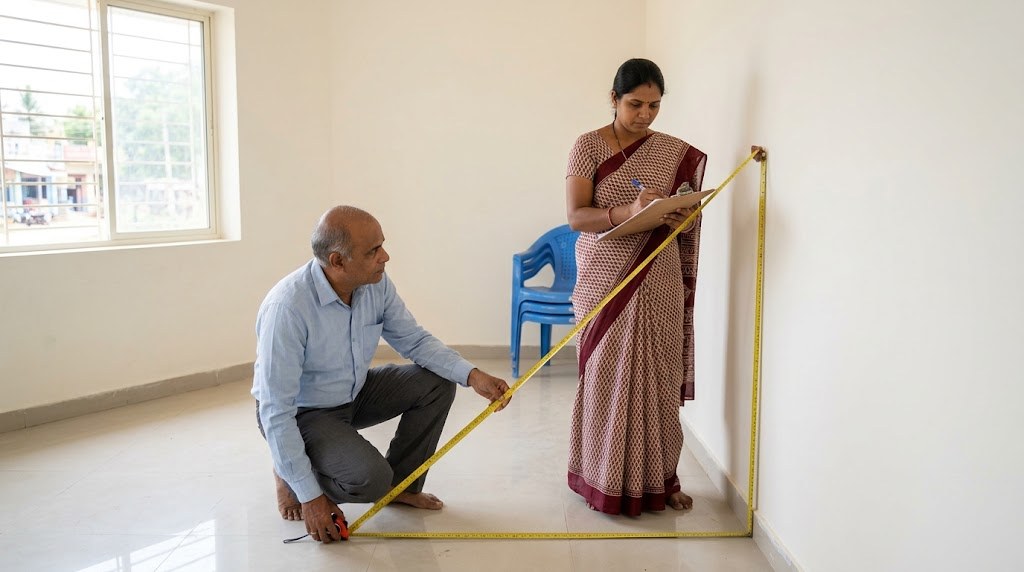
Circular No. 04/2026 (19 January 2026) replaced the old clauses 3.3 to 3.7, and the 8,000 and 4,000 sq m figures older guides still quote, with one table.
| Category | Where the school is | Minimum land, up to Secondary (Class 10) | Minimum land, up to Senior Secondary (Class 12) |
|---|---|---|---|
| A | Anywhere in the country | 6,000 sq m | |
| B | Municipal limits of “Y” category cities (as notified by the Government of India), other towns where HRA at “Y” city rates applies, municipal limits of state capitals, hilly areas | 2,400 sq m | 3,200 sq m |
| C | Municipal limits of “X” category cities; Arunachal Pradesh, Sikkim, Andaman and Nicobar Islands, Lakshadweep | 1,600 sq m | 2,400 sq m |
- Play area. 2,000 sq m on campus, or, on relaxed land norms, a 15-year arrangement with a school, stadium or public park within 200 metres, with no highway to cross.
- Building. Covered area and height under state building bye-laws, or the Model Building Bye-Laws 2016.
- Sections. Capped by total built-up area (Appendix-V); classrooms over 500 sq ft.
- One plot. A single contiguous plot with a pucca boundary wall (clause 3.1); the Manual asks for concrete, at least 6 ft high.
CBSE says it cut the required lease period from 30 to 15 years.
The documents checklist
Section 1.3 of the SARAS Manual lists the mandatory documents for a private independent school. If they are not as prescribed, the application is rejected and the fee forfeited.
- State NOC, or an application without NOC (next section)
- Recognition Certificate from the state under the RTE Act 2009, valid on the date of application
- Registration of the society, incorporation of the Section 8 company, or registered trust deed
- Built-up Area Certificate (Annexure-E), from the local body or a licensed architect
- Land Certificate strictly in the Annexure-B format, from a DM, SDM, Tehsildar, Sub-Registrar or equivalent, under one year old
- Fire Safety Certificate from the fire department or local body (a note about extinguishers does not count)
- Building Safety Certificate (Annexure-D), from an Assistant Engineer or above, or an empanelled structural engineer
- Safe Drinking Water and Sanitary Condition Certificate (Annexure-C), with a PHED lab water test
- Last six months’ staff salaries, with proof of payment through ECS
- Self-certification signed by the principal and the manager
The salary item means CBSE expects a school already running, with staff, when it applies. Every applicant must also run pre-primary Bal Vatika 1 to 3 for ages 3 to 6 (Circular 12/2023).
State NOC: with or without, and the Tamil Nadu example
Clause 2.3.5 used to require a prior state “No Objection Certificate”. Circular No. 04/2025 (20 February 2025) changed it: from session 2026-27, a private school may apply with or without an NOC.
- You apply without NOC. CBSE writes to the state for comments.
- 30 days. The state may comment through the Board’s link.
- 15 more days. If nothing arrives, CBSE sends a reminder.
- Deemed no objection. Still no reply, and the state is deemed to have no objection.
The Recognition Certificate is still mandatory, and the state can still object, so talk to your district education office first.
Procedure to start a CBSE school in Tamil Nadu
Under the Tamil Nadu Private Schools (Regulation) Act (Tamil Nadu Act 35 of 2019):
| Stage | What the Act says |
|---|---|
| The applicant | An “educational agency”: a Section 8 company, a registered society, or a trust under the Indian Trusts Act 1882 (section 2(h)) |
| Who handles CBSE schools | The Director of Private Schools, for self-financing private schools affiliated to CBSE, ICSE, IB and other boards (section 2(g)(iii)) |
| 1. Permission to establish | No private school may be established without prior written permission (section 4). The authority decides within three months; an appeal lies within 30 days (section 6) |
| 2. Recognition | Apply within three years of the permission, or it lapses (section 7). The authority may inspect, and considers the need for a school in the locality, playground, facilities and pupil numbers (section 8) |
| 3. Then the board | No educational agency may apply for affiliation to the State Board or any other board without the certificate of recognition (section 9) |
Forms, fees and recognition periods sit in the state rules; confirm them with the School Education Department. Kerala, Telangana, Andhra Pradesh, West Bengal, Uttar Pradesh and Odisha each have their own law for this stage. The CBSE side is the same everywhere.
Want to build a school in India, without spending years on land and paperwork first?
Another way to solve a problem in Indian education is to lead a model that already runs. NIJIN Academy is an alternative school in Japan for children who do not fit conventional school. It opened in September 2023, runs about 100 live online classes a month, and has 52 physical classrooms across Japan. NIJIN is looking for one person to start and lead NIJIN Academy India, as both its business head and its principal.
See the Country Head role in IndiaThe SARAS 7.0 application, step by step
Applications go through SARAS 7.0 (School Affiliation Re-Engineered Automation System). A new private school picks Approval for Middle Class Syllabus, Fresh Affiliation up to Secondary, or up to Senior Secondary Level. Section 1.9 of the Manual sets the flow:
- Registration and KYC. Pay the initial ₹10,000, adjusted against the final fee.
- Part A and documents. School details, UDISE number, disclosure link, certificates, and a video of the whole infrastructure.
- Part B and balance fee within 15 days. Staff, students, subjects, infrastructure, geo-tagged photos.
- Inspection Committee within 15 days. Members from affiliated schools, chosen at random. Fresh affiliation gets 100% physical inspection (Circular 07/2026).
- Decision. Grant letter if found fit; if rejected, review may be sought within 15 days (Form RC).
- Part C within 21 days. SQAAF and OASIS; the grant letter is generated only after this.
About consultants. The Manual says CBSE has authorised no agency to offer affiliation services, and warns against anyone claiming to speed up approval.
When to apply, and what CBSE charges
CBSE opens one window per session. For 2027-28, Circular 07/2026 opened it from 26 February to 31 July 2026, and Circular 11/2026 extended it to 10 October 2026. It has closed; the 2028-29 window had not been announced when we checked.
Affiliation is granted for an initial three years (clause 2.7) and is “composite” (clause 2.9): you run every class from the starting class to the level granted, such as Class 1 to 10.
| Category (school in India) | CBSE application fee |
|---|---|
| Approval for Middle Class Syllabus | ₹50,000 |
| Fresh Affiliation up to Secondary Level | ₹1,50,000 |
| Fresh Affiliation up to Senior Secondary Level | ₹2,50,000 |
| Upgradation to Secondary or Senior Secondary Level | ₹1,00,000 |
Board fees only, from Section 3 of the SARAS 7.0 Manual. Land, building and staff are the real costs.
How to run a CBSE school after the grant
| Area | What CBSE expects (Manual and Bye-Laws) |
|---|---|
| Teachers | Pupil-teacher ratio up to 30:1, and 1.5 teachers per section |
| Support staff | Special educator; one wellness counsellor per 500 students and a career counsellor per 500 in Classes 9 to 12 (Circular 02/2026) |
| Pay | Salaries through ECS only (clause 2.4.4) |
| Safety | CCTV with 15 days of footage; 40 computers at 1:18; RPWD Act 2016 access |
| Disclosure | A website with Mandatory Public Disclosure, including teachers and fees |
Running a CBSE school is mostly leading people and an organisation inside a tight rulebook.
Is a CBSE school the only route?
No. A CBSE school is a land-heavy, long-term project for families who want a mainstream board school. The National Education Policy 2020 cites 3.22 crore out-of-school children aged 6 to 17 (NSSO 75th round, 2017-18), and calls for multiple pathways to learning.
| CBSE-affiliated school from scratch | Leading NIJIN Academy India | |
|---|---|---|
| What you build | A recognised board school, Bal Vatika to Class 10 or 12 | An alternative school, online and in person, for children who do not fit conventional school |
| Legal shape | Non-proprietary society, trust or Section 8 company | A local company set up together (for example you 20%, NIJIN 80%), or a service contract to begin with |
| Land | 1,600 to 6,000 sq m depending on location and level | Format and location discussed in the interview |
| Your money | Land, building and staff before you can apply | Investment is optional. If you invest, the guide is JPY 1 to 2 million from you and JPY 4 to 8 million from NIJIN |
| Your pay | Depends on how the entity is set up | As a guide, 10% of revenue (excluding tax), up to JPY 50 million; no revenue, no pay under this formula |
NIJIN Academy is not a franchise: you lead it as founder, business head and principal, and India’s rules are worked out together.
Figures are those published by NIJIN. “Attendance recognition” means the school a child is registered at counts learning at NIJIN Academy as school attendance. Compensation figures are a guide, not a promise of income.
Questions and answers
Can I open a CBSE school without an NOC?
Yes, from session 2026-27 (Circular 04/2025). If the state does not comment within 30 days plus a 15-day reminder, no objection is deemed. A state Recognition Certificate is still required.
How much land is needed for a CBSE school?
From 1,600 sq m (X-category cities, up to Class 10) to 6,000 sq m (anywhere), under Circular 04/2026, plus a 2,000 sq m play area or an approved nearby arrangement.
Can an individual or a private limited company start a CBSE school?
Not as a private independent school. Clause 2.3.2 requires a non-proprietary society, trust or Section 8 company.
How long does CBSE affiliation take?
CBSE publishes no total. The Manual sets 15-day deadlines for Part B, the Inspection Committee and post-inspection compliance, and 21 days for Part C. You apply only in the yearly window, with the school already running.
What is the procedure to start a CBSE school in Tamil Nadu?
Get written permission to establish, apply for recognition within three years, then apply to CBSE. The Director of Private Schools handles self-financing CBSE schools.
Is this a job or a business?
A CBSE school is a business you build. The NIJIN Academy India Country Head role sits between the two: you lead a company as founder and principal, as a co-owner or on a service contract, even as a side job at first, with pay guided by 10% of revenue rather than a salary scale. Teaching experience is not required.
Lead a school in India, with a working model behind you
NIJIN is looking for one founder to start and lead NIJIN Academy India, as business head and principal. Teaching experience is not required. Investment is optional. If you have led people and want to build a school for children who do not fit school, read the role.
See the Country Head role in IndiaWhere to go next
The India page explains the role in full; the global page covers other countries.
Related guides for founders in India
- How to start a school in India
- Cost to start a school in India
- How to become a school principal in India
- Is school a profitable business in India?
- Alternative schools in India
- How to start an education NGO in India
- School business plan in India: what to put in it
- How to start a Montessori school in India: 5 steps
Sources
Rules and dates are as published by CBSE and the Tamil Nadu Government up to October 2026. CBSE amends its Bye-Laws by circular, so check the SARAS circulars page before you apply. This article is general information, not legal advice.
- https://saras.cbse.gov.in/SARAS/ui/assets/affiliation_bye_laws/Affiliation-Bye-Laws-English.pdf
- https://saras.cbse.gov.in/SARAS/manuals/SARAS_MANUAL.pdf
- https://saras.cbse.gov.in/SARAS/Circulars/Circular04_2026639044408174897436.pdf
- https://saras.cbse.gov.in/SARAS/Circulars/Circular04_2025638757507350885363.pdf
- https://saras.cbse.gov.in/SARAS/Circulars/Circular07_2026639077259171158558.pdf
- https://saras.cbse.gov.in/SARAS/Circulars/Circular11_2026639263675960837014.pdf
- https://saras.cbse.gov.in/SARAS/Home/Circulars
- https://saras.cbse.gov.in/SARAS/Home/landingnew
- https://www.cbse.gov.in/cbsenew/affiliation.html
- https://prsindia.org/files/bills_acts/acts_states/tamil-nadu/2019/Act%2035%20of%202019%20TN.pdf (Tamil Nadu Government Gazette text)
- https://static.pib.gov.in/WriteReadData/userfiles/NEP_Final_English_0.pdf
- https://nijin.co.jp/recruit/nijin-academy-india-country-head/