
For future school leaders
To become a school principal in India, you usually need the qualifications set by the rules that govern your school (for a CBSE school, the NCTE regulations and the recruitment rules of the state, KVS or NVS), years of teaching or academic experience, and the proven ability to lead staff, run operations and hire well. There is also a second route: starting a school and leading it as a founder-principal. This guide explains both, side by side.
Most guides on how to become a school principal in India stop at “a degree, a B.Ed and some years of experience”. This one goes to the official text: what the CBSE Affiliation Bye-Laws, 2018 say about a principal’s qualifications and duties, and which skills decide who gets the job.
In this article
- What a school principal does in India
- Principal qualification in India: what the rules say
- Government school vs private school principal
- The path to principal, step by step
- The skills that decide who gets the job
- Employed principal vs founder-principal
- Is this a job or a business? The Country Head role
- Questions and answers
What a school principal does in India

The clearest official description of the job is clause 9.2 of the CBSE Affiliation Bye-Laws, 2018, “Role of Head of School”. It lists the principal’s duties in 27 sub-clauses.
| Area | What the principal is responsible for (CBSE Bye-Laws, clause 9.2) | Skill it calls for |
|---|---|---|
| Academic leadership | Planning the year’s academic work with colleagues, holding a staff meeting at least once a month, supervising classroom teaching, arranging remedial teaching, sending progress reports to parents, and teaching at least one period a day | Pedagogy, coaching teachers |
| Administration and money | Acting as head of office, keeping accounts, school records and teachers’ service books, making purchases under the rules, a yearly stock check, and the proper use of the Pupils Fund | Operations, finance, compliance |
| People | Supervising teaching and non-teaching staff, allocating duties and teaching load, encouraging teachers’ professional growth and their in-service training | Management, hiring, development |
| Admissions and safety | Being in charge of admissions and the timetable, drinking water, maintenance of the building and grounds, and periodic medical check-ups for students | Planning, care for children |
| Governance and the Board | Serving as ex-officio Member Secretary of the School Management Committee, complying with all CBSE bye-laws and directions, and taking on Board examination duties | Accountability, working with a board |
Under clause 9.1.5, the society, trust or company running the school must “safeguard the autonomy of the Principal”, and under clause 8.4.12 the School Management Committee reviews the budget the principal presents. The role is closer to heading a small organisation than to being the senior teacher.
Principal qualification in India: what the rules say
There is no single national “principal licence” in India. The qualification depends on which rules apply to the school. For CBSE-affiliated schools, clause 5.1 of the Affiliation Bye-Laws, 2018 is explicit: the minimum qualifications for the teaching staff, “including the Principal/Vice-Principal/Head of school”, follow the sources below.
| Clause | Source of the qualification rule | What it means for you |
|---|---|---|
| 5.1.1 | The National Council for Teacher Education (NCTE) regulations on minimum qualifications for teachers, as amended from time to time | The national floor. It prevails over the other two sources. |
| 5.1.2 | The recruitment rules of the appropriate government where the school is located, or the recruitment rules of Kendriya Vidyalaya Sangathan (KVS) or Navodaya Vidyalaya Samiti (NVS) | The detailed degree, experience and age conditions are found here. They differ by state. |
| 5.1.3 | Appendix VII of the bye-laws, for subjects introduced by CBSE | Applies to subject teachers rather than to the head of school. |
Clause 5.1.4 sets the order: 5.1.2 prevails over 5.1.3, and 5.1.1 prevails over both. CBSE repeats these norms in its “Mandatory Directions” on teacher qualification.
So the exact principal qualification as per CBSE norms is not printed in one line of the bye-laws. It sits in the recruitment rules they point to: your state’s, or those of KVS or NVS. Degree, experience and age conditions change from notification to notification, so always read the current one. State Board schools follow their own state’s rules, available from the state education department.
One more point from clause 2.3.2: a private school seeking CBSE affiliation is run by a registered society, trust or section 8 company “having non-proprietary character”. That body, not the board, appoints the principal.
Government school vs private school principal
The question “how to become a government school principal in India” comes up as often as the general one, because the two routes work differently.
| Point | Government school (state, KVS, NVS) | Private school (CBSE or State Board) |
|---|---|---|
| Who appoints | The state government, KVS or NVS, under its recruitment rules | The managing society, trust or company |
| How you get in | A published recruitment notification, by direct recruitment or promotion as the rules provide | Applications, interviews and selection by the management |
| Minimum qualification | Set in the recruitment rules for the post | For CBSE schools, at least the minimum in clause 5.1 (NCTE plus state, KVS or NVS rules) |
| Where to check | The recruiting body’s official notification | The school’s management and the board’s bye-laws |
This table compares how the routes work. It does not state the qualification for any specific post. Check the current notification or recruitment rules.
The path to principal, step by step
Most principals reach the job through a ladder rather than a single exam. This is the general pattern; exact conditions come from the rules above.
- Earn the academic base. A degree, usually a postgraduate degree, in a subject or in education.
- Add a recognised teaching qualification. NCTE regulations set the minimum qualifications for teachers, and CBSE applies them to the principal too.
- Teach, and teach well. Classroom years are where most recruitment rules count experience, and where you learn what teachers need from a leader.
- Take on leadership before the title. Head of department, coordinator, examination in-charge or vice-principal: roles in which you plan, supervise and answer for results.
- Build a record of continuous learning. India’s National Education Policy 2020 expects school principals to take part in 50 hours or more of continuing professional development a year, covering leadership and management.
- Apply against the right rules. For government posts, the recruitment notification. For private schools, the management’s criteria and the board’s minimum.
NEP 2020, paragraph 5.19, adds that teachers with “demonstrated leadership and management skills” would be trained over time for academic leadership positions. Merit and leadership, not only years of service, are meant to move people up.
The skills that decide who gets the job
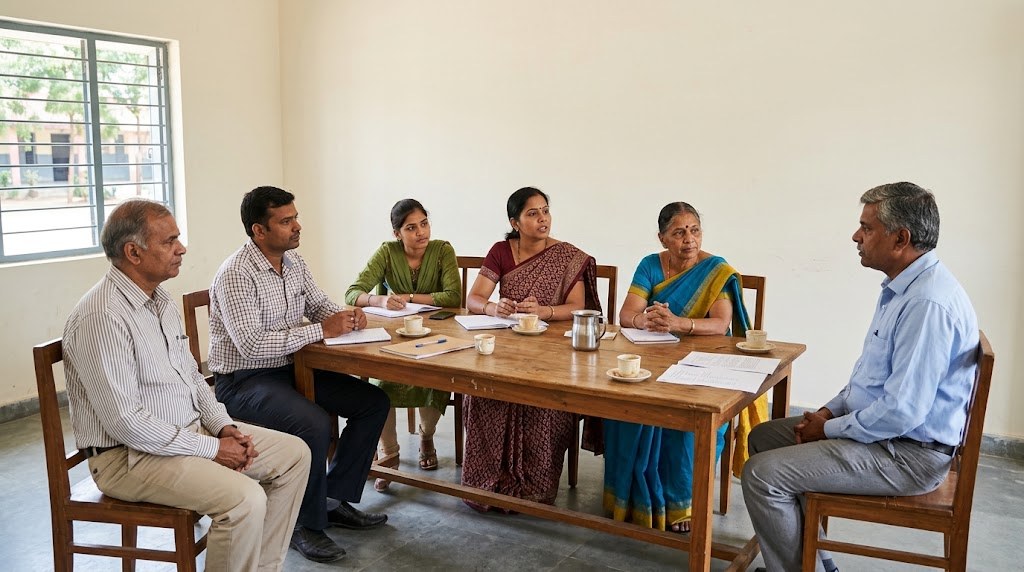
Qualifications get you onto the shortlist; the duties in clause 9.2 decide whether you can do the job. Check your experience against this list and fill the gaps on purpose.
- Leadership: you have set a direction for a group of adults and kept it through a difficult term.
- Running operations: you have managed a budget, purchases, records or a timetable, and kept them accurate.
- Hiring and developing people: you have chosen who joins a team, given feedback, and helped someone grow.
- Working with parents: you can explain a hard decision to a worried family and keep their trust.
- Compliance: you can read a bye-law or a circular and turn it into a working routine.
- Care for every child: you notice the children who are falling behind or no longer coming, and you act.
The last point matters. NEP 2020 cites the NSSO 2017–18 survey figure of 3.22 crore out-of-school children aged 6 to 17, calls bringing them back a top priority, and backs multiple pathways, including open schooling through NIOS and state open schools. Principals who can reach children a standard classroom has lost will be needed everywhere.
Employed principal vs founder-principal
Everything above describes the employed principal, appointed to lead a school that already exists. A founder-principal starts a school, learning centre or education business and leads it from the first family. The work overlaps; the job is different.
| Point | Employed principal | Founder-principal |
|---|---|---|
| Starting point | An existing school, staff and students | An idea, a group of children to serve, and no team yet |
| Who decides the direction | Shared with the management or the government | Mostly you, within the law and any co-owners’ agreement |
| Main early work | Raising quality and keeping the school compliant | Finding families, hiring the first team, building the model |
| How you are paid | A salary set by the employer | Depends on the business and how it is owned |
| Formal qualifications | Set by the board or recruitment rules for the post | Depend on the kind of setting; a recognised school still has to meet the official rules for its head |
If you want to build a school rather than inherit one, the founder route may fit you better, though it asks more of your business skills. The practical side of that route is covered in how to start a school in India and the cost to start a school in India.
Want to be a founder-principal, with a working model behind you?
NIJIN is looking for one person to start and lead NIJIN Academy India, as both its business head and its principal. Teaching experience is not required. If you have led an organisation and hired people, read the role.
See the Country Head role in IndiaIs this a job or a business? The Country Head role
People looking at school principal jobs in India or a country manager role in education often ask this first. For the role NIJIN offers, the answer is: it is a business you lead, and you are also its principal.
NIJIN Academy is an alternative school in Japan for children who do not fit conventional school, opened in September 2023 by NIJIN Inc. Children attend from home through a metaverse campus, choose from about 100 live online classes a month, and can also go to 52 physical classrooms across Japan. NIJIN describes it as one of the largest alternative schools in Japan, with more than 1,000 children enrolled since opening (cumulative).
Two different things, kept separate. NIJIN does not require teaching experience for the Country Head role. What it values most is experience of managing an organisation and of hiring people. That is NIJIN’s own condition for its own role. It does not change the official rules: where a school in India must meet the qualification rules for its head, those rules apply as described above. What NIJIN Academy India will need locally is worked out together.
There is also a choice in how you start. Investment is optional.
| Way to start | How it works | Compensation guide |
|---|---|---|
| Co-owner of a local company | You and NIJIN set up a local company for NIJIN Academy India together. For example, you hold 20% of the shares and NIJIN holds 80%. If you invest, the guide is JPY 1 to 2 million from you and JPY 4 to 8 million from NIJIN, decided with you. | 10% of revenue (excluding tax), as a guide |
| Service contract | You start on a service contract, even as a side job alongside your current work, and decide later whether to become a co-owner. | The same guide: 10% of revenue |
As a guide, JPY 100 million of revenue gives JPY 10 million, JPY 200 million gives JPY 20 million, and JPY 500 million or more gives the cap of JPY 50 million. These rows only show how the formula works. They are not a forecast or a promise of income: with no revenue, the formula pays nothing. If you ask someone else to do part of the work the role requires, that person is paid out of your 10%. Amounts are in Japanese yen only. This is not a franchise: you do not pay to copy a format. Every other term is discussed in the interview. For other pay models, see country manager in education: the role and three pay models.
Questions and answers
What is the principal qualification as per CBSE norms?
Clause 5.1 of the CBSE Affiliation Bye-Laws, 2018 says the minimum qualifications for teaching staff, including the principal, follow the NCTE regulations and the recruitment rules of the state government where the school is located, or of KVS or NVS. NCTE prevails if there is a conflict. The exact degree and experience conditions are in those recruitment rules.
What is the qualification for a principal in a private school in India?
For a private school affiliated to CBSE, the minimum is whatever the NCTE regulations and the recruitment rules of your state (or of KVS or NVS) set for the post, because clause 5.1 of the Affiliation Bye-Laws points to them. In practice those rules ask for a postgraduate degree, a B.Ed. and several years of teaching or school-leadership experience; the KVS table below is one published example. Schools under a State Board follow that State’s rules, so ask the district education office for the written list.
How to become a government school principal in India?
Government principals are appointed by the state government, KVS or NVS under their recruitment rules, by direct recruitment or promotion. Eligibility, experience and age conditions are set in each recruitment notification, so read the current one.
How to become principal in KVS?
There are two ways in: direct recruitment through a KVS recruitment notification (a written exam and an interview), or promotion inside the system. For direct recruitment, the KVS and NVS Recruitment Notification 01/2025, as corrected on 4 December 2025, set these conditions for the Principal post:
| Condition | KVS/NVS Principal (Notification 01/2025, Corrigendum 2) |
|---|---|
| Age | Minimum 35, maximum 50 years |
| Degrees | Master’s degree with at least 50% marks, and B.Ed. with at least 50% marks (or an integrated B.Ed.-M.Ed. or four-year integrated degree from an NCTE-recognised institution) |
| Experience (one of these) | Already a Principal at Pay Level 12; or 3 years as Vice-Principal at Pay Level 10; or 12 years of regular service as PGT/Lecturer at Pay Level 8; or 12 years combined as PGT and Vice-Principal, all in Central or State Government or their autonomous bodies |
| Other | Knowledge of computer applications and a working knowledge of Hindi and English |
So the realistic path to a KVS principal post runs through years of government-school teaching as a PGT, then Vice-Principal. Conditions change between notifications, so check the latest one on the KVS website before you plan around them (source: CBSE, KVS/NVS Recruitment Corrigendum 2, 4 December 2025). If you would rather lead a school without waiting for that ladder, read employed principal vs founder-principal.
Can I become a school principal without teaching experience?
For a recognised or CBSE-affiliated school, the head must meet the qualification rules that apply to that school, and those rules usually count teaching or academic experience. Founding and leading a new education business is different: NIJIN, for example, does not require teaching experience for its Country Head role, while any official rules for the school itself still apply.
Are there school principal jobs in India for freshers?
Principal posts are senior, and recruitment rules normally ask for years of experience. A realistic first step is a teaching or coordinator role with leadership duties. If you already lead teams in another field, the founder route is where that experience counts directly.
Is the Country Head role a job or a business?
It is closer to a business. You lead NIJIN Academy India as its founder, business head and principal, either as a co-owner of a local company or, to begin with, on a service contract. Compensation is 10% of revenue as a guide, capped at JPY 50 million, and it is not guaranteed.
Lead a school in India as its founder-principal
NIJIN is looking for one person to start and lead NIJIN Academy India. Teaching experience is not required. Investment is optional. If you have led people and want to build a school for children who do not fit school, read the role.
See the Country Head role in IndiaWhere to go next
NIJIN Academy Country Head pages are open for several countries, and the global page covers every other country. Our English careers page lists everything else we are working on.
Related guides for founders
- How to start a school in India
- Cost to start a school in India
- Alternative schools in India
- Education franchise in India
- Edupreneur meaning
- Country manager in education: the role and three pay models
- How to start a CBSE school in India: affiliation steps
Sources
Clause numbers refer to the CBSE Affiliation Bye-Laws, 2018 as published on cbse.gov.in. Rules are amended from time to time; please check the original and the current recruitment notification.
- https://www.cbse.gov.in/cbsenew/aff-bye-laws.html
- https://www.cbse.gov.in/cbsenew/staff.html
- https://cbse.gov.in/cbsenew/documents/Mandatory Directions of The Board With Regard To Teacher Qualification.pdf
- https://static.pib.gov.in/WriteReadData/userfiles/NEP_Final_English_0.pdf
- https://nijin.co.jp/recruit/nijin-academy-india-country-head/
- https://nijin.co.jp/recruit/nijin-academy-country-head/
- CBSE (for KVS and NVS), Recruitment Notification 01/2025, Corrigendum 2 (4 December 2025): https://www.cbse.gov.in/cbsenew/documents/Qualification_Corrigendum_05122025.pdf