For education founders in India
To start a Montessori school in India, decide the age band first (most new schools begin with ages 3 to 6), put a Montessori-trained adult at the centre of every classroom, prepare a mixed-age environment with the right materials, and then register the setting under your state’s rules for preschools, adding RTE Act recognition only if you plan to teach Class 1 and above. The word “Montessori” is the easy part. Training, environment and registration are where the work is.
This guide is about starting a school that is genuinely Montessori, not about play schools in general. If you are comparing play-school formats or franchises, our guide on how to start a play school without a franchise in India covers the full preschool norms checklist. Here we focus on what changes when the school carries Maria Montessori’s name.
In this article
- What “Montessori” means for a new school
- Step 1: Choose your age band
- Step 2: Montessori teacher training (AMI and AMS)
- Step 3: Prepare the environment and materials
- Step 4: How to register a Montessori pre-school in India
- Step 5: If you go beyond age 6, RTE recognition
- The first twelve months, in order
- Three ways to start
- Questions and answers
What “Montessori” means for a new school
Many founders assume they need permission or a licence from a Montessori organisation to use the name. As far as we could confirm, that is not how it works. AMI/USA, the United States affiliate of the Association Montessori Internationale (AMI), states plainly on its website that the name Montessori isn’t trademarked and that any school can use it, whether or not it follows Dr. Maria Montessori’s principles. AMI/USA adds the consequence: because of this, quality varies widely.
That statement is about the United States, and we did not find an official Indian ruling on the word. Logos and composite names belonging to Montessori organisations are a different matter. If you plan a school brand that contains “Montessori”, search India’s trade marks registry or ask a lawyer before you print anything.
For a founder in India, the practical point is this: parents cannot rely on the word, so they look for proof. What separates a Montessori school from a school with Montessori in its name is visible in three places.
| What parents check | School that only uses the name | School built on the method |
|---|---|---|
| The adult in the room | General preschool staff, perhaps a short course | A teacher with a recognised Montessori diploma or credential for that age level |
| The room | Rows of tables, teacher-led timetable, a shelf of “Montessori toys” | A prepared environment: low open shelves, a full set of materials, free choice of activity |
| The children | Grouped by single year of age | A mixed-age group within a defined range, such as 3 to 6 |
| The founder’s answer | “We follow Montessori principles” | “Here is our teachers’ training, our materials list and our daily rhythm” |
Step 1: Choose your age band
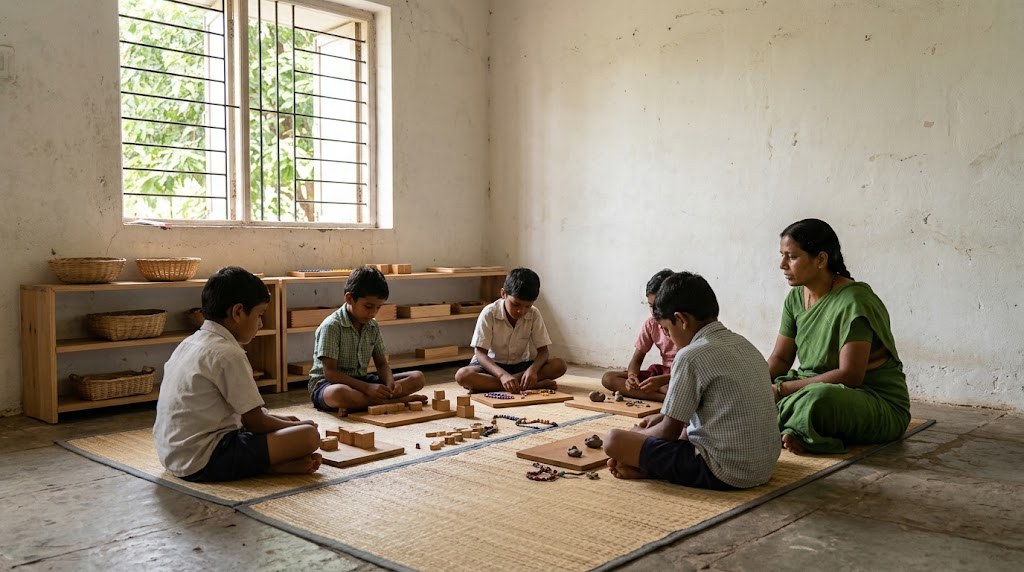
Montessori education is organised in age bands, and so is Indian regulation. Choosing the band first saves you from training the wrong teacher or registering under the wrong rules. AMI runs diploma courses for Assistants to Infancy (0–3), Primary (3–6), Elementary (6–12) and Adolescents (12–18). AMI describes the 3–6 environment, which Maria Montessori called the Casa dei Bambini or Children’s House, as built around Practical Life, Sensorial, Language and Mathematics activities, with children free to choose their work and to concentrate at their own pace.
| Age band | Montessori level | Where it sits in India | What to confirm |
|---|---|---|---|
| Under 3 | Assistants to Infancy (0–3) | Outside the NCPCR play-school guidelines, which say no child below three should be admitted to a play school | Whether your state treats it as a crèche or day care, and which department licenses that |
| 3 to 6 | Primary / Children’s House (3–6) | Early Childhood Care and Education (ECCE), the first part of the NEP 2020 Foundational Stage | Your state’s preschool registration rules and the competent authority for your district |
| 6 to 12 | Elementary (6–12) | Elementary education under the RTE Act, which covers ages 6 to 14 | A certificate of recognition before the school is established or functions |
| 12 to 18 | Adolescents (12–18) | Secondary education, board affiliation and examinations | Which board, and the state’s rules for secondary schools |
Most founders start with one 3–6 classroom. It is the level with the most training places in India, the clearest regulatory path, and the age at which parents most often go looking for a Montessori school.
Step 2: Montessori teacher training (AMI and AMS)
A Montessori school is only as Montessori as the adult in each room. The two best-known international training bodies are the Association Montessori Internationale (AMI) and the American Montessori Society (AMS). Both publish their training structure on their official websites.
| AMI | AMS | |
|---|---|---|
| What you earn | AMI Diploma for one age level | AMS credential from an AMS-affiliated teacher education programme (TEP) |
| Levels for young children | Assistants to Infancy (0–3); Primary (3–6); First Plane (0–6) | Infant & Toddler (birth–3); Early Childhood (2½–6) |
| Older levels | Elementary (6–12); Adolescents (12–18) | Elementary I, II, I–II; Secondary I, I–II |
| For school leaders | AMI Montessori School Leadership Certificate, open to anyone developing Montessori leadership skills | Administrator credential |
| Entry requirement | Set by each training centre | Full credential: a bachelor’s degree from a regionally accredited US college or university, or its equivalent. Associate credential (Infant & Toddler and Early Childhood only): high school |
| Format | Courses listed by centre and start date | Typically 1–2 years, in-person or blended coursework, with a yearlong practicum |
AMI training in India. AMI’s directory of training centres lists seven in India: JFA Montessori Teacher Training Centre (Kolkata), Kodaikanal AMI Centre for Montessori Studies, Montessori Institute of Bangalore, R.T.I. Montessori Training (Mumbai), Supraja Montessori Study Centre (Chennai), The Montessori Training and Research Trust (Jeedimetla) and Vivek High Montessori Institute (Chandigarh). AMI’s course list, when we checked in October 2026, showed Primary (3–6) diploma courses in India starting in 2026 in Bangalore, Chennai, Chandigarh, Hyderabad, Delhi NCR, Mumbai and Kolkata, and Elementary (6–12) courses in Chandigarh, Kolkata, Mumbai and Moinabad.
Fees and online courses. Montessori teacher training course fees are set by each centre, not by AMI or AMS, and AMI asks applicants to contact the centre for enrolment and fees. Some courses advertised as “Montessori teacher training online” are not AMI diplomas or AMS credentials. Before you hire, ask which body issued the qualification, for which age level, and whether it included supervised practice with children.
A founder does not have to be the teacher. Your job is to make sure that every classroom is led by a properly trained adult and that the school runs well around them. If you want to understand the method as a leader, the AMI School Leadership Certificate and the AMS Administrator credential exist for exactly that.
Step 3: Prepare the environment and materials
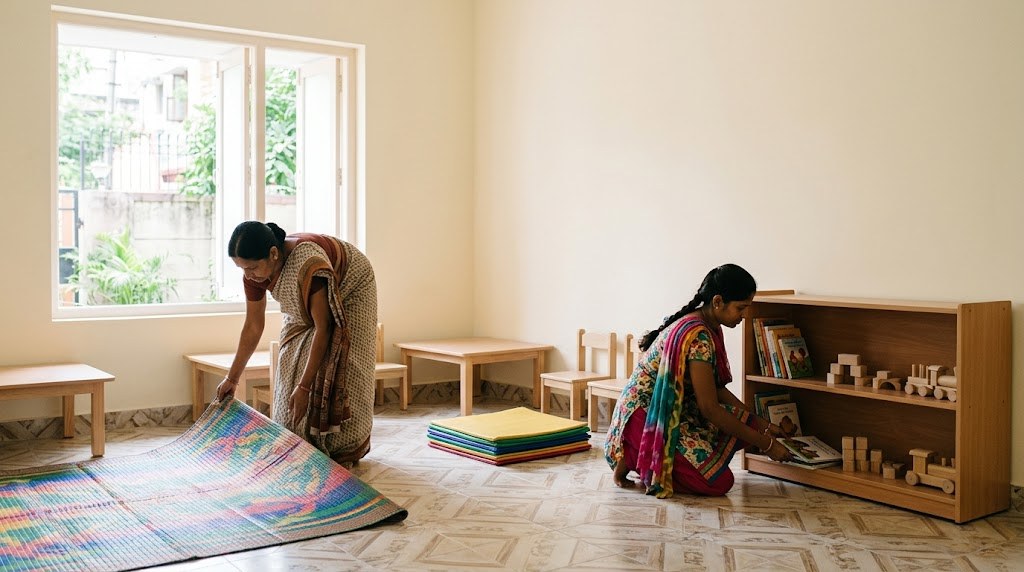
AMI describes a Montessori environment as organised for a mixed-age group, adaptable to any culture, with accessible furniture, a variety of work spaces, and materials “displayed for free choice of activity”. The teacher gives short lessons, and children then work hands-on, often with materials that let them see and correct their own mistakes. AMI also notes the absence of an imposed daily schedule.
Use this checklist when you look at a room and plan a materials budget:
- Floor space for children to work on mats, not only at tables
- Low, open shelves on every wall the children use, arranged by area: Practical Life, Sensorial, Language, Mathematics, Culture
- Child-sized tables, chairs, sinks and toilets, with safe water within reach
- A complete set of materials for each area, sourced from a supplier you can reorder from, with a plan for local-language and Indian cultural materials
- Outdoor space or a garden the children can use as part of their work
- A quiet corner for observation, where the trained adult can take notes
- Building safety basics your state will inspect: boundary, exits, fire safety, toilets, drinking water
A small, complete room is better than a large, half-equipped one. Parents who know Montessori will look at the shelves before they look at the paint.
Want to build a school in India with a model that already runs?
If what draws you to Montessori is the idea that children learn best when the school fits the child, you may be interested in a different route. NIJIN Academy is an alternative school in Japan, opened in September 2023, for children who do not fit conventional school. NIJIN is looking for one founder to start and lead NIJIN Academy India, as both business head and principal. Teaching experience is not required, and it is not a franchise.
See the Country Head role in IndiaStep 4: How to register a Montessori pre-school in India
There is no separate “Montessori licence” in India. A Montessori school for ages 3 to 6 is registered the way other preschools in your state are registered. Three official documents frame what you should expect.
NEP 2020 puts ECCE at the base of school education. The National Education Policy 2020 replaces the old 10+2 structure with a 5+3+3+4 design. Its Foundational Stage covers ages 3 to 8: three years of Anganwadi or pre-school, then Grades 1 and 2. The policy says universal, quality ECCE must be achieved no later than 2030, and lists stand-alone pre-schools as one of the four kinds of institution that will deliver it, all recruiting teachers specially trained in ECCE. It describes good ECCE as play-based, activity-based and inquiry-based, which a well-run Montessori classroom already is. It also plans a State School Standards Authority in each state, with standards that apply to private, public and philanthropic pre-school education too.
NCPCR has published model guidelines for private play schools. The National Commission for Protection of Child Rights’ Regulatory Guidelines for Private Play Schools cover children aged three to six. The points that matter most for a Montessori founder:
| NCPCR guideline | What it means for a Montessori school |
|---|---|
| Recognition from a competent authority, defined as the district-level nodal officer for ICDS in the state’s WCD or Social Justice department, renewed every year | Find out which office this is in your district before you sign a lease |
| No child below the age of three in a play school | A 0–3 “infant community” needs a different licence, if your state allows it |
| One teacher and one caregiver for every 20 children | A typical Montessori room of mixed ages needs both a trained guide and an assistant |
| Non-residential, 3 to 4 hours a day as per the National ECCE Policy 2013 | Plan your daily rhythm, and any longer day-care hours, with this in mind |
| Teachers with minimum qualifications laid down by a notified academic authority | Ask your state whether a Montessori diploma alone satisfies this, or whether an ECCE qualification is also needed |
| Affidavits that office bearers and staff have never been convicted under the POCSO Act and related laws | Build background checks into hiring from day one |
Your state decides. These are guidelines from a national commission. Whether your state has adopted them, which department registers preschools, and what documents it asks for differ from state to state. The NCPCR guidelines also describe the applicant as a trust, society or not-for-profit company, so ask your state which legal forms it accepts before you incorporate. This is not legal advice: take the questions to your state’s education or Women and Child Development department and, for the legal form, to a lawyer or chartered accountant.
Step 5: If you go beyond age 6, RTE recognition
Many Montessori schools want to grow with their children into a 6–12 Elementary class. In India that is a different legal step. The Right of Children to Free and Compulsory Education Act, 2009 covers children aged six to fourteen. Section 18 says that no school, other than one established, owned or controlled by the government or a local authority, shall be established or function without a certificate of recognition. Section 19 says no school shall be established or recognised unless it fulfils the norms and standards in the Act’s Schedule.
Two more points matter for Montessori founders. Section 12(1)(c) requires unaided private schools, among others, to admit, in Class 1, at least 25% of the class from weaker sections and disadvantaged groups in the neighbourhood, and the Act adds that where such a school imparts pre-school education, those admission provisions apply to the pre-school too. And the Act’s norms are written for conventional classes, so ask your state early how a mixed-age 6–12 room will be assessed. For the full path to a recognised school, see how to start a school in India.
The first twelve months, in order
- Months 1 to 2: age band and families. Choose 3–6 or another band. Talk to thirty families about what they want and how far they will travel.
- Months 2 to 3: the trained adult. Find your lead teacher, or enrol someone in a diploma course that finishes before you open.
- Months 3 to 4: the official answer. Ask your state and district which department registers preschools, what it inspects, and which legal forms it accepts.
- Months 4 to 6: the room. Lease a space that passes the safety checks. Order materials early, as complete sets take time.
- Months 6 to 8: registration and trial mornings. Apply for recognition. Run open mornings so parents can watch a prepared room in use.
- Months 9 to 12: open small. One classroom, a mixed-age group, written observations shared with parents every month.
Three ways to start
A Montessori school is one way to give children a school that fits them. There are others. If you are more of an organiser and leader than a classroom teacher, it is worth comparing the routes honestly.
| Your own Montessori school | Preschool franchise | Co-founding NIJIN Academy India | |
|---|---|---|---|
| What you build | An independent school following the Montessori method | A local branch of an existing brand | An alternative school, online and in person, adapted to India |
| Ages | Usually 3–6 first | Set by the brand | NIJIN Academy serves elementary to high school age in Japan; India’s focus is decided with you |
| Teaching experience | Trained Montessori teachers essential | Set by the brand | Not required for the Country Head |
| Money | You fund everything | Fees to the brand | Investment is optional; start on a service contract or as a co-owner |
| Your pay | What the school earns after costs | What remains after fees | As a guide, 10% of revenue (excluding tax), up to JPY 50 million |
NIJIN Academy is not a franchise. You can lead it as a co-owner of a local company set up together (for example, 20% of the shares for you and 80% for NIJIN; if you invest, the guide is JPY 1 to 2 million from you and JPY 4 to 8 million from NIJIN, decided with you), or begin on a service contract, even as a side job. Either way, the compensation guide is the same: 10% of revenue. Revenue of JPY 100 million would give JPY 10 million, JPY 200 million would give JPY 20 million, and the cap of JPY 50 million is reached at JPY 500 million. These figures show how the formula works. They are not a forecast or a promise of income, and with no revenue the formula pays nothing.
Figures are those published by NIJIN. “Attendance recognition” means the school a child is registered at counts learning at NIJIN Academy as school attendance.
Questions and answers
How much does it cost to start a Montessori school in India?
We do not quote a figure, because costs depend heavily on your city, your building and how many classrooms you open, and we could not verify any reliable average. The lines to price are stable, though: trained teachers and assistants, rent and safety work on the building, a complete set of Montessori materials for each classroom, registration and compliance, and your own pay until the school breaks even. Our guide to the cost to start a school in India shows how to build the budget.
How to register a pre school in India?
Registration is handled by your state, not by a Montessori body. The NCPCR guidelines describe recognition by a district-level competent authority, renewed every year, but states differ on whether and how they apply them. Ask your state’s education or Women and Child Development department which office registers preschools in your district and what it inspects.
How to start a Montessori school in India online?
The Montessori 3–6 method depends on children handling physical materials in a prepared room, so a Montessori school itself is hard to run online. What can be partly online is the adults’ preparation: some training bodies offer blended coursework, and AMS describes in-person or blended courses with a yearlong practicum. Check that any online course leads to a recognised diploma or credential.
Do I need Montessori teacher training to open a Montessori school?
The founder does not have to be a trained teacher, but each classroom needs one. Parents who choose Montessori often ask which body trained the teachers and for which age level. Your state may also have its own teacher qualification rules for preschools.
How much are Montessori teacher training course fees?
Each training centre sets its own fees. AMI asks applicants to contact the centre for enrolment and fee enquiries, and AMS lists its affiliated programmes in a directory. Compare the age level, the length of supervised practice and who issues the final qualification, not only the price.
I am looking for an education leadership job in India. Is the NIJIN Country Head role a job or a business?
It is closer to founding a business than to taking a job. The Country Head is both business head and principal of NIJIN Academy India, and compensation is, as a guide, 10% of revenue, not a salary. You can start on a service contract, even alongside your current work, or as a co-owner. Contract type, location and start date are discussed in the interview.
Build a school in India that fits the child
NIJIN is looking for one founder to start and lead NIJIN Academy India, as business head and principal. Teaching experience is not required. If you have led a team, hired people, and want to build a school for children who do not fit school, read the role.
See the Country Head role in IndiaWhere to go next
Country Head pages are open for several countries, and the global page covers every other country.
Related guides for founders
- How to start a play school without a franchise in India
- Alternative schools in India: types, NEP 2020 and NIOS
- How to start a school in India
- Cost to start a school in India
- How to start an edtech startup in India
- How to start a microschool
Sources
Course dates and centre lists were checked on the official websites in October 2026. Please check the originals for later updates.
- https://amiusa.org/choosing-a-school
- https://montessori-ami.org/training-programmes/training-centres
- https://montessori-ami.org/training-programmes/diploma-courses
- https://montessori-ami.org/training-programmes/qualifications/ami-montessori-school-leadership-certificate
- https://montessori-ami.org/about-montessori/montessori-3-6
- https://montessori-ami.org/about-montessori/montessori-environments
- https://montessori-ami.org/node/7182
- https://amshq.org/Educators/Montessori-Careers/About-AMS-TEP
- https://amshq.org/educators/become-a-montessori-educator/
- https://static.pib.gov.in/WriteReadData/userfiles/NEP_Final_English_0.pdf
- https://www.ncpcr.gov.in/public/uploads/165753774662cc04d28580b_regulatory-guidelines-for-private-play-schools-by-national-commission-for-protection-of-child-rights-85-kb.pdf
- https://panchayatwiki.lsgkerala.gov.in/THE_RIGHT_OF_CHILDREN_TO_FREE_AND_COMPULSORY_EDUCATION_ACT,_2009
- https://nijin.co.jp/recruit/nijin-academy-india-country-head/