
For education founders in India
To start a pre school in India, you do four things: design it for the first three years of the NEP 2020 Foundational Stage (ages 3 to 6), find out which department in your state registers private preschools and what it asks for, secure a safe, child-sized space that the local rules allow, and hire teachers trained in early childhood care and education. There is no single national preschool licence. The rules are set state by state, and in some states the preschool desk sits in the Women and Child Development Department, not in School Education.
This guide covers the preschool itself: policy, programme, registration, space and staff. For the franchise question, read how to start a play school without a franchise in India. For Montessori, read how to start a Montessori school in India.
In this article
- What a pre school is under NEP 2020
- Why there is room for new preschools
- Design the preschool around the Foundational Stage
- Registration: state by state
- Preparing the space
- Preparing the people
- How to open a preschool in India, in order
- From a preschool business to a wider school
- Questions and answers
What a pre school is under NEP 2020
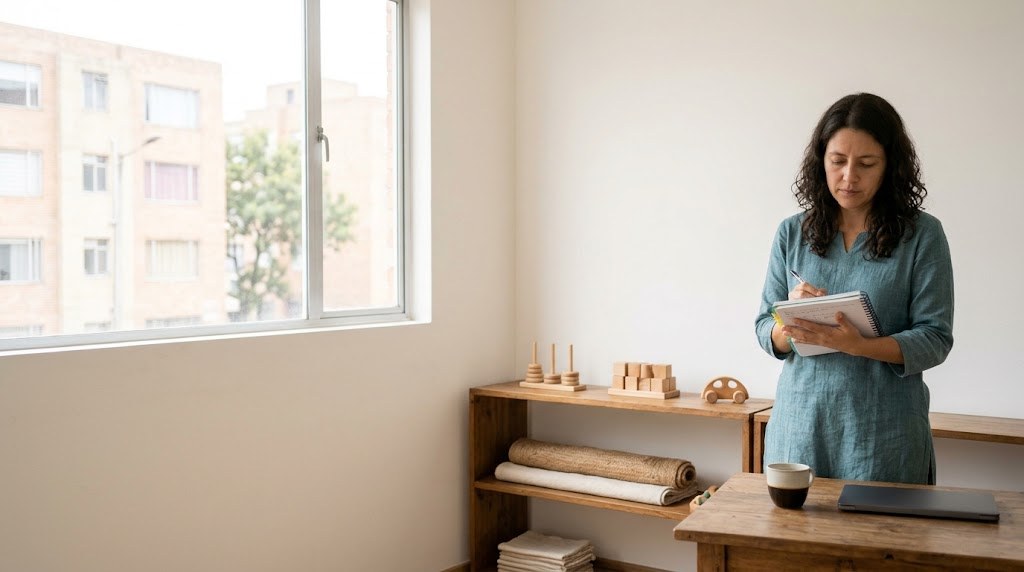
The National Education Policy 2020 replaced the old 10+2 picture of schooling with a 5+3+3+4 design. The first block, the Foundational Stage, covers ages 3 to 8 in two parts: three years of Anganwadi or pre-school, then Grades 1 and 2 in primary school.
So a preschool is now the first three years of a stage that continues into primary school. The policy describes learning at this stage as flexible, multilevel and play- and activity-based. The National Curriculum Framework for the Foundational Stage (NCF-FS), published by NCERT in 2022, adds that children should begin Grade 1 at the age of 6.
NEP 2020 names four kinds of institution for early childhood care and education (ECCE):
| Type named in NEP 2020 (para 1.4) | Who usually runs it | What it means for a founder |
|---|---|---|
| Stand-alone Anganwadi | Government (ICDS) | Not a private route, but often the nearest alternative a family has |
| Anganwadi co-located with a primary school | Government | Shows the direction of policy: preschool linked to a school |
| Pre-primary school or section (at least age 5 to 6) co-located with a primary school | Government or private school | The route if you already run, or plan to run, a primary school |
| Stand-alone pre-school | Private, philanthropic or public | The usual route for a new founder starting a preschool business |
The policy adds that all four types would recruit workers or teachers specially trained in the curriculum and pedagogy of ECCE.
Why there is room for new preschools
Sources: NCF for the Foundational Stage 2022 (NCERT), section 1.1, citing UDISE+ 2020-21 and Lok Sabha Unstarred Question 2146 (2022); NEP 2020, para 4.1.
NCF-FS is also frank about the private sector. It says accurate data on private play schools and preschools is not available. It describes most private preschools as “downward extensions of school”, focused on rote memorisation and often with teachers untrained in early childhood education. A preschool that genuinely follows the play-based framework can stand out.
Design the preschool around the Foundational Stage
Before signing a lease, take three things from NCF-FS.
The five domains
NCF-FS sets curricular goals and competencies in five domains: physical development; socio-emotional and ethical development; cognitive development; language and literacy development; and aesthetic and cultural development. It adds positive learning habits. The competencies are guidelines, not a rigid prescription.
The shape of the day
NCF-FS gives two illustrative daily routines for ages 3 to 6. The first runs from 9:30 in the morning to about 3:30 in the afternoon and moves through free play and corners time, circle time, a snack break, rhymes and movement, concept time and pre-numeracy, arts and crafts, lunch, story time and outdoor play. In that example, children aged 3 to 4 go home after lunch. A second routine, for smaller groups, gives children “work time” to choose their own activity.
| Decision | What NCF-FS says | Question for your plan |
|---|---|---|
| Age groups | Foundational Stage begins at 3; Grade 1 should begin at 6 | Which of the three years (often called Nursery, LKG and UKG, or Balvatika) will you open first? |
| Length of day | The illustrative day runs about 9:30 to 3:30, with the youngest leaving after lunch | Half-day, full day, or both? What do your target families need? |
| Balance | Art and craft, outdoor play and free play must have adequate time | Is outdoor play possible every day at this address? |
| Language | Children are encouraged to learn through their home languages | Which languages do your families speak at home, and do your teachers speak them? |
| Pupil-teacher ratio | A lower ratio matters most in the early years, achieved with qualified teachers | Check whether your state sets a number |
The learning environment
NCF-FS asks for indoor spaces that are well lit, well ventilated, safe, inclusive and inviting, with children’s work on display. Its infrastructure list includes clean, safe, working toilets and safe drinking water; clean, well-lit classrooms that use natural light; learning spaces kept apart from areas such as cooking; and safe outdoor space or a small garden for play. Buildings and equipment must meet safety standards under the law.
Registration: state by state
NEP 2020 says an effective system of quality self-regulation or accreditation will cover all stages of education, including pre-school education, private, public and philanthropic. It asks each State and Union Territory to set up a State School Standards Authority (SSSA) to fix minimum standards on safety, security, basic infrastructure, number of teachers, financial probity and governance, with schools disclosing this information publicly. Do not assume your state has set this up yet.
In practice, the department responsible for private preschools differs by state. Haryana is one documented example: the state’s Women and Child Development Department, on its own website, directs operators to “Apply for Recognition for Private Play Schools” on the SARAL portal. In other states, the School Education Department or a municipal body may be responsible.
Before you rent anything, take this list to your state’s School Education Department and its Women and Child Development Department, and ask for the answers in writing.
- Which department registers or recognises a private preschool for ages 3 to 6 here, and through which portal?
- Is registration compulsory, and does it have to be renewed?
- Which legal form may hold the registration: trust, society, Section 8 company, or another form?
- What are the minimum norms for space, toilets, drinking water, outdoor area and staff?
- What qualification must the lead teacher have in ECCE?
- Which clearances does the municipality or fire service require for this address?
- What are the admission age rules, and when does a child move to Grade 1?
This checklist lists questions, not legal requirements. Rules change and differ by state and city. The state department, or a lawyer, is the only reliable source.
Starting a school in India, beyond the preschool years?
NIJIN Inc., an education company in Japan, is looking for one person to start and lead NIJIN Academy India, as both its business head and its principal. NIJIN Academy is an alternative school for children who do not fit conventional school, mainly of elementary and junior high school age. It is not a franchise, and investment is optional: you can co-own a local company with NIJIN or start on a service contract, even as a side job.
See the Country Head role in IndiaPreparing the space
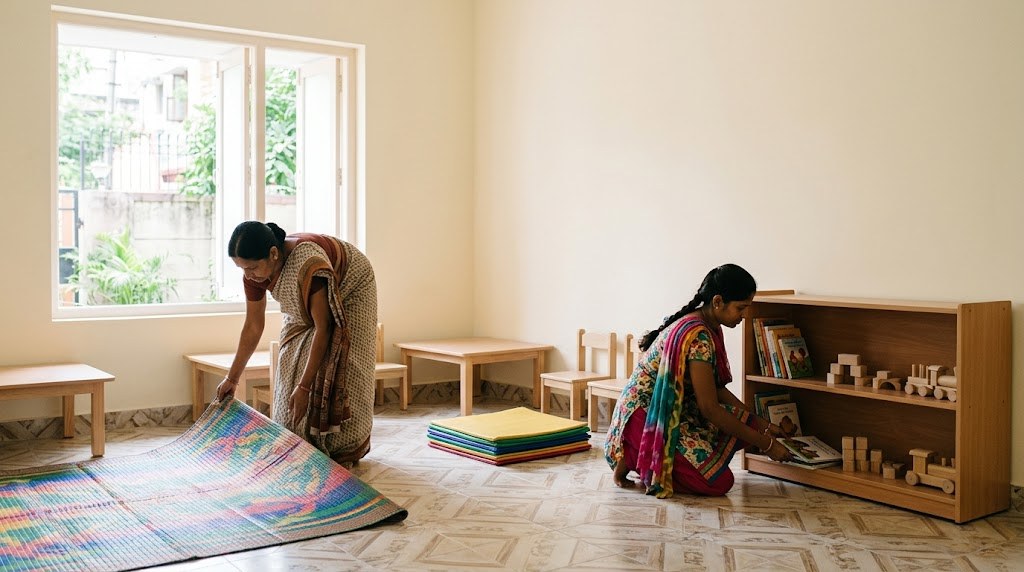
The space is the step hardest to undo. Check every address against this list.
- Permitted use. Ask the owner and the municipality whether an educational or childcare use is allowed at this address, including for a home-based setting.
- Ground level and access. Young children need barrier-free movement, safe stairs, and an exit route the staff can use quickly.
- Light and air. NCF-FS asks for well-lit, well-ventilated rooms that make the most of natural light.
- Toilets and water. Clean, safe, child-friendly toilets with running water and safe drinking water.
- Separation. A kitchen or cooking area kept away from the learning space.
- Outdoor play. A safe outdoor space or garden, or a safe nearby place you can reach every day.
- The journey. Parents of three-year-olds rarely accept a long daily commute. Choose the neighbourhood first.
Preparing the people
NEP 2020 says every child should move, before the age of 5, to a “Preparatory Class” or “Balavatika” with an ECCE-qualified teacher. For Anganwadi workers, the policy describes a 6-month certificate in ECCE for those with qualifications of 10+2 and above, and a one-year diploma for those with lower qualifications. What your state requires of a teacher in a private preschool is one of the questions on the checklist above.
| Role | What the role does | What to look for |
|---|---|---|
| Founder / head | Registration, families, money, hiring, safety | Organising and hiring experience; parents trust them |
| Lead teacher | Runs the day around the five domains; observes and records | ECCE training as your state requires; calm with young children |
| Assistant / caregiver | Care, hygiene, meals, helping in corners and outdoors | Reliability; speaks the children’s home languages |
| Part-time support | Accounts, cleaning, transport if offered | Clear contracts; background checks before starting |
Write a safeguarding routine before you hire: how you check the background of every adult, who may collect a child, how injuries and concerns are recorded, and how parents are told.
How to open a preschool in India, in order
- Talk to thirty families. Ages, timings, home languages, and what they use now.
- Get your state’s answers in writing. Use the registration checklist. Choose your legal form with that answer, and with professional advice.
- Write the programme. Map a week against the five NCF-FS domains and one of its illustrative daily routines.
- Secure the space. Check permitted use, safety and the environment list before you sign. Prefer a short first lease.
- Hire and train. One lead teacher and one assistant per group to start, with background checks and a safeguarding routine.
- Register and apply for clearances. Submit to the department your state named, plus any municipal and fire clearances it lists.
- Open small, then report. Start with one age group. Send families a simple monthly note on what their child did in each domain.
From a preschool business to a wider school
Families who trust you at age 3 will ask what comes next. Adding Class 1 and above is a different legal step, usually needing recognition as a school. See how to start a school in India and the cost to start a school in India.
Some founders find that what they want to build is not another formal school, but a place for children who have stopped fitting into one. That is what NIJIN Academy does in Japan. It opened in September 2023. Children join from home through a metaverse campus and can also go to physical classrooms. NIJIN describes it as one of the largest alternative schools in Japan.
Figures are those published by NIJIN. Compensation is a guide, not a promise of income: 10% of revenue, capped at JPY 50 million. With no revenue, the formula pays nothing. Other terms are discussed in the interview.
The NIJIN Academy India Country Head is both business head and principal. Teaching experience is not required. What counts most is leadership, management, business ability and the skills of a principal, together with experience of managing an organisation and hiring people. Ideally you work in an Indian official language, English and Japanese, but English alone is fine.
Questions and answers
How do I open a pre school in India: who registers it?
It depends on your state. There is no single national preschool licence. In Haryana, for example, the Women and Child Development Department handles recognition of private play schools through the SARAL portal. Elsewhere it may be another department. Ask in writing before you rent.
Does NEP 2020 apply to a private preschool?
NEP 2020 is a policy, not a licence. It places pre-school inside the Foundational Stage and says quality self-regulation or accreditation will cover pre-school education that is private, public or philanthropic. The rules themselves come from each state.
What age should children be in a pre school?
Under NEP 2020, the three pre-school years cover ages 3 to 6. NCF-FS says children should begin Grade 1 at the age of 6. Your state sets the admission rules.
How to start a play school at home in India?
First check whether your state and municipality allow an educational or childcare use at a residential address, and whether a home setting can be registered. Then test the rooms against the space checklist above.
Do I need a franchise to start a preschool?
No. You can design your own programme around NCF-FS. The trade-offs are set out in our guide to starting a play school without a franchise.
Is the NIJIN role a preschool teacher job?
No. If you searched for preschool teacher jobs, note that the NIJIN Academy India Country Head is a founder’s role: you lead the business and serve as principal, working with NIJIN in Japan. Teaching experience is not required, and NIJIN Academy mainly serves school-age children rather than preschoolers.
Build a school in India, with a team behind you
NIJIN is looking for one founder to start and lead NIJIN Academy India. It is not a franchise, and investment is optional. If you want to start a company in India and solve a problem in education, read the role.
See the Country Head role in IndiaWhere to go next
NIJIN Academy Country Head pages are open for several countries. Our English careers page lists everything else we are working on.
Related guides for founders
- How to start a play school without a franchise in India
- How to start a Montessori school in India
- How to start a school in India
- Cost to start a school in India
- How to raise funds for a school
Sources
Figures are quoted with the year they refer to. Please check the originals for later updates.