
For education founders in India
To start a day care in India, you decide which working parents you serve and for how many hours, check with your state’s Women and Child Development department and your municipal body how a day care or creche is registered at your address, and set up a small, safe room near homes or workplaces with one trained creche worker and one helper for up to 25 children, the group size of the government’s own Palna creches.
This guide is about full-day care for babies and young children while their parents work. For a half-day programme for three- to six-year-olds, read how to start a preschool in India and how to start a play school without a franchise. instead; they cover NEP 2020 and the NCPCR play school norms.
In this article
- Day care, creche or play school: what you are actually opening
- The official framework: Palna and the creche rule for employers
- Three day care business models in India
- Registration and licence: the state-by-state checklist
- Location and safety requirements
- Staff: who you need and what they do
- Day care centre business plan: the cost lines
- How to start a day care centre in India, in order
- From day care to a wider place of learning
- Questions and answers
Day care, creche or play school: what you are actually opening
In India, “day care centre” and “creche” mean the same thing: care for most of a working day. A play school is early learning for a few hours. The difference changes your hours, ages, staffing, food, sleep space and often the department you deal with.
Under the Palna scheme of the Ministry of Women and Child Development (MWCD), a creche serves children from 6 months to 6 years and offers day care with sleeping arrangements, early stimulation for children under 3, pre-school education for children aged 3 to 6, supplementary nutrition, and growth monitoring, health check-ups and immunisation support. Palna creches are meant to open 26 days a month and 7.5 hours a day, timed to the work schedule of most mothers in the area.
| Format | Main purpose | Typical ages | What it must plan for |
|---|---|---|---|
| Day care centre / creche | Care while parents work | From 6 months (Palna: 6 months to 6 years) | Long hours, sleep, meals, nappies, health checks, safe handover |
| Play school / preschool | Early learning for a few hours | About 3 to 6 years | Curriculum, learning materials, short sessions |
| Workplace creche | An employer’s duty to staff with young children | Children of employees | Distance from the workplace, visits by mothers, an employer contract |
The official framework: Palna and the creche rule for employers
Neither of these is a licence for private centres, but they show what the government counts as a good creche, and where demand comes from.
Palna (formerly the National Creche Scheme)
In 2022 the National Creche Scheme was reorganised and renamed Palna, under the “Samarthya” sub-scheme of Mission Shakti. MWCD issued the Mission Shakti guidelines on 14 July 2022. It is a centrally sponsored scheme run through state and UT governments, with two kinds of creche: standalone creches, and Anganwadi-cum-Creches (AWCCs), which add a creche worker and helper to an existing anganwadi.
The ministry’s reason for the scheme is also the market case: more women in paid work, more nuclear families, and children once cared for by a joint family now needing day care. MWCD says the lack of proper day care often stops women from going out to work.
The creche rule for establishments with 50 or more employees
The Maternity Benefit (Amendment) Act, 2017 inserted section 11A into the Maternity Benefit Act, 1961. It says that every establishment with fifty or more employees shall have a creche facility within a prescribed distance, either on its own or along with common facilities, and that the employer shall allow a woman four visits a day to the creche, including her rest interval. Palna asks states to monitor this rule, for example through a portal with the state labour department.
Labour law has since changed: the Ministry of Labour and Employment made the four Labour Codes, including the Code on Social Security, 2020, effective from 21 November 2025, rationalising 29 earlier laws. If you plan employer creches, ask your state labour department how the creche duty now reads under the Codes and their rules.
For a founder, “common facilities” is the phrase to notice: the law expects that employers may share a creche, which opens the door to one centre serving several offices or a business park.
Three day care business models in India
- Neighbourhood day care. Parents pay you directly. You win on distance, hours and trust; infant places cost the most staff time.
- Employer or shared creche. One or more establishments contract you. Your customer is the employer, and the contract and distance rules come first.
- Day care at home. A small group in your own home. Check permitted use, your housing society’s rules and insurance before the first child.
Registration and licence: the state-by-state checklist
We could not find a single national licence for private day care centres on official sites. Rules for private creches and play schools are set or applied state by state, and sometimes by the municipality. Haryana’s Women and Child Development department, for example, lists “Haryana Creches” and “Play Schools” as separate state initiatives on its website. Take these questions to your state WCD department, your municipal body and, for workplace creches, the state labour department, and ask for written answers.
- Does a private day care or creche at this address have to register, and with which department?
- Which legal form will run the centre, and which business registration applies to the premises?
- What does the fire, building and health authority require for a room used by babies and young children?
- Are there rules on the number of children per room, per adult, and on the youngest age you can take?
- What background checks and child protection policy are expected for every adult on the premises?
- If you cook on site, which food safety registration applies?
- For employer creches: what distance from the workplace is prescribed in your state, and how does the employer report the creche?
These are questions, not requirements. The state department and a local lawyer are the reliable sources for your address.
Location and safety requirements
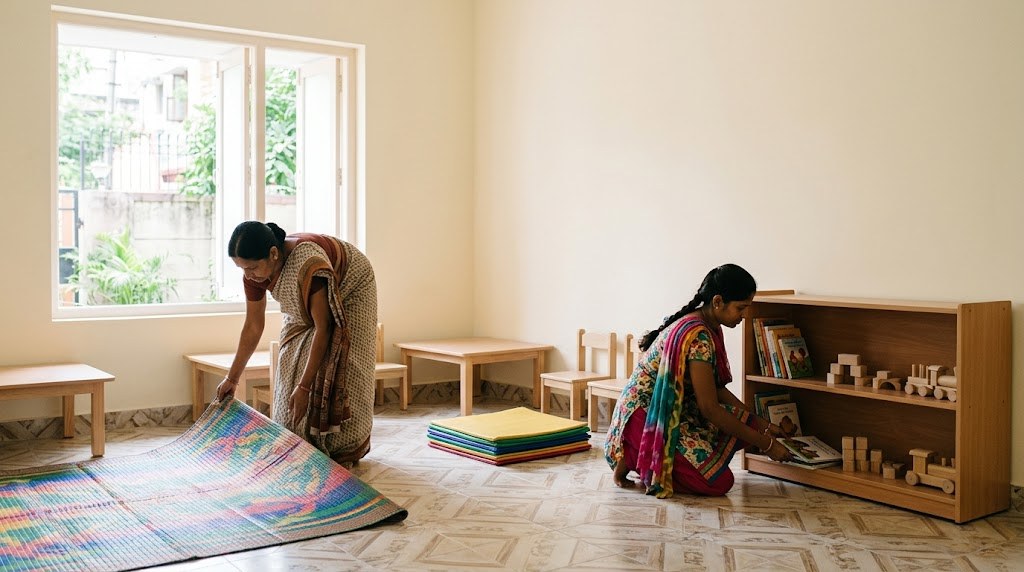
The Mission Shakti guidelines describe a Palna creche in practical terms. They are written for government creches, but they are the clearest official benchmark a private day care can show parents.
| Area | What the Palna guidelines describe |
|---|---|
| Group size | Ideally no more than 25 children in a creche |
| Distance | Near children’s homes or mothers’ workplaces, at a walkable ½ to 1 km, so mothers can breastfeed and parents can be reached in an emergency |
| Room | Safe, secure, welcoming and child-friendly; clean, well lit and ventilated; a fan where there is electricity, an inverter where supply is irregular |
| Water | Safe, regular drinking water, for example a filter or purifier cleaned regularly; storage, ideally a 300-litre tank, where water is short |
| Toilets | Child-friendly toilets, including for children with special needs, with soap, towel, bin, a low wash basin and a tap children can use by themselves |
| Handover | Laid-down safety procedures for taking and handing over each child, and for the quality of toys and materials |
Add what your state and building authority require: fire exits, window guards, covered sockets, safe storage of medicines and cleaners.
Staff: who you need and what they do
Under the Mission Shakti guidelines, a standalone Palna creche has one creche worker and one creche helper. The minimum qualification is Class XII for creche workers and Class X for helpers, with relaxation possible where no one qualified is available, but never below Class X for workers and Class VII for helpers. These are scheme rules, not rules for private centres, but they show a workable level. The ministry’s list of duties (sleep and rest, hygiene and toilet training, health check-ups with ASHA workers or the Primary Health Centre, safe food, and safe handover of each child) makes a good first job description.
Plan for cover: if the worker is ill, you cannot open safely with only a helper.
Running a day care already, and thinking about a school?
NIJIN Academy is an alternative school in Japan, opened in September 2023 and run by NIJIN Inc. Children join from home through a metaverse campus, choose from about 100 live online classes a month, and can also go to 52 physical classrooms across Japan. NIJIN is looking for one person to lead NIJIN Academy India as business head and principal. Teaching experience is not required.
See the Country Head role in IndiaDay care centre business plan: the cost lines
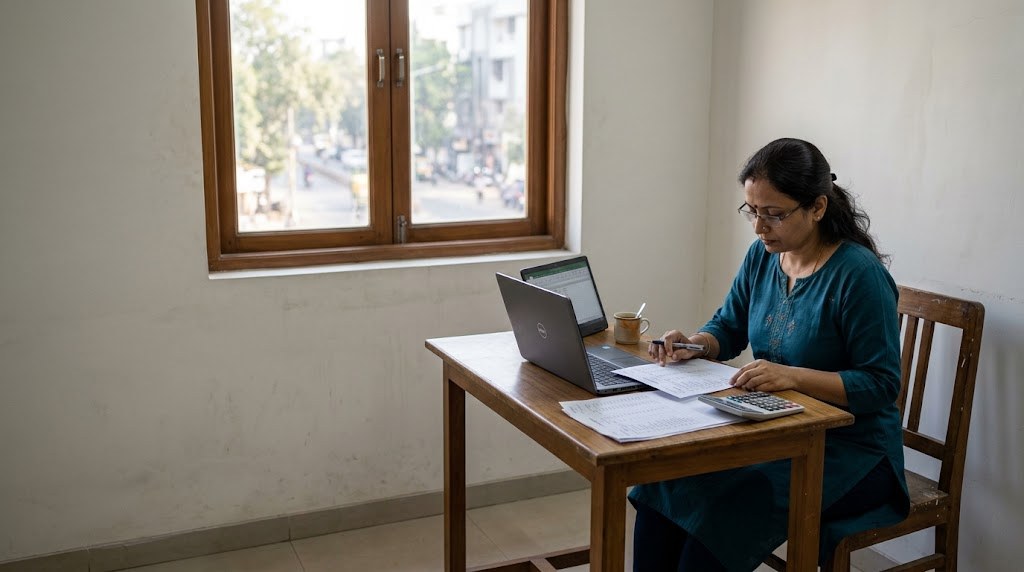
We do not publish cost figures; rent, wages and fit-out vary too much between cities for one number to be honest. The list of lines does not vary.
| Cost line | What to include | Fixed or per child |
|---|---|---|
| Premises | Rent, deposit, electricity, water, cleaning, repairs | Fixed |
| Fit-out and safety | Child-friendly toilets, low basins, mats, cots, fans, inverter, water purifier, safety guards, first-aid kit | One-off |
| Staff | Creche worker, helper, cover for leave, a cook if needed | Fixed (rises with infant places) |
| Food | Meals and snacks, cooking gas, storage | Per child |
| Health and records | Doctor tie-up for check-ups, growth records, attendance and handover log | Fixed |
| Compliance | Registrations, background checks, insurance, accounting, legal advice | Fixed |
| Materials | Toys, books, art supplies, nappies and wipes if included | Per child |
| Founder’s pay | What you need to keep going for three years | Fixed |
The break-even question. Children needed = fixed costs per month ÷ (monthly fee − per-child costs per month). Run it at 60% of your places, and run it again with more infants in the mix. If the answer is more children than your room or your staff can safely hold, change the hours, the age mix or the fee before you open.
For an employer creche, the plan is a contract: places, hours and shifts. For wider money questions, see is school a profitable business in India.
How to start a day care centre in India, in order
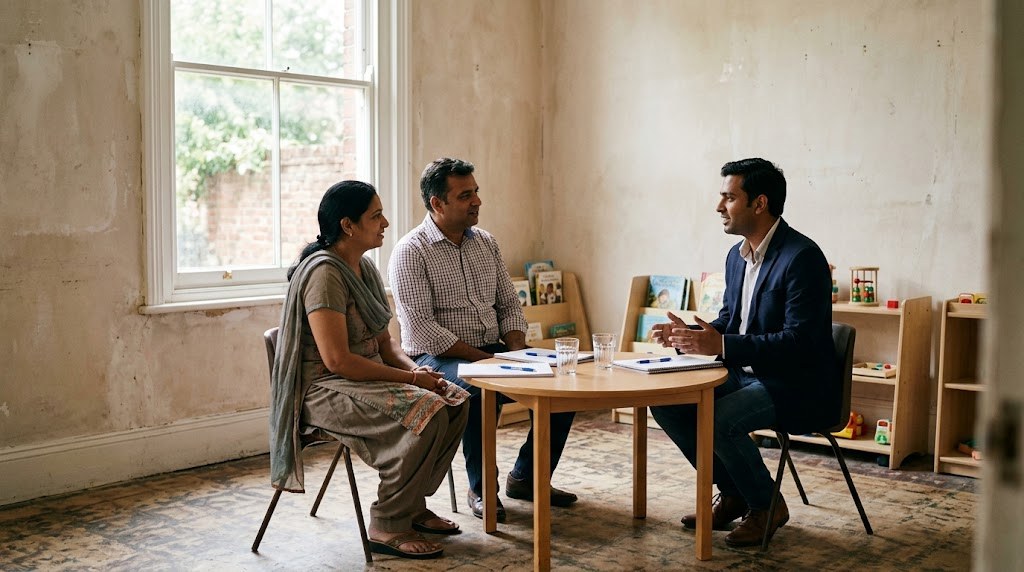
- Name the parents you serve. Shift workers at a hospital, office staff in one business district, or families in one housing colony. Their hours set yours.
- Talk to thirty families or five employers. Ask children’s ages, hours, and what they use now.
- Get the written answer from your state. Take the checklist above to the WCD department, the municipal body and, for employer creches, the labour department.
- Choose the legal form. Take advice from a chartered accountant or lawyer.
- Find the room near homes or workplaces. Check permitted use, fire safety, water and toilets before you sign. Use the Palna table as your benchmark.
- Hire and check your first two adults. One creche worker and one helper, background-checked, with first-aid training and a written child protection policy.
- Write the routine and handover rules. Meals, sleep, play, hygiene, and who may collect each child.
- Open small. Fewer children than you can take; report to parents daily in the first month.
From day care to a wider place of learning
Every day care family leaves when the child turns six. By then you have earned the trust of parents still looking for good places for their children to learn.
Palna itself joins care and early learning. Many founders add a play school, then an after-school programme, and some build a school. Each step changes the rules, so treat each as a new start. Our guides on how to start a school in India and alternative schools in India describe the next stages.
There is another group of children worth noticing. India’s National Education Policy 2020 cites an NSSO survey of 2017-18 that put the number of out-of-school children aged 6 to 17 at 3.22 crore. Some families at your gate will have an older child for whom ordinary school is not working.
NIJIN Academy is not a franchise. The Country Head of NIJIN Academy India would lead it as founder, business head and principal. You can start as a co-owner of a local company set up with NIJIN (for example, you 20%, NIJIN 80%) or on a service contract, even as a side job. Investment is optional; if you invest, the guide is JPY 1 to 2 million from you and JPY 4 to 8 million from NIJIN. As a guide, compensation is 10% of revenue excluding tax (JPY 100 million gives JPY 10 million), capped at JPY 50 million. It is not a promise of income: with no revenue, the formula pays nothing. Anyone you hand part of the role to is paid from your 10%.
NIJIN figures are those published on NIJIN’s websites. NIJIN describes the academy as one of the largest alternative schools in Japan.
Questions and answers
How to start a day care centre in India?
Decide which working parents you serve, get your state’s written answer on registration, find a safe room within walking distance, hire a trained worker and helper, and open small. The Palna norms are a sound official benchmark.
How to start a daycare at home in India?
Start with what your state and local body allow at a residential address, your housing society’s rules and your insurance. Then apply the same safety benchmark as a centre, and stay small enough for the adults present to watch every child.
Is creche registration required in India?
It depends on your state and setting. We found no single national registration for private creches on official sites. Ask your state WCD department and municipal body in writing; for workplace creches, also the state labour department.
What is the day care centre meaning? Day care centre kya hota hai?
A day care centre, or creche, cares for babies and young children during the day while their parents work. Government Palna creches take children from 6 months to 6 years.
Is the Country Head role a job or a business?
It is closer to founding a business. The Country Head leads NIJIN Academy India as business head and principal, as a co-owner of a local company or, to begin with, on a service contract. Contract type, location, timing and other terms are to be discussed in the interview.
Build a school in India, with a team behind you
If you have led and hired people and want to build a place for children who do not fit school, apply. Teaching experience is not required; English alone is enough.
See the Country Head role in IndiaWhere to go next
Related guides for founders
- How to start a preschool in India
- How to start a play school without a franchise in India
- Education business ideas in India
- Cost to start a school in India
- Education leadership jobs in India
Sources
Figures are quoted with the date they refer to. Please check the originals for later updates.
- https://static.pib.gov.in/WriteReadData/specificdocs/documents/2025/apr/doc202547535701.pdf
- https://wcd.delhi.gov.in/sites/default/files/WCD/universal-tab/palna_scheme_under_mission_shakti.pdf
- https://www.labour.gov.in/static/uploads/2025/06/1a64517bcba2fab5650a9ff66d429080.pdf
- https://www.pib.gov.in/PressReleasePage.aspx?PRID=2192463
- https://wcdhry.gov.in/play-schools/
- https://static.pib.gov.in/WriteReadData/userfiles/NEP_Final_English_0.pdf
- https://nijin.co.jp/recruit/nijin-academy-india-country-head/