
For public school teachers in the Philippines
Teacher workload in the Philippines is set by law and by DepEd: an eight-hour working day made up of six hours of actual classroom teaching and two hours of ancillary tasks, or 30 teaching hours and 10 ancillary hours a week, with any teaching beyond six hours counted as overload, capped at two hours a day and paid at least 25% extra. Those are the rules in Republic Act No. 4670 (1966) and DepEd Order No. 005, s. 2024. Since early 2024, DepEd Order No. 002, s. 2024 has also ordered that administrative tasks be taken off teachers entirely.
Below: what each part of the workload means, which tasks are allowed, how extra hours are paid, what research says about real hours, and what to do if workload is why you want a change.
In this article
- What is teacher workload in DepEd terms?
- The rules on teacher workload, year by year
- The 6-hour teaching load and the 2 ancillary hours
- Coordinator roles: the allowed list
- Administrative tasks removed from teachers
- Overload pay and vacation service credits
- What research says about actual hours
- A workload check for your own week
- When workload is the reason you want a change
- Leading NIJIN Academy Philippines
- Questions and answers
What is teacher workload in DepEd terms?
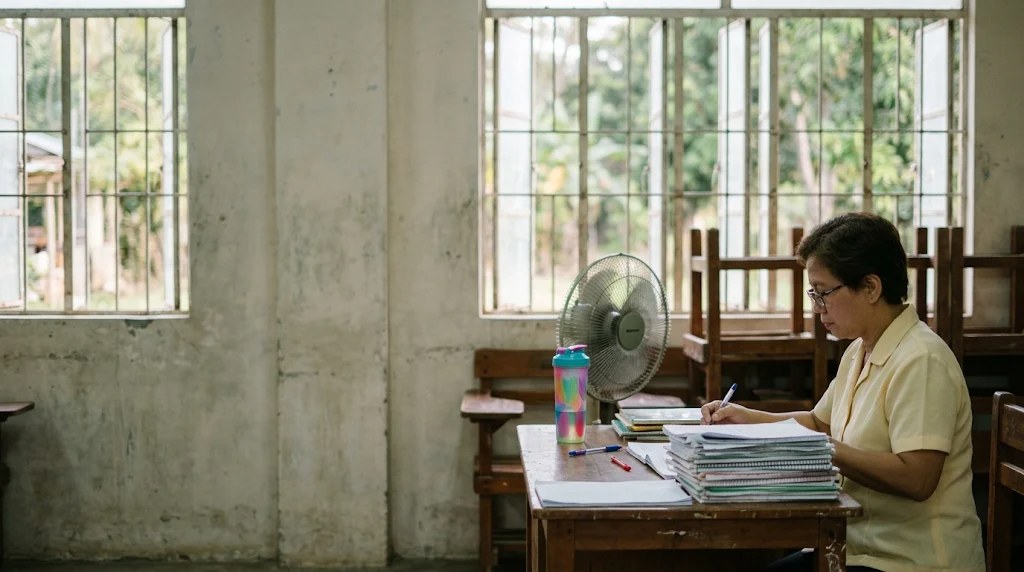
DepEd Order No. 005, s. 2024, Rationalization of Teachers’ Workload in Public Schools and Payment of Teaching Overload (29 April 2024), splits “workload” into parts that are counted and paid differently.
| Term in DO 5, s. 2024 | What it means | How it is counted |
|---|---|---|
| Teaching load | Actual classroom teaching hours or minutes | 6 hours a day, 30 hours a week |
| Teacher ancillary tasks | Work incidental to normal teaching duties, such as lesson plans, checking tests, grading and report cards | The remaining 2 hours a day, 10 hours a week, inside or outside school |
| Teaching-related assignments | Designated roles such as school coordinator, school paper adviser or grade level chair | Only from an allowed list; beyond regular hours, credited with vacation service credits |
| Teaching overload | Actual classroom teaching beyond 6 hours in a day | Not more than 2 hours a day or 10 hours a week |
| Teaching overload pay | Extra pay for teaching beyond 30 hours a week | At least 25% of regular remuneration |
| Vacation service credits (VSC) | Leave credits for authorised work beyond regular hours | 8 hours of service = at least 1.25 VSC |
The order covers full-time DepEd classroom teachers (permanent, provisional or substitute) in public elementary and secondary schools. ALS and SNED teachers follow the same work hours.
The rules on teacher workload, year by year
The six-hour rule is not new. What changed in 2024 is that DepEd wrote down, in one order, what counts; DO 5 itself says “various interpretations” of the earlier rules were common.
- 1966: Republic Act No. 4670, the Magna Carta for Public School Teachers. Section 13: no more than six hours of actual classroom teaching a day, or up to eight in exigencies of service with at least 25% extra pay. Section 14: activities outside normal duties are paid at least 25% extra.
- 2008 and 2009: CSC Resolution No. 080096, DepEd Memorandum No. 291, s. 2008, DepEd Order No. 016, s. 2009. Teachers are not exempt from the eight-hour day: six hours teaching, two for incidental tasks.
- 2024: DepEd Order No. 002, s. 2024. The Immediate Removal of Administrative Tasks of Public School Teachers.
- 29 April 2024: DepEd Order No. 005, s. 2024. Teaching load, ancillary tasks, allowed coordinator roles and overload pay defined.
- 28 May 2024: DBM press release. 5,000 non-teaching posts (Administrative Officer II, Salary Grade 11) approved for DepEd for fiscal year 2024.
The 6-hour teaching load and the 2 ancillary hours
The core of DO 5 is one sentence: a public school teacher renders eight hours of work a day, six of them in actual classroom teaching and two for teacher ancillary tasks, which may be spent inside or outside the school. Master Teachers follow the same six-and-two split.
The line most teachers have not noticed. DO 5, s. 2024 says: “No teacher shall be required to submit documentary evidence or accomplishment reports” on how the two hours of ancillary tasks are spent outside school premises.
Some duties count as teaching load even though they are not a regular lesson:
- Class advising counts as one hour a day, or five hours a week, of teaching load. The Homeroom Guidance Program time is included in those five hours.
- Remediation and enhancement classes count as teaching load.
- Programmes run inside the time already allotted to a learning area do not add teaching load.
The two ancillary hours have a defined list. These are the tasks DO 5 names:
- Curriculum planning: lesson plans or daily lesson logs, action research, Learning Action Cell (LAC) sessions
- Curriculum delivery: preparing instructional materials, checking attendance and participation, classroom management
- Assessment: checking exercises and summative tests, recording and grading performance
- Homeroom guidance: class advising, periodic attendance reports, report cards and other school forms, parent conferences and home visits when necessary
School heads must leave teachers “ample time” for preparation and correction and distribute teaching load “equitably and fairly”. A Teacher-in-Charge (TIC) counts as a school head and is relieved of teaching, except in exigencies of service.
Coordinator roles: the allowed list
Many teachers describe their workload problem as “too many coordinatorships”. DO 5 answers this with a closed list. On top of ancillary tasks, only the following teaching-related assignments may be designated to teachers, and only where the programme is in the School Improvement Plan:
| Category | Allowed assignments |
|---|---|
| School coordinator | Reading/literacy and numeracy; research; Special Needs Education; ICT; guidance and advocacy; inclusive education (where applicable) |
| Trainer or adviser | School paper; sports development programmes; Supreme Elementary or Secondary Learner Government |
| Chairmanship | Grade level; learning area |
The designation is made by an order from the school head “duly concurred by the teacher concerned”. Teachers with less than six hours of teaching load are prioritised, and every assignment must appear in the electronic School Form 7 (eSF7), the basis for later workload decisions. New programmes are folded into these categories, not added as new roles.
Administrative tasks removed from teachers (DO 2, s. 2024)
DepEd Order No. 002, s. 2024 was issued in 2024 under the title Immediate Removal of Administrative Tasks of Public School Teachers. The DBM, announcing the 5,000 new posts, described it as an order “which mandates the removal of administrative tasks from the workload of teachers”. A PIDS discussion paper from December 2025 summarises it the same way, adding that responsibility was transferred to school heads and non-teaching personnel.
The problem was documented earlier. A 2019 PIDS policy note, from focus groups and interviews in seven field sites, found teachers also ran programmes such as immunisation, deworming, feeding, census and election work, and that with little administrative staff, teachers did the administrative work.
What we could not confirm. The DepEd website, where the full text is published, could not be opened while this guide was written, so the specific tasks named in DO 2 are not listed here. Ask your Schools Division Office (SDO) for the copy it circulated.
For the staffing side of the same problem, including how many posts are still unfilled, see our guide to the teacher shortage in the Philippines.
Overload pay and vacation service credits: how extra hours are paid
DO 5 separates two kinds of extra time. Extra teaching is paid as overload. Extra non-teaching work beyond regular hours is credited as vacation service credits (VSC).
| Situation | How DO 5, s. 2024 treats it |
|---|---|
| Teaching beyond 6 hours a day | Teaching overload, at most 2 hours a day. Paid at least 25% of regular remuneration, quarterly, subject to available funds. |
| Overload when funds run short | Converted to earned VSC. |
| Who is eligible for overload pay | As a general rule, teachers in schools with a teacher shortage. Relieving duties for other teachers beyond normal hours can also count. |
| Contractual teachers funded by the Local School Board | Not eligible for overload pay, but entitled to a fair distribution of workload. |
| Parent conferences and home visits beyond regular hours | VSC. |
| Coordinator and other assignments beyond regular hours | VSC: 8 hours of service = at least 1.25 VSC. |
VSC are not paid automatically. The order sets out a paper trail:
- Ask first. Written authority from your school head: name, position, date, hours, task and justification.
- Report after. Submit an individual accomplishment report with the approved authority.
- School head to SDO. The school head approves the report and forwards it to the Schools Division Superintendent.
- Special Order. HR prepares a Special Order listing eligible teachers and earned VSC, approved by the SDS.
- Leave card. VSC is recorded on your leave card, offsets absences, and may be converted to leave credits for monetisation, subject to funds.
Good at organising time, people and systems? There is a bigger version of that job.
NIJIN, an education company in Japan, is looking for one person to start and lead NIJIN Academy Philippines as business head and principal. Teaching experience is not required, and you can start on a service contract alongside your current work.
See the Country Head role in the PhilippinesWhat research says about actual hours
Rules describe the intended week. Two public research papers from the Philippine Institute for Development Studies (PIDS), the government’s policy think tank, describe the real one.
Source: PIDS Discussion Paper No. 2025-55 (December 2025), “The Impact of Curriculum Reform on Teacher Workload: A Multidimensional Time-Use Analysis”. Teachers recorded their activities every twenty minutes over one full day. The ranges are the group averages in the paper’s Table 1, for teachers in pilot and non-pilot schools of the revised K to 10 curriculum. PIDS discussion papers are preliminary and unreviewed.
On the recorded day, the average teacher in every group worked roughly ten to eleven hours, not eight. Teachers of pilot grades spent about 96 fewer minutes on class activities, but moved part of that time to preparation and other duties, so total work time fell only modestly. Many continued lesson preparation and administrative tasks at home.
The 2019 PIDS note adds something numbers miss: teachers interviewed did not name salary as the problem. Their main restriction was time with students.
A workload check for your own week
Compare your real week with the rules. These questions come straight from DO 5, s. 2024; raise them with your school head as questions about the order, not complaints.
- Is my actual classroom teaching 30 hours a week or less? If more, is the extra recorded weekly as overload?
- Is my class advising counted as five hours a week of teaching load?
- Am I asked to prove how I spend ancillary time outside school? (The order says no teacher shall be required to.)
- Is every coordinator role I hold on the allowed list, in a designation order I agreed to, and in eSF7?
- Do I still do work that looks administrative rather than ancillary, such as property custody, personnel files or finance records? Ask the SDO how DO 2, s. 2024 is applied in my school.
- When I work beyond eight hours on an assignment, do I ask for written authority first, so the time can be credited as VSC?
When workload is the reason you want a change
Sometimes the rules fix the problem once applied. Sometimes they do not. Each path below changes a different part of the workload; the detail is in the linked guides.
| Path | What it changes | What to read |
|---|---|---|
| Stay and use DO 5 | Overload recorded, roles limited to the allowed list, VSC claimed | This guide |
| Move up to Master Teacher | Same six-and-two split, plus coaching and mentoring colleagues | How to become a Master Teacher |
| Teach as a side job, with a permit | Adds income, but adds hours outside the eight-hour day | Side hustle for teachers |
| Teach online | Changes where and when you work | Online teaching jobs in the Philippines |
| Move to a private school | Different employer rules; DO 5 covers public schools | Private school teacher salary |
| Leave DepEd | Ends the workload; leaves the paperwork of resigning | DepEd teacher resignation |
| Lead a school, part-time at first | You design the week: for children, for teachers, for yourself | Next section |
If the tiredness has gone beyond the workload itself, our guide to teacher burnout may help. If your health is affected, please also speak with a doctor.
Leading NIJIN Academy Philippines
NIJIN Academy is an alternative school in Japan, opened in September 2023, for elementary and junior high school students who do not fit conventional school. Children attend from home through a metaverse campus, choose from about 100 small, interactive live online classes a month, and can also go to physical classrooms.
Figures are those published by NIJIN. “Attendance recognition” means the child’s registered school counts learning at NIJIN Academy as school attendance.
For a teacher who knows what an unworkable week feels like, the Country Head job is partly this: designing a school where children get adult time, and the team’s hours are planned, not piled on.
- Teaching experience is not required. Leadership, management, business ability and a principal’s skills matter; managing and hiring a team carries over directly.
- You can start on a service contract, even as a side job alongside your current work, and decide later whether to become a co-owner. If you are a DepEd teacher, the rules on outside work and permits apply to you; check them first.
- Investment is optional. You can also set up a local company together as a shareholder (20% for you and 80% for NIJIN is the example given). Article XIV, Section 4(2) of the 1987 Constitution generally requires schools to be owned by Filipino citizens or corporations at least 60% Filipino-owned, so the actual structure is decided in the interview and with legal professionals.
- Compensation, as a guide, is 10% of revenue (excluding tax), up to JPY 50 million, the same whichever way you start. It is not a promise of income: with no revenue, the formula pays nothing. Other terms are to be discussed in the interview.
English alone is enough to apply.
Questions and answers
What is teacher workload?
The total work expected of a teacher. For DepEd teachers, DO 5, s. 2024 divides it into teaching load, ancillary tasks (planning, checking, grading, forms, advising) and a limited list of teaching-related assignments such as coordinator roles.
What is the DepEd teacher workload in hours?
Eight hours a day: six hours of actual classroom teaching and two hours of ancillary tasks. That is 30 teaching hours and 10 ancillary hours a week. Teaching beyond six hours is overload, capped at two hours a day or ten a week.
Is the 6 hours teaching load a maximum or a minimum?
Both, in a sense. RA 4670 says no teacher shall be required to teach more than six hours a day, except up to eight in exigencies of service with extra pay. DO 5 says teachers must complete the six hours before being given overload.
Are DepEd teachers paid for overtime?
Extra teaching is paid as teaching overload, at least 25% of regular remuneration, quarterly and subject to funds; if funds are insufficient, it becomes vacation service credits. Extra non-teaching work beyond regular hours, with prior written authority, earns VSC: at least 1.25 credits for every eight hours.
What administrative tasks were removed from DepEd teachers?
DepEd Order No. 002, s. 2024 ordered their immediate removal, moving the work to school heads and non-teaching staff; the DBM approved 5,000 Administrative Officer II posts in 2024. For the exact task list, ask your SDO for its copy of the order.
Is the Country Head a job or a business?
Closer to running a business. You lead NIJIN Academy Philippines as business head and principal; compensation, as a guide, is 10% of revenue up to JPY 50 million, with no guaranteed income. You can start on a service contract alongside your current work.
Build a school where the week works, for children and for teachers
NIJIN is looking for one founder to start and lead NIJIN Academy Philippines. Teaching experience is not required, investment is optional, and you can begin on a service contract while you keep your current work.
Where to go next
- MATATAG curriculum: meaning, changes and rollout
- Philippines Country Head
- Country Head (global)
- NIJIN careers in English
Related guides
- Teacher shortage in the Philippines: numbers, causes and paths
- Side hustle for teachers in the Philippines: DepEd rules
- How to become a Master Teacher in DepEd
- DepEd teacher resignation: requirements and steps
- Online teaching jobs in the Philippines
- How to start a learning center in the Philippines
Sources
Figures are quoted with the year they refer to. DepEd’s own website could not be opened while this guide was written; DO 5, s. 2024 was read in the copy circulated by the Schools Division Office of Muntinlupa City. Please check the originals for later updates.
- https://deped-muntinlupa.com/wp-content/uploads/2024/04/NUM-2024-138.pdf
- https://lawphil.net/statutes/repacts/ra1966/ra_4670_1966.html
- https://region8.deped.gov.ph/2024/03/14/march-11-2024-rm-278-s-2024-dissemination-of-advocacy-materials-on-the-implementation-of-deped-order-no-002-s-2024-or-the-immediate-removal-of-administrative-tasks-of-public-school-teachers/
- https://www.dbm.gov.ph/index.php/management-2/2811-promise-fulfilled-helping-our-beloved-teachers-dbm-approves-the-creation-of-5-000-deped-non-teaching-positions
- https://pidswebs.pids.gov.ph/CDN/document/pidsdps2555.pdf
- https://pidswebs.pids.gov.ph/CDN/PUBLICATIONS/pidspn1901.pdf
- https://lawphil.net/consti/cons1987.html
- https://nijin.co.jp/recruit/nijin-academy-philippines-country-head/
- https://academy.nijin.co.jp/