For education founders in the Philippines
To start a learning center in the Philippines, first decide whether you are opening a tutorial center that helps children who are enrolled in a school, or a place that teaches in place of school: the first is generally set up as a business (DTI or SEC, barangay clearance, mayor’s permit, BIR), while the second needs authority from the Department of Education (DepEd), whose rules name “learning centers” among the institutions its Regional Directors approve. Everything else in this guide follows from that one decision.
This guide covers the line between a tutorial business and a school, the registrations in order, what to check before you sign a lease, and how a center can support homeschooled and out-of-school children. It is not legal or tax advice. Rules differ by region and city, so confirm each point in writing with the office named.
In this article
- Tutorial center, learning center or school?
- Why the word “learning center” matters to DepEd
- How to register a tutorial center business, step by step
- Choosing your business form
- Tutorial center requirements in the Philippines: a checklist before you open
- What to budget for
- Serving homeschooled and out-of-school children
- Starting alone, with a franchise, or inside a network
- Questions and answers
Tutorial center, learning center or school?
In everyday use, “tutorial center”, “learning center” and “review center” often mean the same thing: a small business where children come after school for help with lessons or exams. The law looks less at your sign than at what you do. Find your row first.
| What you want to open | What it does | First office to ask |
|---|---|---|
| Tutorial or homework center | Supports children who are enrolled in a school; does not give grades, credits or diplomas | Your city or municipal Business Permits and Licensing Office (BPLO), plus DTI or SEC and BIR |
| Learning center that teaches in place of school | Children learn the basic education curriculum there instead of at a school | The Schools Division Office (SDO), then the DepEd Regional Office |
| Support center for homeschoolers | Gives study space, sessions or coaching to children in a homeschooling program run by a school | The school that holds the homeschooling permit, and your SDO |
| Skills or technical-vocational training center | Teaches job skills under a TESDA training regulation | TESDA, which requires program registration before a program is offered |
| Center for very young children (0 to 4) | Care and early learning before Kindergarten age | Your city or municipal hall and the Early Childhood Care and Development (ECCD) Council |
This table names offices only, not what the law requires for your case. If your plan sits between two rows, ask both offices in writing.
Why the word “learning center” matters to DepEd
Do not assume a learning center is always “just a business”. DepEd’s 2010 Revised Manual of Regulations for Private Schools in Basic Education (DepEd Order No. 88, s. 2010), as quoted in a DepEd Region VII memorandum, says in Section 28 that the Regional Director has the authority to approve “the establishment of private pre-school, elementary, and high schools and learning centers.” In DepEd’s vocabulary, a learning center can need government authority.
Behind the Manual is the Education Act of 1982 (Batas Pambansa Blg. 232). Section 27 makes the educational operations of schools subject to prior authorization of the government. Section 28 says that recognition entitles a school to give a certificate, title or diploma, and declares the operation of schools and educational programs without authorization a punishable violation.
A practical rule. If your center supports children enrolled elsewhere, say so on your forms and website, and do not promise grades, credits or a diploma. If you want to teach children in place of school, you are planning a school, and the DepEd permit process applies. It is covered in our guide on how to start a school in the Philippines.
Before you register a business name, write one paragraph on what children will do at your center and ask your Schools Division Office, in writing, whether DepEd authority is needed.
How to register a tutorial center business, step by step
For a tutorial center run as a business, the order below follows the national laws and agency pages in the sources. Ask your BPLO for its current local checklist.
- Write down what the center does. Ages, subjects, hours, and a clear statement that you do not award grades or credits. You will reuse it with every office.
- Register the business name or the company. If you trade under a name other than your own true name, register it with the Department of Trade and Industry (DTI) through its online Business Name Registration System. Registration is valid for five years, with fees set by the territory you choose, from barangay to national. A partnership or corporation registers with the Securities and Exchange Commission (SEC) instead.
- Get a barangay clearance. The Local Government Code (Republic Act No. 7160, Section 152) says no city or municipality may issue a business permit unless a clearance is first obtained from the barangay where the business is located.
- Apply for the mayor’s permit (business permit). Under the Ease of Doing Business Act (Republic Act No. 11032), cities use a unified business application form and a Business One Stop Shop (BOSS) that gathers zoning, building, sanitary and fire safety clearances. The law sets maximum processing times of three working days for simple transactions and seven for complex ones.
- Register with the BIR. The tax code, as amended by the Ease of Paying Taxes Act (Republic Act No. 11976), requires registration with the appropriate Revenue District Office (RDO), electronically or manually, on or before the commencement of business. Ask your RDO which forms and books apply.
- Complete what applies when you hire. Employer registrations and payroll duties depend on how you engage tutors. Ask an accountant before your first payday.
- Renew and keep records. Note every renewal date (the DTI name expires after five years) and keep receipts and enrolment records from day one.
Choosing your business form
The form you choose decides where you register first and who carries the risk. Confirm your choice with an accountant or lawyer.
| Form | Where you register | Worth knowing |
|---|---|---|
| Sole proprietorship | DTI business name (if you trade under a name other than your own) | One owner. Ask an accountant how liability and tax work for you. |
| Partnership | SEC | Useful when two or three co-founders share the work and the money. Put the agreement in writing. |
| Corporation, including a One Person Corporation | SEC | Under the Revised Corporation Code (Republic Act No. 11232), up to 15 incorporators may organize a corporation for any lawful purpose, and a single natural person may form a One Person Corporation. |
For a school rather than a tutorial business, the Revised Corporation Code says educational corporations are governed by special laws. Ask the SEC and DepEd before you incorporate.
Tutorial center requirements in the Philippines: a checklist before you open
Permits are the easy part. These are the questions that close small centers in their first year. Tick each one before you sign a lease or take a deposit.
- Do I have a written answer from my Schools Division Office on whether my activity needs DepEd authority?
- Is a tutorial center a permitted use at this address under the city’s zoning? Ask the zoning office before you pay rent.
- Can the space pass the Bureau of Fire Protection’s fire safety inspection?
- Do my forms, receipts and ads say clearly that we support learning and do not award grades, credits or diplomas?
- Who will teach, and do they need a licence? (See the FAQ below.)
- How will I protect the personal information I collect from families, under the Data Privacy Act of 2012 (Republic Act No. 10173)?
- What is my child-safety routine: who may pick a child up, and how are incidents recorded?
- If I teach job skills or very young children, have I asked TESDA or the ECCD Council and my city hall which rules apply?
- Is the business insured for children on the premises?
- Do I know my break-even number (below)?
What to budget for
No single cost figure is honest, because rent and pay differ by city. The structure does not. Fill in this table with real local quotes before you set a fee.
| Line | What to include | Fixed or per student |
|---|---|---|
| Registration and advice | DTI or SEC, barangay, mayor’s permit, BIR, renewals, bookkeeping | Fixed |
| Space | Rent, deposit, utilities, cleaning, minor fit-out to pass inspection | Fixed |
| Tutors | Pay, employer contributions, training, cover when someone is ill | Fixed or per session |
| Materials and devices | Workbooks, printing, tablets or laptops, software licences | Per student |
| Your own pay | What you need to keep going for at least two years | Fixed |
The break-even number. Students needed = fixed costs per month ÷ (monthly fee per student − cost per student per month). If the answer is more than your room holds, add a second shift or change the fee. Then test it at 60% of your expected enrolment.
Serving homeschooled and out-of-school children
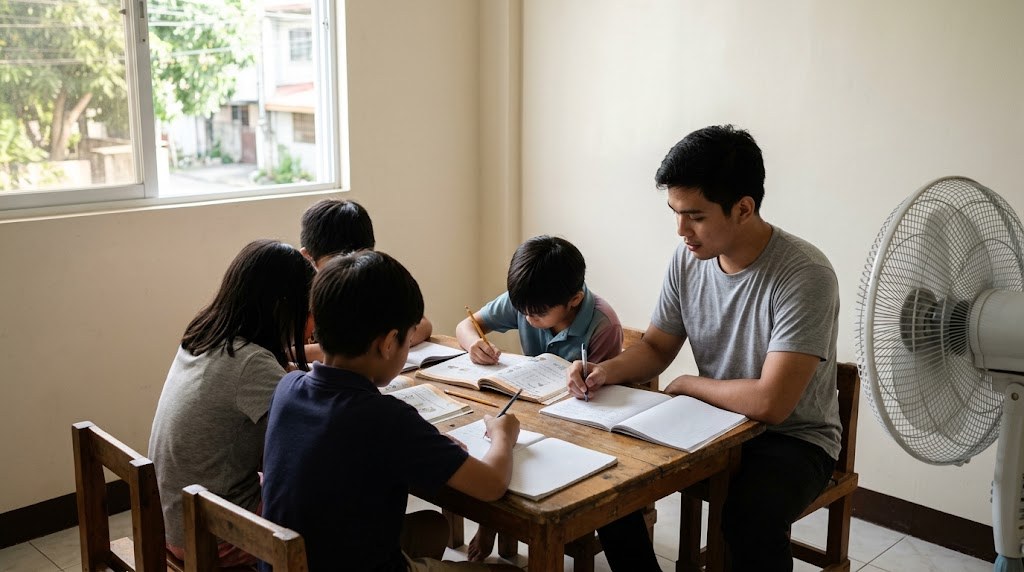
A growing reason to open a learning center is not exam prep but children for whom school is not working. The World Bank’s learning poverty brief for the Philippines reports that 91 percent of children at late primary age are not proficient in reading, adjusted for out-of-school children, on the latest data from before the pandemic school closures.
Philippine policy names two routes for children outside the regular classroom. A center can support both without pretending to be either.
Homeschooling
Under DepEd Order No. 001, s. 2022, the Homeschooling Program is an alternative delivery mode offered by public and private schools, with parents or guardians as the primary agents of teaching. DepEd NCR lists schools holding a homeschooling permit. The child is enrolled with the school; your center can offer study space and small-group sessions.
Alternative Learning System (ALS)
The ALS Act (Republic Act No. 11510) calls ALS a parallel learning system. It defines Community Learning Centers as venues for face-to-face learning, recognises Learning Facilitators financed by the private sector, and provides for recognition of service providers. Ask your SDO’s ALS staff how to take part.
In both cases, agree in writing who keeps the child’s official records, and keep attendance notes a school can read.
Want to build a learning place for children who do not fit school?
NIJIN Academy, run by NIJIN Inc. since September 2023, is an alternative school in Japan for children who do not fit conventional school. Children join from home through a metaverse campus, choose from about 100 live online classes a month, and can also go to 52 physical classrooms across Japan. NIJIN is looking for one person to start and lead NIJIN Academy Philippines as its business head and principal. Teaching experience is not required; English alone is enough to apply.
See the Country Head role in the PhilippinesStarting alone, with a franchise, or inside a network
The registration steps above apply to all three routes.
| On your own | Tutorial center franchise | NIJIN Academy Philippines | |
|---|---|---|---|
| Program | You design it | You follow the franchisor’s format | You start from a model run with more than 1,000 children in Japan and decide what fits the Philippines |
| How you start | Your own money and time | Set by each franchise contract | Either as a co-owner of a local company set up together (for example, you 20%, NIJIN 80%) or on a service contract, even as a side job. Investment is optional |
| How you are paid | What the center can sustain | What remains after the franchise fees | As a guideline, 10% of revenue excluding tax, capped at JPY 50 million. Not a promise of income: with no revenue, the formula pays nothing |
| Best fit | You have your own method and time to test it | You want a ready format and accept its limits | You want to found and lead an organisation, and you are strongest at leading and hiring people |
The franchise column describes franchising in general, not any brand. NIJIN Academy is not a franchise. If you invest, the guideline is JPY 1 to 2 million from you and JPY 4 to 8 million from NIJIN, decided together. Amounts are in Japanese yen only. Contract type, location and every other term are discussed in the interview.
Figures are those published by NIJIN. “Attendance recognition” means the school a child is registered at in Japan counts learning at NIJIN Academy as attendance.
Questions and answers
Do I need a DepEd permit to open a tutorial center?
It depends on what the center does. Supporting children enrolled in a school is generally run as a business. DepEd’s manual names “learning centers” among the institutions its Regional Directors approve, so if you teach in place of school or promise credits, ask your Schools Division Office in writing first.
How to open a tutorial center in the Philippines?
Five steps: write down what the center does, register the business name with DTI (or the company with SEC), get a barangay clearance, apply for the mayor’s permit through your city’s Business One Stop Shop, and register with the BIR before you open. If you will teach in place of school or promise credits, ask your Schools Division Office in writing first. The step-by-step section above has the law behind each step.
What are the learning center requirements in the Philippines?
For a tutorial business: DTI or SEC registration, a barangay clearance, a mayor’s permit through your city’s Business One Stop Shop, and BIR registration on or before you start. Cities add zoning, sanitary and fire safety clearances. See the checklist above.
How long does it take to get a business permit for a tutorial center?
Once your application is complete, the Ease of Doing Business Act sets maximum processing times of three working days for simple transactions and seven for complex ones.
Do tutors need a PRC licence?
The Teachers Professionalization Act (Republic Act No. 7836) defines teaching as classroom instruction at the elementary and secondary levels under the DepEd curriculum, in private or public schools. Whether your tutors’ work falls under it depends on what they do. Ask the Professional Regulation Commission if you are unsure.
Can a learning center help homeschooled or ALS learners?
Yes, as a support. Homeschooled children in DepEd’s program are enrolled with a school that offers it, and ALS is run by DepEd with the private sector. Agree in writing who keeps official records.
Is the Country Head role a job or a business?
It is closer to founding a business. If you have searched for country manager jobs in the Philippines, note the difference: you lead NIJIN Academy Philippines as its business head and principal, either as a co-owner of a local company or on a service contract, and your compensation guideline is 10% of revenue, not a fixed salary.
Start a learning place for children who do not fit school
NIJIN is looking for one founder in the Philippines to start and lead NIJIN Academy Philippines. Teaching experience is not required. If you want to start a company in your own country and solve a problem in education, read the role.
See the Country Head role in the PhilippinesWhere to go next
For permits, start with your city or municipal BPLO and your Schools Division Office. NIJIN Academy Country Head pages are open for several countries, and the global page covers every other country.
- Country Head: Philippines
- Country Head (global)
- India
- United States
- United Kingdom
- NIJIN careers in English
Related guides for founders
- How to start a school in the Philippines: the DepEd permit guide
- How to start a microschool
- How to start an education business
- Homeschooling vs online school vs alternative school
- Out-of-school children: causes and solutions
- Microschool franchise: cost, contracts and alternatives
- How to be a homeschool provider in the Philippines
- How to become a school principal in the Philippines
- How to start a school without money: what is possible
Sources
Laws are quoted from the texts linked below. DepEd’s manual is quoted as reproduced in a DepEd regional memorandum. Check each office for later changes.
- DepEd Region VII Regional Memorandum No. 475, s. 2016, quoting Sections 28 and 29 of DepEd Order No. 88, s. 2010
- Education Act of 1982 (Batas Pambansa Blg. 232)
- DTI Business Name Registration System
- DTI Business Name Registration System, FAQ
- Local Government Code of 1991 (Republic Act No. 7160), Section 152
- Ease of Doing Business and Efficient Government Service Delivery Act (Republic Act No. 11032)
- Ease of Paying Taxes Act (Republic Act No. 11976), amending Section 236 of the tax code
- Revised Corporation Code (Republic Act No. 11232)
- Philippine Teachers Professionalization Act of 1994 (Republic Act No. 7836)
- Data Privacy Act of 2012 (Republic Act No. 10173)
- Early Years Act of 2013 (Republic Act No. 10410)
- TESDA, Program Registration and Accreditation (UTPRAS)
- Alternative Learning System Act (Republic Act No. 11510)
- DepEd NCR, schools with homeschooling permit
- World Bank, learning poverty brief for the Philippines
- NIJIN, Country Head role in the Philippines (NIJIN figures and role terms; DepEd Order No. 001, s. 2022 as summarised there)