For education founders in India
The strongest education business ideas in India start from a gap the country has already measured: children who have not learned to read and count, children who have left school, children taught in a language they do not speak at home, schools with too few teachers, and teenagers with no route to a skill. Pick one of those gaps, then choose the format your state allows you to run. The table below compares ten ideas on exactly that basis.
This guide starts from what the National Education Policy 2020, UNESCO and UNICEF say is missing, shows which education related business ideas in India answer each gap, and says which ones need a licence or a recognised legal body.
In this article
- The gaps that make an education business worth starting
- 10 education business ideas in India, compared
- Which ideas need a licence, and which do not
- School business ideas in India: the full-time route
- How to choose and start, in six steps
- Start alone, buy a franchise, or co-found
- Questions and answers
The gaps that make an education business worth starting
Figures are quoted with the year they refer to, from the National Education Policy 2020 published by the Government of India. Newer counts may differ.
Learning. NEP 2020 calls this a learning crisis. The government’s NIPUN Bharat mission, launched in July 2021, set the goal that every child reaches foundational literacy and numeracy by the end of Grade 3, by 2026–27.
Staying in school. NEP 2020 shows enrolment falling to 79.3% in Classes 9–10 and 56.5% in Classes 11–12. It asks for “alternative and innovative education centres” with civil society, and for open and distance learning through NIOS and the State Open Schools to be expanded.
Language. UNESCO’s State of the Education Report for India 2025 reports a language mapping of Grade 1 learners in Rajasthan in which over 72% of Grade 1 learners had limited proficiency in Hindi, the language of instruction, while 42% of their teachers reported fluency in the children’s home languages.
Teachers. NEP 2020 notes that teachers in small schools often teach several grades at once, and that vacancies must be filled “in a time-bound manner”. UNESCO’s 2021 report on India’s teachers, No Teacher, No Class, profiles a workforce of nearly 9.7 million.
The early years. UNICEF India, citing a government survey from 2013–14, reports that about 20 million children were not attending pre-school, and that around half of adolescents do not complete secondary education.
10 education business ideas in India, compared
Each idea answers one gap above. The permission column is a starting point for your questions, not legal advice: rules are made largely by states, and they change.
| Idea | Gap it answers | Permission to check | How to start small |
|---|---|---|---|
| 1. Foundational reading and maths centre (Classes 1–5) | Over 5 crore children without basic literacy and numeracy | Usually no school recognition; check your state’s coaching and tuition rules and local trade licence | One room after school, 20 children, a reading level test on day one and every month |
| 2. Mother-tongue bridge classes and reading materials | Children taught in a language they do not speak at home | None to publish; working inside government schools needs state or district permission | Graded readers in one local language, piloted with one school or NGO |
| 3. Re-entry programme for out-of-school children | 3.22 crore out-of-school children aged 6 to 17 | Often run with the state; a trust, society or not-for-profit company is the usual partner form | Survey one ward or block, enrol the first batch, track who returns to school |
| 4. Study support centre for open-school learners | Drop-off after Class 8 and 10; NEP’s push for NIOS and State Open Schools | Ask NIOS or your State Open School how official study centres are approved; tutoring alone is a different activity | Evening batches for Class 10 and 12 open-school learners, with exam calendars managed for them |
| 5. Live remote classes for small and single-teacher schools | Multigrade classrooms and teacher shortages | A contract with the school, trust or state; data rules for children | One subject, one grade, ten schools, a fixed weekly timetable |
| 6. Teacher coaching and in-school training | Teachers handling several grades and subjects | Short workshops: usually none; courses that award a teaching qualification are regulated separately | Sell a term-long coaching cycle to a private school group |
| 7. Play school or early-years centre | About 20 million children not in pre-school (2013–14) | State rules for pre-schools, building safety, child protection | Two rooms, ages 3 to 6, a parent-visible daily routine |
| 8. Vocational and skills courses for Classes 9–12 | NEP target that at least 50% of learners get vocational exposure | None for informal courses; certification through government schemes has its own rules | Weekend courses run with one school or industry partner |
| 9. Exam coaching for senior students | Demand for competitive exam preparation | Registration under the 2024 central guidelines and state coaching laws; advertising rules | Only if you accept heavy regulation; small batches and full fee transparency |
| 10. Alternative school or microschool (full-time) | Children who do not fit standard school | Generally state recognition as a school; board affiliation has its own conditions; or an open-school route | Start part-time, prove the model, then decide on the legal route |
This table names questions to ask. It does not state what the law requires in your state. Confirm every licence in writing with your state education department or a lawyer.
Which ideas need a licence, and which do not
The single biggest difference between these ideas is how close they come to being a “school” or a “coaching centre” in law.
Coaching and tuition
The Ministry of Education circulated Guidelines for Regulation of Coaching Center to States and Union Territories on 16 January 2024. According to the Ministry’s Rajya Sabha reply of August 2026, they cover registration, fees, infrastructure, a code of conduct, mental well-being and grievance redressal, and expect centres to publish tutor qualifications, fees and refund policy on a website. Since then, states including Rajasthan, Haryana, Assam, Andhra Pradesh, Himachal Pradesh and Tamil Nadu have brought in their own laws, rules or guidelines. Separately, the Central Consumer Protection Authority issued guidelines in November 2024 against misleading advertisements in the coaching sector.
If you plan a learning centre for young children, ask your state whether its coaching rules apply to you. Do not assume a small centre is exempt.
Not-for-profit structures
Ideas 3 to 5 often work best with government schools or funders. NEP 2020 says all education institutions will be held to the same standards of audit and disclosure as a not-for-profit entity, with any surplus reinvested in education. Which legal form suits you is a question for a lawyer and a chartered accountant.
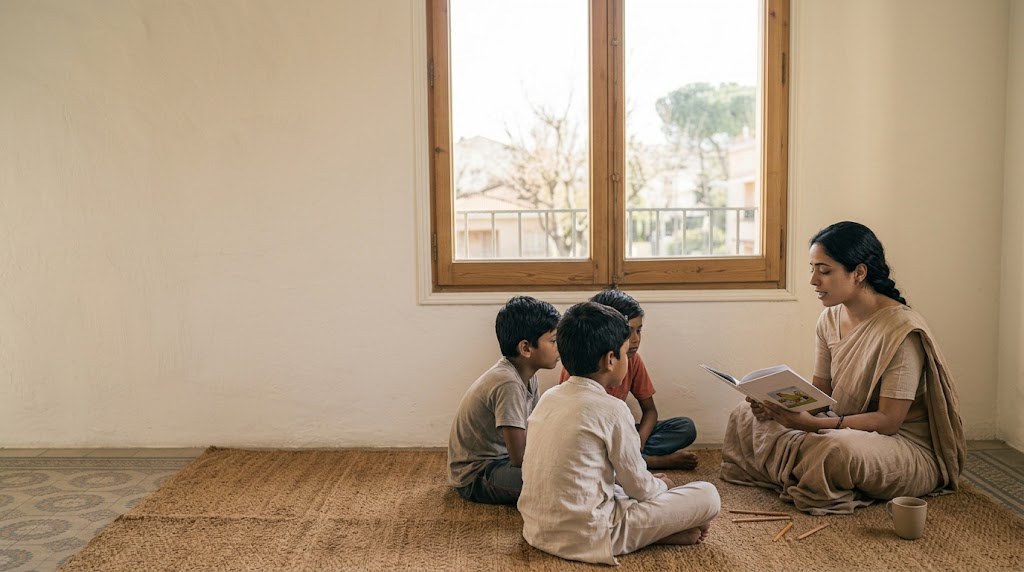
Want to build an education business that answers these gaps?
NIJIN Academy is an alternative school in Japan for children who do not fit conventional school, opened in September 2023 by NIJIN Inc. Children join from home through a metaverse campus, choose from about 100 live online classes a month, and can also go to 52 physical classrooms across Japan. More than 1,000 children have enrolled since it opened. NIJIN is looking for one founder to start and lead NIJIN Academy India as its business head and its principal. Teaching experience is not required.
See the Country Head role in IndiaSchool business ideas in India: the full-time route
A full-time school is the hardest education business to start in India, and the most regulated. A private school generally needs recognition from the state education authority before it opens, and has to meet the norms that apply in that state for land, buildings, teachers and classrooms. These differ from state to state. Start with the Ministry of Education’s RTE pages and your state’s education department.
Board affiliation adds its own conditions. CBSE’s Affiliation Bye-Laws, 2018 require the body running the school to be a registered society, a registered trust or a company under section 8 of the Companies Act, 2013, with a non-proprietary character, so that control does not sit with a single individual or one family. The same bye-laws say the school must be run “as a community service and not as a business”, with its funds spent for the school and for education.
So many founders begin with a part-time centre, a hybrid online model or open-school study support instead. NEP 2020 says requirements for schools will be made less restrictive to allow alternative models of education. For the cost side, see our guide on the cost to start a school in India.
Questions to take to your state education department, in writing
- At what hours, ages or numbers does our setting count as a school, or as a coaching centre?
- Which registration, if any, applies to us, and which documents does it need?
- Which legal form may run this kind of setting here?
- Can children learning with us stay enrolled at their own school, or study through NIOS or the State Open School?
- Which building, fire and child-protection rules apply to this address?
How to choose and start, in six steps
- Choose one gap and one group of children. “Class 3 children in our ward who cannot read a short paragraph” is a business. “Better education” is not.
- Talk to 30 families and 5 teachers. Ask what they have tried and what success would look like.
- Get the rules in writing. Take the questions above to your state education department before you sign a lease.
- Run a six-week pilot. Measure learning at the start and the end.
- Do the break-even arithmetic. Fixed monthly costs divided by what each child pays after per-child costs. If the number is above what your room or team can serve, change the model.
- Choose your legal form and partners. A company, a trust, a society or a section 8 company; alone or with an established model. Decide this with professional advice.
Start alone, buy a franchise, or co-found

| Start alone | Education franchise | Co-found with an existing model | |
|---|---|---|---|
| What you get | Full control and every task | A brand and a format to copy | A tested programme and people to work it out with |
| What you pay | All set-up costs | Usually a fee to join and ongoing payments | Depends on the agreement |
| Who adapts it to India | You | Mostly fixed by the franchisor | You, with the partner |
| Fits you if | You want to design the model yourself | You want a ready format | You lead and hire well, and want backing |
NIJIN Academy India is the third kind, and it is not a franchise. The Country Head leads it as founder, business head and principal. You can start as a co-owner of a local company set up with NIJIN (for example, 20% of the shares for you and 80% for NIJIN), or on a service contract, even as a side job alongside your current work. Investment is optional. If you choose to invest, the guide is JPY 1 to 2 million from you and JPY 4 to 8 million from NIJIN, decided together.
As a guide, compensation is 10% of revenue excluding tax, capped at JPY 50 million: JPY 100 million of revenue gives JPY 10 million, and JPY 200 million gives JPY 20 million. This is not a forecast or a promise of income; with no revenue, the formula pays nothing. If you hand part of the role to someone else, they are paid from your 10%. Every other term is discussed in the interview. See country manager in education: three pay models.
Questions and answers
What is the best education business idea in India for a beginner?
One that needs no school recognition and can be tested in six weeks, such as a foundational reading and maths centre or teacher coaching for one school. Check your state’s coaching rules first.
Which education startup ideas in India need the least money?
Ideas that use a borrowed room or existing schools: bridge classes, teacher coaching, reading materials, remote live classes for small schools. Full-time schools and play schools need premises that meet state norms, so they need the most capital.
Can an education business in India make a profit?
Tutoring, coaching and training are not bound by the school rules in this guide, though coaching has its own rules. Schools are different: NEP 2020 holds education institutions to not-for-profit standards of audit and disclosure, and CBSE’s bye-laws require affiliated schools to be run as a community service. See is school a profitable business in India?
Is an education franchise business opportunity in India a safer start?
It gives you a format, but you pay to join and usually cannot change much. See the table above and our guide to education franchises in India.
Are there country manager jobs in India’s education sector, or is this a business?
The NIJIN Academy India Country Head role is closer to founding a business than to a salaried country manager job. You lead the company and the school, and compensation is, as a guide, 10% of revenue rather than a fixed salary. You can start on a service contract, so you do not have to leave your current job on day one.
Do I need a teaching degree to start an education business in India?
Not to start a business. Some activities need qualified staff, for example schools, and the 2024 central guidelines expect coaching centres to publish their tutors’ qualifications. NIJIN does not require teaching experience for the Country Head role; experience of managing an organisation and hiring people matters more.
Build NIJIN Academy India
NIJIN is looking for one founder in India who wants to start a company and solve a problem in education. You can start on a service contract or as a co-owner. Teaching experience is not required, and English alone is enough to apply.
See the Country Head role in IndiaWhere to go next
Related guides for founders in India
- How to start a school in India
- Alternative schools in India
- How to start an online school in India
- How to start a play school without a franchise in India
- Edupreneur: meaning and what the work involves
- Out-of-school children: causes and solutions
- How to start an NGO for education in India
- How to start a Montessori school in India: 5 steps
- How to start an EdTech startup in India: the first 12 months
- How to start a coaching centre in India: rules and steps
Sources
All figures are quoted with the year they refer to. Please check the original for later updates. NIJIN figures are those published on NIJIN’s official websites.
- https://static.pib.gov.in/WriteReadData/userfiles/NEP_Final_English_0.pdf
- https://www.pib.gov.in/Pressreleaseshare.aspx?PRID=1732830®=48&lang=2
- https://www.pib.gov.in/PressReleasePage.aspx?PRID=2298513®=48&lang=2
- https://articles.unesco.org/sites/default/files/medias/fichiers/2025/12/SOER%202025_Digital.pdf
- https://www.unesco.org/en/articles/no-teacher-no-class-state-education-report-india-2021
- https://www.unicef.org/india/what-we-do/education
- https://www.cbse.gov.in/cbsenew/aff-bye-laws.html
- https://www.cbse.gov.in/cbsenew/board//Role%20of%20Society.pdf
- https://www.education.gov.in/rte
- https://nijin.co.jp/recruit/nijin-academy-india-country-head/