For parents, teachers and education founders
The main alternatives to public school in the US are private schools, public charter and magnet schools, full-time online (virtual) schools, homeschooling and homeschool co-ops, hybrid schools and microschools, and they differ on three things that matter more than the label: who pays, who is legally responsible for the child’s education, and which rights (including special education rights) the child keeps. All three answers change from state to state, so the last step is always your state department of education.
This guide adds what most lists skip: a side-by-side comparison, the questions to ask for an autistic child or a struggling high school student, and a section for teachers who want to build an alternative themselves. Figures come from NCES, the U.S. Department of Education and state agencies, as of November 2026. This is not legal advice.
In this article
- How many families already use an alternative
- The alternatives to public school, compared
- Who pays: school choice programs and ESAs
- Alternatives to public school for an autistic child
- Alternatives to high school for struggling students
- Alternatives to public school in Texas
- How to choose: seven questions, in order
- For teachers: build the alternative yourself
- Questions and answers
How many families already use an alternative
Leaving the assigned school is no longer unusual:
Sources: NCES Fast Facts on charter schools; NCES Condition of Education indicators on private school enrollment and on characteristics of elementary and secondary schools (magnet data for 2021–22 are missing for California); NCES release of September 17, 2024.
The home figure breaks down further. NCES reports that in 2022–23 about 3.4 percent of students were homeschooled and 2.5 percent were enrolled in full-time virtual education; 1.8 percent were full-time virtual students of public or private schools, and 0.7 percent were enrolled in virtual programs as homeschoolers. In a 2019 NCES survey, chosen public schools accounted for 17.3 percent of students in grades 1–12. Several “alternatives” are, in other words, still public.
The alternatives to public school, compared
The rows run from “still public” to “fully outside the system.”
| Option | Public or private? | Who usually pays | Who is legally responsible | What varies by state |
|---|---|---|---|---|
| Magnet school | Public (a traditional public school or program with a theme) | Public funds; no tuition | The district | Whether one exists near you; admission rules |
| Charter school | Public, run under a charter with the state, district or another entity | Public funds; no tuition | The charter school and its authorizer | Whether charters exist at all; how many; admission by lottery or other rules |
| Full-time online public school | Public (district or charter) | Public funds | The enrolling public school | Which programs are approved; who may enroll |
| Private school | Private | Families, sometimes with state scholarships or ESAs | The school | Registration, accreditation, teacher and curriculum rules |
| Microschool or hybrid school | Usually private, sometimes a homeschool program or part of a charter | Families, sometimes ESAs | Depends on its legal route | Whether it must register as a school or as child care |
| Homeschool | Private, at home | Families; in some states an ESA | The parents | Notice, subjects, records, testing |
| Homeschool co-op | Private group of homeschool families | Families, shared | Each family for its own child | When a co-op becomes a school |
Summary of the NCES definitions and state agency pages listed in the sources. Private schools, NCES says, are institutions not primarily supported by public funds. Charter law: according to NCES, 45 states and the District of Columbia had charter legislation as of fall 2021; Montana, Nebraska, North Dakota, South Dakota and Vermont did not.
Three options are easy to confuse:
- Charter vs. private. NCES describes a charter school as publicly funded and exempt from certain state or local rules in return for meeting the accountability standards in its charter, which can be revoked.
- Online public school vs. homeschool. A child in a full-time virtual public or private school is enrolled in that school. A homeschooled child who uses online courses is still homeschooled, and the parent carries the legal duty.
- Microschool vs. co-op. A co-op shares teaching among homeschool families; a microschool usually has a paid lead teacher on most weekdays. Where the line falls is covered in how to start a homeschool co-op. For how alternative schools differ from traditional ones in teaching, see alternative school vs. traditional school.
Who pays: school choice programs and ESAs
Several states give families public money to spend outside the public system, through education savings accounts (ESAs), vouchers or scholarships. Names, amounts, eligibility and approved providers differ by state and change often, so read your state’s official program site.
Texas shows how much the details matter. Its Texas Education Freedom Accounts (TEFA), run by the Texas Comptroller, set different amounts by situation for 2026–27:
| Child’s situation (Texas, 2026–27) | TEFA amount |
|---|---|
| Enrolled in a participating private school | $10,474 (85% of the estimated statewide average of state and local funding per student) |
| Child with a disability in a participating private school, with an IEP on file with TEA by the end of the application period | Up to $30,000, based on the funding the district would receive for the child’s IEP services |
| Homeschooled, or not enrolled in a public school or pre-K/kindergarten program | $2,000 a year |
Source: educationfreedom.texas.gov, as of November 2026. The 2026–27 application window ran February 4 to March 31, 2026.
The same child can bring very different amounts depending on the option chosen, and only approved providers can be paid.
Alternatives to public school for an autistic child
For a child with an IEP, the biggest difference between alternatives is not teaching style. It is which rights under the Individuals with Disabilities Education Act (IDEA) travel with the child.
| If the child moves to… | What the federal IDEA regulations say |
|---|---|
| A public charter school | Children with disabilities who attend public charter schools and their parents “retain all rights” under Part B (34 CFR 300.209). |
| A private school chosen by the parents | No parentally placed private school child has an individual right to the special education and related services they would receive in a public school; the district provides “equitable services” decided with private schools (34 CFR 300.137). |
| A private school, when the parents believe the district did not offer an appropriate program | The district does not have to pay if it made FAPE available; disagreements about FAPE and reimbursement go through due process (34 CFR 300.148). |
Short summary of the regulations on sites.ed.gov/idea. How homeschooled children are treated for these services depends partly on state law. This is not legal advice.
Practical steps before leaving public school with an autistic child:
- Get a copy of the current IEP and recent evaluations, whatever you decide.
- Ask each school, in writing, which services it can provide itself, by whom, and how often.
- Ask your district what equitable services it offers parentally placed private school children, and what it offers homeschooled children under your state’s rules.
- Check whether your state’s ESA or scholarship has a separate amount for children with disabilities, as Texas does.
- Talk to the child’s pediatrician, therapists and current school team. They know the child; a school’s marketing does not.
Alternatives to high school for struggling students
For a teenager who is failing, refusing to attend or simply lost in a large high school, the realistic options are:
- A different public option: a charter or magnet high school, a district alternative program, or a full-time online public school.
- A small private school or microschool with more adult attention.
- Homeschooling, often with online courses.
- A high school equivalency credential through your state’s approved program. The Texas Education Agency, for example, lists high school equivalency programs among the state’s alternative schooling options.
- College courses while in high school (often called dual enrollment or early college): ask your district and local community college what exists where you live.
Before switching, ask how credits will transfer and what the student’s diploma will be. Credit from an unaccredited private school or a homeschool may not be accepted automatically; in Texas, for example, TEA says the state does not award a diploma to home-schooled students and that most districts have procedures to assess their courses for grade placement or credit. Texas details are in how to start a microschool in Texas.
Alternatives to public school in Texas
The Texas Education Agency (TEA) sums up the state’s options in one paragraph: charter schools, “monitored and accredited under the statewide testing and accountability system”; private schools, which may or may not be accredited; and home schooling, which TEA says is not accredited or regulated by any state agency in Texas. Families may also look at online learning programs and high school equivalency programs.
Other states draw these lines differently: some require homeschool notices, some license private schools, some have no charter law. Read your own state department of education’s pages on charter schools, private schools and home schooling, and confirm anything important in writing. Our guide to starting a private school in the US compares the rules in five states.
Want to build an alternative school in the United States, with a model that already runs?
NIJIN Academy is an alternative school in Japan for elementary and junior high school students who do not fit conventional school, opened in September 2023. Children join from home through a metaverse campus, choose from about 100 live online classes a month, and can also go to 52 physical classrooms across Japan. NIJIN is looking for one Country Head to launch and lead NIJIN Academy US as business head and principal. Teaching experience is not required, and you can start on a service contract alongside your current work.
See the Country Head role in the United StatesHow to choose: seven questions, in order
- What exactly is not working? Write it in one sentence.
- Which public options exist? Charter, magnet, online, transfer to another district school. These cost no tuition.
- What can the family carry? Tuition, transport, or a parent’s time for homeschooling.
- What does the state pay for? Check your state’s ESA, voucher or scholarship site, and which providers it approves.
- Which rights does the child keep? Especially IEP services, and how credits and diplomas transfer.
- Who are the adults? Meet the person who will teach your child most days.
- What is the way back? Ask how a return to public school would work, so the choice is not a one-way door.
For teachers: build the alternative yourself
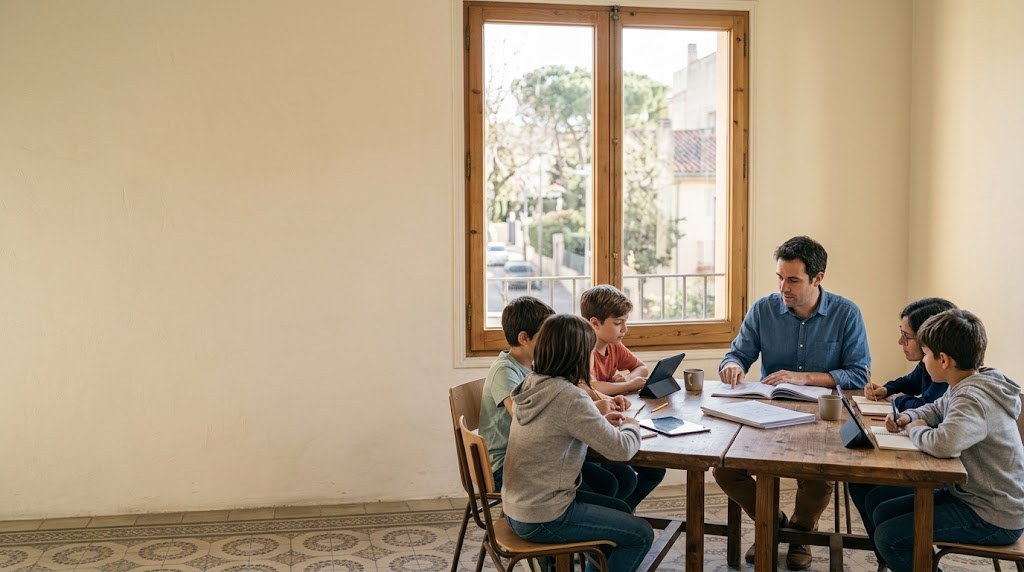
Many people searching for alternatives to public school are teachers who see students the system is not serving. If you would rather build a place for them than wait for one, these are the common routes:
| Route | What you build | Main legal question | Guide |
|---|---|---|---|
| Homeschool co-op or learning community | Classes for homeschooled children a few days a week | When does it stop being home education? | Homeschool co-op |
| Microschool | A small full-time or hybrid school you lead | Private school, homeschool program or child care? | Microschool · Texas |
| Private school | A child’s main school with a regular calendar | State registration, entity, 501(c)(3), accreditation | Private school |
| Local school of an existing model | A new school using a tested program and online classes | Your state’s rules, worked through with the model’s team | See below |
Starting alone gives you full control and the full workload. An existing model gives you a tested program and people who have met your problems before.
One option: lead NIJIN Academy US as Country Head
NIJIN Academy was built in Japan for children who had stopped going to school, on the belief that the child is not the problem. It is a hybrid: a metaverse campus, small dialogue-based live classes, a homeroom and physical classrooms.
Figures are those published on NIJIN’s official websites.
The Country Head is both business head and principal of NIJIN Academy US. It is not a franchise: you do not buy a format. What a teacher needs to know:
You can start on a service contract, even as a side job alongside your current teaching job, and decide later whether to become a co-owner of a local company (for example 20% for you, 80% for NIJIN). Investment is optional. Either way, compensation is, as a guide, 10% of revenue excluding tax, capped at JPY 50 million (JPY 100 million of revenue gives JPY 10 million). No income is guaranteed: with no revenue, the formula pays nothing. Teaching experience is not required, English is enough, and the starting state and other terms are discussed in the interview.
Questions and answers
What are the alternatives to public school?
Magnet schools, public charter schools and full-time online public schools (all still public), plus private schools, microschools and hybrid schools, homeschooling and homeschool co-ops. The table above compares who pays, who is responsible and what varies by state.
How do I find alternatives to public school near me?
Check your district’s site for magnet, transfer and online options, then your state department of education’s pages on charter, private and home schooling. A state ESA or scholarship site lists approved providers. Then visit.
What is the best alternative to public school for an autistic child?
There is no single best one. The key question is which IEP rights continue: in a public charter school a child keeps all IDEA Part B rights, while a child placed in private school by the parents has no individual right to the same services. Decide with the child’s clinicians and current school team.
What are the alternatives to public school in Texas?
TEA lists charter schools, private schools, home schooling, online learning and high school equivalency programs. TEFA may help accepted families pay approved providers.
What are the alternatives to high school for struggling students?
Another public high school (charter, magnet or online), a small private school, homeschooling, a high school equivalency program, or college courses. Check credit transfer first.
Is free online school an alternative to public school?
Often it is a public school delivered online. A full-time online public school is free to the family and the child is enrolled in it. A private online school usually charges tuition. Using online courses at home on your own is homeschooling.
I am a teacher. Is NIJIN Academy US a job or a business?
A business you lead, as business head and principal, with compensation tied to revenue (10% as a guide). You can start on a service contract alongside current work. Details are discussed in the interview.
Found NIJIN Academy in the United States
If you have looked at every alternative to public school and still see children nobody is serving, consider building the school yourself. NIJIN is looking for one Country Head to start and lead NIJIN Academy US. Teaching experience is not required.
See the Country Head role in the United StatesWhere to go next
Country Head pages are open for several countries, and the global page covers every other country.
- United States
- Australia
- Canada
- Country Head (global)
- United Kingdom
- Philippines
- India
- NIJIN careers in English
Related guides
- How to start a microschool: 7 steps for founders
- How to start a homeschool co-op
- How to start a microschool in Texas
- How to start a private school in the US
- Alternative school vs. traditional school
- Homeschooling vs. online school vs. alternative school
- How to start a hybrid school
- Teacher burnout
Sources
All figures are quoted with the year they refer to. Please check the original for later updates.
- https://nces.ed.gov/fastfacts/display.asp?id=30
- https://nces.ed.gov/fastfacts/display.asp?id=6
- https://nces.ed.gov/programs/coe/indicator/cgc
- https://nces.ed.gov/programs/coe/indicator/cla
- https://ies.ed.gov/learn/press-release/higher-percentage-k-12-students-are-receiving-academic-instruction-home
- https://sites.ed.gov/idea/regs/b/c/300.209
- https://sites.ed.gov/idea/regs/b/b/300.137
- https://sites.ed.gov/idea/regs/b/b/300.148
- https://educationfreedom.texas.gov/
- https://tea.texas.gov/families-and-students/finding-school-your-child/alternative-schooling
- https://tea.texas.gov/families-and-students/finding-school-your-child/home-schooling
- https://nijin.co.jp/recruit/nijin-academy-us-country-head/