Homeschooling vs online school vs alternative school comes down to one question: who is responsible for the teaching. In homeschooling the parent is; in an online school a school is, and the child attends from home; in an alternative school a school is, in a physical place, with a different approach from the mainstream. That one difference decides most of the others: how much time it takes from a parent, whether the child has classmates, what it costs, and how the learning is recognised. This article compares the three side by side, uses official statistics where they exist, and is written both for families choosing and for people thinking of starting one.
In this article
The three in one table
| Homeschooling | Online school | Alternative school | |
|---|---|---|---|
| Who is responsible for teaching | The parent or guardian | A school and its teachers | A school and its teachers |
| Where the child learns | Home and community | Home, through live and recorded classes | A physical site |
| Who plans the curriculum | The family, within local rules | The school | The school, often around a distinct philosophy |
| Time asked of a parent | High | Medium: supervision, especially for younger children | Lower: travel and involvement in the community |
| Daily contact with other children | Arranged by the family | On screen; in person only if the school organises it | Built in |
| Typical cost to the family | Materials and a parent’s time | Ranges from publicly funded to fee-paying | Usually fees, sometimes public funding |
| Recognition | Set by national or state law | Depends on the school’s status and accreditation | Depends on the school’s status and accreditation |
This table describes the general shape of each option. Costs and recognition vary by country, state and provider.
Before anything else: the law is local. Whether home education is permitted, whether you must notify or register, what must be taught, and whether an online or alternative school counts as “school” are all decided by national or state law. This article does not tell you what is legal where you live. Ask your education ministry, state department of education or local authority, and read their guidance directly.
Homeschooling: what the official numbers say
Homeschooling means the parent takes responsibility for the child’s education, with or without tutors, co-operatives and bought-in courses. Two countries publish regular official figures that show its scale.
United States
The National Center for Education Statistics (NCES) measured this in its 2023 National Household Education Surveys Program, with data collected from January to August 2023. For the 2022–23 school year:
Source: NCES / Institute of Education Sciences, 2023 NHES Parent and Family Involvement in Education survey. The two groups overlap, because some homeschooled students also take full-time virtual courses, which is why 3.4 and 2.5 do not add up to 5.2.
The same survey asked homeschooling parents why. They could choose more than one reason.
Reasons selected by parents of homeschooled students, 2022–23. Source: NCES. “Concern about the environment of other schools” was also the reason most often named as the single most important (28%).
England
The Department for Education (DfE) collects figures from local authorities on what it calls elective home education (EHE): a choice by parents to educate their children at home instead of sending them to school full-time.
- 126,000 children were in elective home education on census day in autumn 2025, about 1.5% of the comparable age group, and 14,300 more than a year earlier.
- 175,900 children were in elective home education at some point during the 2024/25 academic year.
- Of the reasons recorded, mental health was the most common (16%), followed by philosophical or preferential reasons (12%). For a large share, the reason was unknown or not given.
Source: DfE, Elective home education, autumn term 2025/26 (published January 2026). The DfE labels these “official statistics in development”: the collection became mandatory in autumn 2024, so part of the rise reflects better reporting.
Read the two countries together and a pattern appears. Many families who homeschool are not rejecting education. They are leaving a school environment that was not working for their child. The American survey says so in its top reason; the English data says so through mental health. That matters for the other two options, which exist for much the same families.
Online school: a school, attended from home
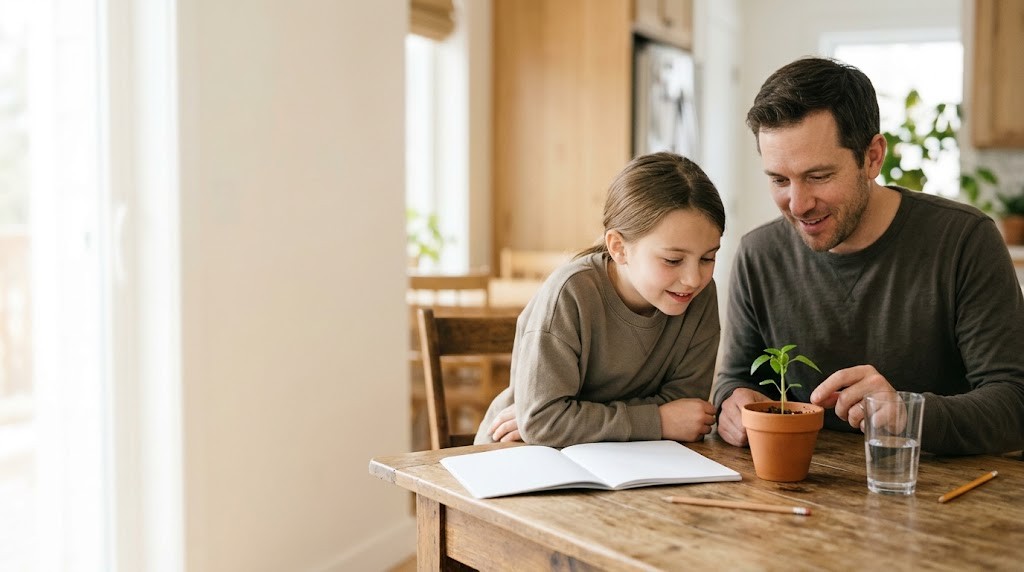
An online school enrols the child, employs teachers, sets a timetable and assesses progress. The child attends from home. NCES separates this from homeschooling for that reason: in 2022–23, 2.5% of American students were in full-time virtual education, and most of them were enrolled in a public or private school, not homeschooled.
What it does well. It lifts the planning and teaching from the parent. It reaches children who cannot travel, who live far from a suitable school, or who are not ready to be in a room with thirty others. A child can keep a camera off and still be present.
Where it is weak. Screens do not replace playing, eating and making things with other children. Younger children need an adult nearby. A family needs a device, a connection and a quiet corner. And quality varies widely, so ask to sit in on a live class before you decide.
Questions to ask a provider. How many hours are live, and how many are recorded? How large are the classes? Who notices if my child stops logging in? What does the school’s status mean for exams, transfers and attendance records where we live?
Alternative school: a different school, in person
“Alternative school” is a broad label. It covers schools built on a named philosophy, democratic and free schools, small independent schools often called microschools, and schools created for children who had stopped attending. The United States also uses the term for public programmes serving students at risk of leaving school. What they share is a physical community and a deliberate difference from the standard classroom: smaller groups, mixed ages, more choice for the child, or a different rhythm to the day.
What it does well. Belonging. A child is known by adults and by peers, in person, every day.
Where it is weak. There may be none within reach of your home. Fees can be high because groups are small. And an “alternative” label says nothing about quality or legal status, so visit, ask how the school is registered, and ask what leavers go on to do.
Hybrid: when the lines blur
The three categories are tidy on paper and mixed in real life. Homeschooling families buy online courses. Online schools open meeting places. Alternative schools add online days. The most deliberate version is a hybrid school, which is designed from the start as an online campus plus physical rooms.
NIJIN Academy in Japan is a documented example. It is an alternative school for children who do not fit conventional school, opened in September 2023. Children attend from home through a metaverse campus, choose from about 100 live online classes a month, and can also go to one of 48 physical classrooms across Japan. Classes are small, with 8 to 10 students of mixed ages, and cameras and microphones are optional. More than 900 children have enrolled since opening (cumulative). Among families who applied for it, 97% had the child’s learning at NIJIN Academy recognised as attendance by the school where the child is registered. We explain the model in detail in What is a metaverse school?
Who each one fits: a decision guide
Homeschooling may fit if
A parent has the time and wants to lead the learning; the family has strong views on what and how to teach; you can find other families nearby for company; and your local rules allow it on terms you can meet.
Online school may fit if
You want teachers and a timetable without the journey; your child is more comfortable joining from home, at least for now; and an adult can be nearby during the day.
Alternative school may fit if
Your child needs people and a place more than a different curriculum; there is a school within reach whose approach you trust; and the fees are sustainable for years, not months.
A hybrid may fit if
Your child’s energy changes from week to week; you want daily contact online and in-person friends as well; and you would like the option to move between the two without changing schools.
Three questions cut through most of the choice:
- Who teaches?If not you, rule out pure homeschooling.
- What does the child need most?Rest, people, challenge or freedom. Name one.
- What is recognised?Ask the authority how each option is recorded.
- Can we sustain it?Time and money, for at least two years.
None of these is a judgement on mainstream school or on the teachers in it. Most children do well there. These options exist for the ones who, at this point in their lives, do not, and some of them return to it later.
If you want to start one
If you read the statistics above as a founder, the gap is plain: a growing number of families are leaving school environments that did not work for their child, and many of them do not actually want to become the teacher. They want another school. Building one is hard, slow and regulated, and it can be done. Our guide on how to start an education business covers the first steps.
NIJIN Academy Country Head. NIJIN is looking for one person in each country to start and lead a NIJIN Academy there, as business head and principal. The plan is to set up a local company in that country and give the Country Head shares in it. As a guide, compensation is 10% of revenue (excluding consumption tax), capped at JPY 50 million once revenue reaches JPY 500 million or more. It is a guide only, decided by the person leading the company as it grows, and no income is guaranteed. Teaching experience is not required. The country’s official language plus English and Japanese is ideal; English alone is acceptable.
Questions and answers
Is online school the same as homeschooling?
No. In an online school the child is enrolled with a school that teaches and assesses. In homeschooling the parent is responsible. Official statistics, such as those from NCES in the United States, count them separately, though some families combine the two.
Is homeschooling legal?
It depends on the country and, in federal countries, on the state. Some places allow it freely, some require registration or assessment, and some do not permit it. Check with your own education authority.
How many children are homeschooled?
In the United States, 3.4% of students aged 5 to 17 in 2022–23 (NCES). In England, 126,000 children were in elective home education on census day in autumn 2025 (DfE). Many countries do not publish comparable figures.
Will my child fall behind or miss out socially?
It depends far more on how the option is run than on its label. Ask any provider how they know what a child has learned and how children spend time together. In homeschooling, those two things are yours to arrange.
Can a child move back to a mainstream school later?
Often yes, but the process and what records are needed vary. Ask the school you might return to, and the local authority, before you leave, not after.
What is a microschool?
A very small school, often a single mixed-age group with one or two adults. It is a size, not a legal category, so how it is registered depends on local law. For the founder’s side, see how to start a microschool.
Families need more kinds of school. Will you build one?
If you want to start a company in your own country and solve a problem in education, read the Country Head role and apply. We talk first.
ApplyRoles and related reading
- What is a metaverse school? How hybrid schools combine a virtual campus with real classrooms
- Out-of-school children: the global numbers, the causes, and what founders can do
- How to start an education business
- Alternative school vs traditional school: what actually differs
- How to start a microschool: a step-by-step guide for founders
- School refusal: what Japan’s futoko teaches school founders
- How to start an online school that children keep attending
Sources:
- https://ies.ed.gov/learn/press-release/higher-percentage-k-12-students-are-receiving-academic-instruction-home
- https://nces.ed.gov/nhes/
- https://explore-education-statistics.service.gov.uk/find-statistics/elective-home-education
- https://www.gov.uk/government/publications/elective-home-education
- https://academy.nijin.co.jp/
- https://nijin.co.jp/recruit/nijin-academy-country-head/