

For aspiring school leaders
To become a school principal in a Philippine public school, you need teacher eligibility, years of teaching and school leadership experience, a relevant master’s degree, recent training hours, and a passing result in DepEd’s school head assessment (the NQESH, now run as the National Assessment for School Heads), and then you must be ranked and selected by your Schools Division Office. Private schools follow a different path: the school’s owners appoint the head, within the rules DepEd sets for private schools and the Constitution’s requirement that schools be administered by Filipino citizens.
This guide explains both routes from DepEd’s own memoranda and the laws they cite, then describes a third route: founding and leading a school yourself.
In this article
- What a school principal does in the Philippines
- Public or private: two different routes
- Principal qualifications in DepEd (School Principal I)
- The principal’s test: NQESH and NASH
- How selection and appointment work
- The path, step by step
- Private school principal requirements
- A third route: found and lead a school
- Questions and answers
What a school principal does in the Philippines
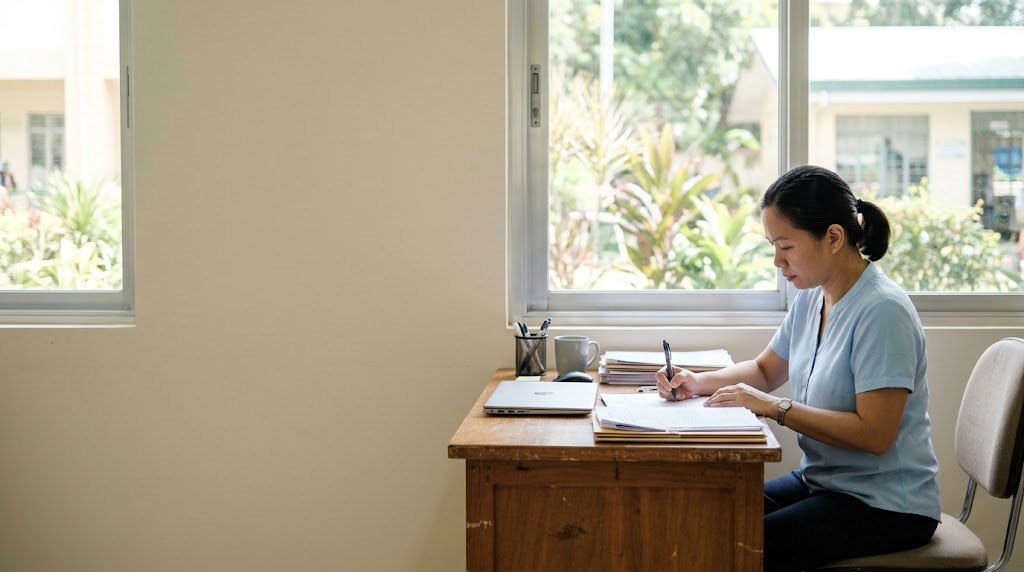
Republic Act No. 9155, the Governance of Basic Education Act of 2001, says in Section 7 that there shall be a school head for every public elementary and high school, or cluster of schools, and that the school head “shall be both an instructional leader and administrative manager.”
The same section makes the school head responsible for the school’s mission and goals, the curriculum and learning outcomes, the school improvement plan, all personnel, physical and fiscal resources, staffing and staff development, and links with parents and the community. DepEd’s principal’s test is built on the Philippine Professional Standards for School Heads (PPSSH), adopted through DepEd Order No. 24, s. 2020.
Public or private: two different routes
A public school principal holds a government position filled through civil service rules. A private school principal is chosen by the school’s owners, under DepEd’s regulation of private schools.
| Question | Public school (DepEd) | Private school |
|---|---|---|
| Who appoints you? | The appointing authority in DepEd, from candidates ranked by a selection board in the Schools Division Office | The school’s owners or board |
| Which standards apply? | Civil Service Commission-approved qualification standards, adopted by DepEd (DepEd Order No. 19, s. 2025) | DepEd’s rules for private schools, the school’s own policies, and the Constitution |
| Is a test required? | Yes. DepEd requires a passing result in its school head assessment for a first appointment as principal | No DepEd principal’s test is required by the memoranda reviewed here; ask the Regional Office |
| Typical starting point | Teacher, then Master Teacher, Head Teacher, Assistant School Principal or Teacher-in-Charge | Varies by school |
| Where to ask | Your Schools Division Office (HR unit) | The DepEd Regional Office that supervises private schools in your region |
Principal qualifications in DepEd (School Principal I)
The entry-level principal position in public schools is School Principal I. Its qualification standards changed in 2025. DepEd Order No. 19, s. 2025, titled “Amended Qualification Standards for Teacher I-III, Master Teacher I-IV, and School Principal I-IV Positions,” adopts Civil Service Commission Resolution No. 2500471 dated May 28, 2025, according to a Schools Division of Sorsogon memorandum issued in August 2025.
The new standard for School Principal I was published in DepEd memorandum DM-OUHROD-2025-1331 (May 27, 2025), circulated by the Schools Division Office of Muntinlupa. It is summarised below.
| Requirement | School Principal I (2025 standard) |
|---|---|
| Education | Master’s degree in Education, Educational Management or Educational Leadership; or a master’s degree in a relevant learning area with at least 9 units in Management |
| Experience | 5 years of teaching experience and 1 year of relevant experience in any of: learning area coordination, subject area supervision, school management and operations, instructional supervision |
| Training | 32 hours of cumulative training in any of: Curriculum, Pedagogy, School Management and Operations, Instructional Leadership, acquired within the last 5 years |
| Eligibility | RA 1080 (Teacher) |
| School head assessment | Principal’s Test or NQESH passer |
Watch out for older guides. Many articles still quote DepEd Order No. 39, s. 2007, which asked for a bachelor’s degree rather than a master’s. DepEd memoranda from 2025 describe the standard above as the new one. Check your division’s latest vacancy memorandum before you apply.
The principal’s test: NQESH and NASH
DepEd Memorandum No. 13, s. 2024 states that passing the National Qualifying Examination for School Heads (NQESH), also known as the Principals’ Test, “is one of the requirements for appointment and reclassification” to Principal and Assistant Principal positions in all public elementary and secondary schools. In 2025 the assessment was run as the National Assessment for School Heads (NASH), described by the Schools Division of Sorsogon as the assessment “formerly known as NQESH.”
Who could take it
For the fiscal year 2023 exam, DepEd Memorandum No. 13, s. 2024 allowed aspiring school heads, “regardless of their current positions,” to apply if they met the qualification requirements and had any of these experiences:
- One year as Head Teacher
- Two years as Master Teacher
- Two years as Teacher-in-Charge
- Five years of teaching as Teacher III (or a position with the same salary grade), or as a public school teacher with managerial and supervisory experience in a DepEd-recognised private institution or a CHED-recognised higher education institution
- Aggregate experience as Head Teacher, Teacher-in-Charge, Master Teacher and Teacher III
For the 2025 NASH, the Sorsogon memorandum asked takers to prove the new standards, including a relevant master’s degree (or substantial progress toward it, for conditional takers) and IPCRF ratings of at least Very Satisfactory in the last two consecutive rating periods.
What it tests and how it is scored
The exam covers “conceptual and situational critical thinking questions” aligned with the PPSSH. It is not a simple pass or fail: DepEd uses an order of merit to decide who moves to the next stage of selection for Principal I. For the FY 2023 exam, DepEd allocated 22,000 examinee slots nationwide.
Passing is necessary, not sufficient. DepEd Memorandum No. 25, s. 2023, reiterated by the Secretary in DM-OSEC-2024-018 (August 6, 2024), says test results score the written examination, but “appointment shall still be based on the readiness of an aspiring principal.” DepEd Order No. 21, s. 2024 (item 27, as quoted by SDO Muntinlupa) requires a pass in the school head assessment for a first appointment as School Principal.
How selection and appointment work

Vacancies are filled under DepEd Order No. 7, s. 2023, the Guidelines on Recruitment, Selection, and Appointment in the Department of Education. Each Schools Division Office runs a Human Resource Merit Promotion and Selection Board (HRMPSB), which checks applications against the qualification standards and then compares candidates on a 100-point scale. This is the scale published by SDO Muntinlupa for school administration positions in 2025:
| Criterion | Points |
|---|---|
| Performance | 25 |
| Potential (written test, BEI, work sample test) | 15 |
| Education | 10 |
| Training | 10 |
| Experience | 10 |
| Outstanding accomplishments | 10 |
| Application of education | 10 |
| Application of learning and development | 10 |
| Total | 100 |
The appointing authority then selects from the top five candidates (or fewer) in the board’s Comparative Assessment Result.
Documents usually requested
The 2025 Muntinlupa call for school administration positions listed the following. Your division’s list may differ, so follow its memorandum.
- Letter of intent naming the position
- Personal Data Sheet (CS Form No. 212, Revised 2017) with Work Experience Sheet
- Valid PRC licence or ID and certificate of eligibility or rating
- Transcript of records and diploma, including graduate units or degrees
- Training certificates
- Service record, certificate of employment or contract of service
- Latest appointment, latest performance rating, and the Omnibus Sworn Statement
The path, step by step
Put together, the public school route looks like this.
- Become an eligible, licensed teacher. RA 1080 (Teacher) eligibility and a valid PRC licence.
- Teach for at least five years.
- Take on coordination or supervision for a year. Head Teacher, Master Teacher and Teacher-in-Charge roles are the usual ways in.
- Finish a relevant master’s degree. Education, Educational Management or Educational Leadership, or a relevant learning area with 9 units in Management.
- Collect 32 hours of relevant training within five years.
- Take the school head assessment. Watch DepEd and division memoranda for the application window.
- Apply when your division posts a vacancy. Late submissions are not accepted.
- Go through comparative assessment. Tests, interview and the 100-point scoring.
Want to lead a school without waiting for a vacancy?
If you want the principal’s chair to shape a whole school, there is another way in. NIJIN Academy is an alternative school in Japan, run by NIJIN Inc. since September 2023. NIJIN is looking for one person to start NIJIN Academy Philippines and lead it as both business head and principal. Teaching experience is not required.
See the Country Head role in the PhilippinesPrivate school principal requirements
What we could verify from official texts:
- Citizenship. Article XIV, Section 4 of the 1987 Constitution says “the control and administration of educational institutions shall be vested in citizens of the Philippines.” The same section requires schools, other than those set up by religious groups and mission boards, to be owned by Filipino citizens or by corporations at least 60% Filipino-owned.
- DepEd supervision. The same section says the State “shall exercise reasonable supervision and regulation of all educational institutions.” For private basic education, DepEd’s rulebook is the 2010 Revised Manual of Regulations for Private Schools in Basic Education (DepEd Order No. 88, s. 2010), as later amended.
- The school’s own policies. Within those rules, the owners or board set the head’s qualifications, contract and pay.
We could not open the official text of the 2010 Manual, so we do not list the qualifications it may require of a private school head. If you are being considered for a private school principal post, or planning to open a school, ask the DepEd Regional Office that supervises private schools in your region, and read our guides to the DepEd permit to operate and how to start a school in the Philippines.
A third route: found and lead a school
Both routes lead to running a school someone else founded. The third is to start one and lead it yourself.
| DepEd public school principal | Private school principal | Country Head, NIJIN Academy Philippines | |
|---|---|---|---|
| How you get there | Qualification standards, school head assessment, ranking, appointment | Chosen by the school’s owners | Apply and talk it through in an online interview |
| Teaching background | Required (teacher eligibility, 5 years of teaching) | Depends on the school | Not required |
| What you lead | An existing public school | An existing private school | A new school you build, as business head and principal |
| Pay | Government salary grade | Set by the school | As a guide, 10% of revenue (excluding tax), capped at JPY 50 million; not guaranteed |
NIJIN Academy is an alternative school in Japan for children who do not fit conventional school, combining a metaverse campus, about 100 live online classes a month and physical classrooms. NIJIN describes it as one of the largest alternative schools in Japan.
Figures are those published by NIJIN. “Attendance recognition” means the child’s registered school counts learning at NIJIN Academy as school attendance.
NIJIN looks for leadership, management, business ability and the skills of a principal; experience of managing an organisation and hiring people carries over directly. Ideally you work in Filipino, English and Japanese, but English alone is fine.
You can set up a local company together (for example 20% of the shares for you, 80% for NIJIN; if you invest, the guide is JPY 1 to 2 million from you and JPY 4 to 8 million from NIJIN), or start on a service contract, even as a side job. Investment is optional, and this is not a franchise. Either way, the compensation guide is 10% of revenue excluding tax: JPY 100 million of revenue gives JPY 10 million, up to a cap of JPY 50 million at JPY 500 million. It is a guide, not a promise of income; with no revenue, it pays nothing. Anyone you hand part of the role to is paid from your 10%. Other terms are discussed in the interview.
Questions and answers
How do you become a school principal in the Philippines?
In public schools: meet the School Principal I standards, pass DepEd’s school head assessment, then apply to a vacancy and be ranked by your Schools Division Office. In private schools, the owners appoint the head under DepEd’s private school rules.
What are the principal qualifications in DepEd?
For School Principal I, the 2025 standard is a relevant master’s degree, 5 years of teaching plus 1 year of relevant supervisory or coordination experience, 32 hours of training in the last 5 years, RA 1080 (Teacher) eligibility, and a Principal’s Test or NQESH pass. Higher principal levels have their own standards; check DepEd Order No. 19, s. 2025 and your division’s vacancy memo.
Is the NQESH still required?
Yes, in the form of DepEd’s school head assessment. DepEd Order No. 21, s. 2024 requires candidates to pass it for a first appointment as School Principal, and in 2025 it was administered as the National Assessment for School Heads (NASH), formerly NQESH. Watch DepEd and division memoranda for each year’s application window.
Can you become a school principal in the Philippines online or for free?
There is no shortcut. The FY 2023 NQESH was taken on a secured online platform at designated sites, and DepEd says it is not affiliated with any review provider. The degree, training and experience still have to be earned.
How much does a school principal make in the Philippines?
Public school principals are paid by salary grade. A 2025 Bulacan division memorandum lists School Principal III at Salary Grade 21 and School Principal IV at Salary Grade 22. Peso amounts depend on the current salary schedule, so check the Department of Budget and Management. Private schools set their own pay.
Is the NIJIN Country Head a job or a business?
Closer to a business. You lead NIJIN Academy Philippines as its founder, business head and principal. You can start on a service contract or as a co-owner of a local company, and the compensation guide is 10% of revenue, not a fixed salary.
Lead a school you build yourself
NIJIN is looking for one person to start NIJIN Academy Philippines and lead it as head and principal. Teaching experience is not required. If you have led a team and hired for it, and you want to build a school for children who do not fit school, read the role.
See the Country Head role in the PhilippinesWhere to go next
Related guides
- How to start a school in the Philippines
- DepEd permit to operate: what private schools need
- How to become a school principal in India
- How to start a learning center in the Philippines
- How to be a homeschool provider in the Philippines
- Country manager in education: the role and three pay models
Sources
DepEd memoranda are quoted from copies posted by DepEd Schools Division Offices. Rules change often; check the latest issuance from DepEd or your division.
- https://deped-muntinlupa.com/wp-content/uploads/2025/06/NUM-2025-255.pdf
- https://deped-muntinlupa.com/wp-content/uploads/2025/06/NUM-2025-305.pdf
- https://depedsorsogon.com.ph/Home/Download/1870
- https://deped-muntinlupa.com/wp-content/uploads/2024/03/UN-2024-075.pdf
- https://deped-muntinlupa.com/wp-content/uploads/2024/08/NUM-2024-241.pdf
- https://deped-muntinlupa.com/wp-content/uploads/2025/03/NUM-2025-120.pdf
- https://bulacandeped.com.ph/wp-content/uploads/2025/11/DIVISION-MEMORANDUM-NO-579-S-2025.pdf
- https://lawphil.net/statutes/repacts/ra2001/ra_9155_2001.html
- https://lawphil.net/consti/cons1987.html
- https://nijin.co.jp/recruit/nijin-academy-philippines-country-head/
- https://nijin.co.jp/recruit/en/