
For teachers in the Philippines
To find teaching jobs abroad as a Filipino teacher, start with the destination’s own rules for teachers (for example, the U.S. State Department’s J-1 Teacher program or qualified teacher status in England), then deal only with a recruitment agency licensed by the Department of Migrant Workers (DMW, formerly POEA) and holding an approved job order, never pay more than the allowed placement fee or pay without a contract and an official receipt, and leave with the exit clearance the DMW requires (the OEC, now the OFW Pass for some returning workers).
This guide follows the process in order, using only official government pages. It gives no salary figures, because the official sources publish no single rate, and it is not legal advice. At the end we describe a different path: leading a new school in the Philippines without leaving.
In this article
- Three kinds of teaching jobs abroad
- The process, in order
- How to check a DMW-licensed agency
- Placement fees: what the rules say
- How to spot illegal recruitment
- The OEC and the OFW Pass
- Teaching in the US: the J-1 Teacher program
- Teaching in England: qualified teacher status
- If you are a DepEd teacher
- Another path: lead a school at home
- Questions and answers
Three kinds of teaching jobs abroad
“Teaching abroad” covers very different jobs, each with its own gatekeeper.
| Route | Who decides you can teach | What to check first |
|---|---|---|
| Teacher exchange in the United States (J-1 Teacher) | A sponsor organisation designated by the U.S. Department of State, the host school and the U.S. state where you would teach | The J-1 Teacher eligibility list on the State Department’s J-1 site, and the standards of that state |
| Teaching in schools in England | Each school hires its own teachers; the Department for Education awards qualified teacher status (QTS) | Which QTS route is open to teachers trained in the Philippines (see below); job and visa are separate applications |
| Teaching English, teacher assistant and international school posts in other countries | The employer and that country’s immigration and education rules | The destination’s official requirements, then a DMW-licensed agency with an approved job order for that exact post |
The process, in order

A common order for a land-based teaching job (your destination may add steps):
- Choose the destination and read its teacher rules.
- Check your own papers. Degree, licence, service record and references.
- Find the job through a DMW-licensed agency.
- Read and sign the employment contract. Pay any allowed fee only after this, against an official receipt.
- Get the visa the job requires.
- Secure your exit clearance. The OEC, or the OFW Pass where it applies.
- Settle your current job properly. Public school teachers follow Civil Service rules.
How to check a DMW-licensed agency
Since Republic Act No. 11641 was signed on 30 December 2021, the Philippine Overseas Employment Administration (POEA) and other agencies have been merged into the Department of Migrant Workers. When older posts say “POEA-licensed”, the office that licenses agencies today is the DMW.
The DMW’s guidance comes down to these checks:
- The agency appears in the DMW’s list of licensed recruitment agencies, and its status allows it to recruit now.
- The specific teaching post is an approved job order. A licence alone is not enough: do not deal with licensed agencies that have no job order.
- The person talking to you is an authorised representative of that agency and can show an ID.
- You meet them at the agency’s registered address, not in a mall, a restaurant or your home.
- If recruitment happens in your province, the agency has a provincial recruitment authority.
- You are not dealing with fixers, or a training centre or travel agency that “promises” jobs abroad.
Search licensed agencies and approved job orders on the official website, dmw.gov.ph, not on social media, where real agency names are often copied.
Placement fees: what the rules say
A placement fee is, in the words of Republic Act No. 8042 as amended by RA 10022, any amount a private recruitment agency charges a worker for its recruitment and placement services, as prescribed by the government. The law makes it illegal recruitment to charge or accept more than the schedule of allowable fees.
| Question | What the official source says | Source |
|---|---|---|
| How much may an agency charge? | Do not pay more than the allowed placement fee. It should be equivalent to one month’s salary, exclusive of documentation and processing costs. | DMW guidance on avoiding illegal recruitment |
| When may you pay? | Do not pay any placement fee unless you have a valid employment contract and an official receipt. | DMW guidance |
| What if more is charged? | Charging or accepting more than the allowable fees, or making you acknowledge more than you received, is illegal recruitment. | RA 8042, as amended by RA 10022, Sec. 6(a) |
| What if you are never deployed? | Failing to reimburse your documentation and processing expenses, when deployment does not happen through no fault of yours, is illegal recruitment. | RA 8042, as amended, Sec. 6(m) |
The DMW issued new rules for land-based recruitment in 2023, and some destinations and categories of workers have their own fee rules. Ask the DMW what applies to your destination before you pay anything.
How to spot illegal recruitment
The DMW lists the signs of an illegal recruiter. In plain English, be careful if someone:
- asks for a placement fee or any payment right away, without a receipt;
- promises a very fast departure, or departure on a tourist or visit visa;
- requires a medical exam or training before there is a clear employer or contract;
- meets applicants in public places or recruits house to house;
- says there is a “direct employer” so you do not need to go through the DMW;
- asks you to bring in other applicants to speed up your own departure.
Under RA 8042 as amended, illegal recruitment by a syndicate (three or more people working together) or in large scale (against three or more people) is an offence involving economic sabotage. If something feels wrong, stop paying and report it to the DMW through the contact channels on its official website.
The OEC and the OFW Pass
The Overseas Employment Certificate (OEC) is the DMW’s exit clearance for overseas Filipino workers. For workers returning to the same employer, the same job and the same country (Balik-Manggagawa), the DMW has integrated the OEC into the OFW Pass, a digital exit clearance with a QR code, opened through the eGovPH app. That is how the DMW’s Migrant Workers Office in Osaka described the roll-out in October 2025.
For a first job abroad, ask your agency and the DMW which clearance you need before you book a flight, and follow the DMW’s latest advisory.
Teaching in the US: the J-1 Teacher program
The U.S. Department of State runs the J-1 Teacher program, which lets foreign teachers teach in accredited primary and secondary schools in the United States through designated sponsor organisations. According to the program page, teachers must:
- be qualified to teach primary or secondary school at home;
- be working as a teacher when they apply (with a narrow exception for recent advanced-degree holders);
- have a degree equivalent to a U.S. bachelor’s degree in education or in the subject they will teach;
- have at least two years (24 months) of teaching or related professional experience;
- satisfy the standards of the U.S. state where they will teach;
- have enough English and good character;
- be coming to teach full time as a teacher of record at an accredited school.
The base period of the exchange is three years; host schools may ask the sponsor for a one- or two-year extension, which is not automatic. Sponsors must state the program’s fees and the compensation package in writing. Each U.S. state sets its own standards; check them with that state’s department of education.
Teaching in England: qualified teacher status
In England, schools hire their own teachers, and the Department for Education (DfE) awards qualified teacher status (QTS). GOV.UK says a qualified teacher from outside the UK can work as a teacher in England for up to four years without QTS, after which QTS is needed in many schools. QTS does not give you a job or a visa; you apply for those separately, and only a small number of schools sponsor visas.
One detail matters for Filipino teachers. DfE’s online service “Apply for QTS in England” is open to teachers trained in a listed set of countries and regions. In the list updated on 13 October 2026, the Philippines does not appear. GOV.UK names other routes:
| Route to QTS | What GOV.UK says it involves |
|---|---|
| Assessment only QTS | For experienced teachers with a degree, without a training programme. You need at least two years’ teaching experience in two separate schools, a bachelor’s degree, and English and maths qualifications at the standard of a grade 4 GCSE (plus science to teach ages 3 to 11). An approved provider assesses you where you work. GOV.UK says fees range from about £1,500 to £4,000 and vary by provider. |
| International qualified teacher status (iQTS) | Train for iQTS while outside the UK. |
| Teacher training in England | Train in England and gain QTS that way. |
Summary of GOV.UK guidance. Eligibility changes; read the current pages.
If you are a DepEd teacher
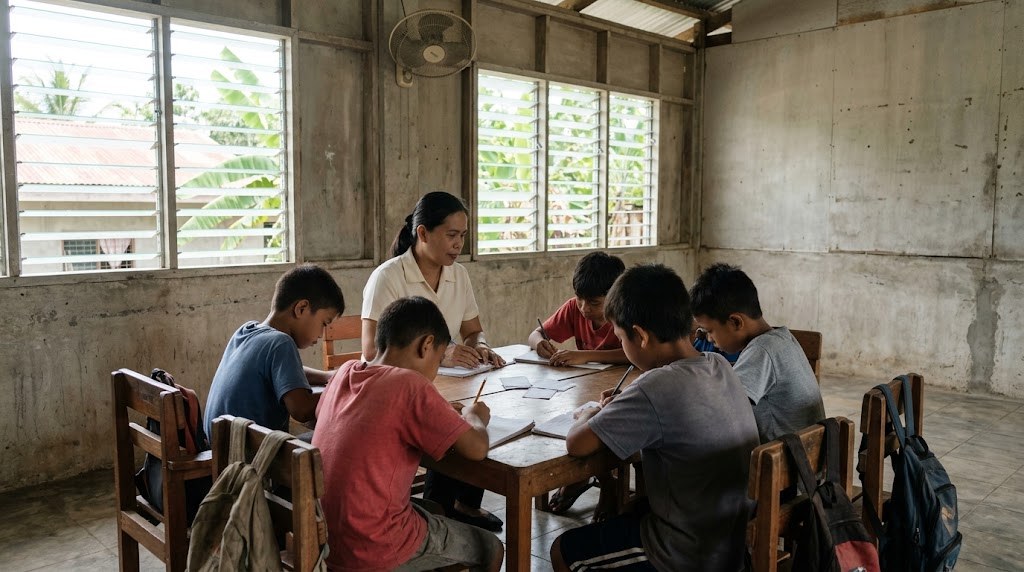
A public school teacher who takes a job abroad usually has to resign or arrange leave under Civil Service rules first. Our guide to DepEd teacher resignation covers the notice period, documents, leave and GSIS questions step by step.
For extra income without leaving, read side hustles for teachers in the Philippines and online teaching jobs in the Philippines. To teach learners abroad from home, see how to teach Japanese students online.
Want to lead, not leave?
NIJIN is looking for one person to launch and lead NIJIN Academy Philippines, as both business head and principal. You can start on a service contract, alongside your current work, and teaching experience is not required.
See the Country Head role in the PhilippinesAnother path: lead a school at home

Many teachers look abroad for room to grow. Another way is to lead something new at home. NIJIN Academy is an alternative school in Japan for elementary and junior high school students who do not fit conventional school, many of whom had stopped going altogether. It opened in September 2023; its founder, Tatsuro Hoshino, taught at a public elementary school for seven years. Children join from home through a metaverse campus, choose from about 100 live online classes a month, and can also attend physical classrooms.
Figures are those published on NIJIN’s official websites. NIJIN describes the academy as one of the largest alternative schools in Japan.
NIJIN is looking for a Country Head for the Philippines: one person who starts NIJIN Academy Philippines and leads it as business head and principal. To be clear, NIJIN does not place teachers abroad and is not recruiting teachers here; this is a founder’s role. What matters for a teacher:
- You can start on a service contract, even as a side job alongside your current work, and decide later whether to become a co-owner. Investment is optional. DepEd employees should check outside-work rules with their division office and a lawyer.
- Compensation is, as a guide, 10% of revenue (excluding tax), the same on a service contract or as a co-owner, capped at JPY 50 million. As examples of the formula only: JPY 100 million of revenue gives JPY 10 million, JPY 200 million gives JPY 20 million. With no revenue, the formula pays nothing. No income is guaranteed, and anyone you ask to do part of the role is paid from your 10%.
- Teaching experience is not required, and English is enough. Location, start date and other terms are discussed in the interview.
A note on ownership. If you become a co-owner, one example is a local company in which you hold 20% and NIJIN 80%, with an investment guide of JPY 1 to 2 million from you and JPY 4 to 8 million from NIJIN. However, Article XIV, Section 4(2) of the 1987 Constitution provides that educational institutions, other than those set up by religious groups and mission boards, be owned solely by Filipino citizens or by corporations at least 60% owned by Filipino citizens, with control and administration vested in Filipino citizens. So 20% and 80% are only an example: the actual structure would be decided in the interview and with legal professionals, in line with Philippine law.
NIJIN Academy is not a franchise. For what starting a school here involves, read how to start a school in the Philippines.
Questions and answers
How can a Filipino teacher find teaching jobs abroad safely?
Read the destination’s official teacher rules, use only a DMW-licensed agency with an approved job order, pay any allowed fee only after signing a contract and against a receipt, and get your DMW exit clearance.
Are there teaching jobs abroad with visa sponsorship for Filipinos?
Some routes include a visa process. In the J-1 Teacher program, a State Department-designated sponsor runs the exchange. In England, GOV.UK says only a small number of schools sponsor visas, and the job and visa are applied for separately.
What about English teaching jobs abroad for Filipinos?
Each destination and employer sets the requirements. Check that country’s official pages, and make sure the post is an approved job order of a DMW-licensed agency. Never work on a tourist visa.
Can I apply for teacher assistant jobs abroad?
Yes, if the destination allows it, but the same protections apply: licensed agency, approved job order, a contract that describes the actual work, and the proper visa.
How much is the placement fee for teachers going abroad?
DMW guidance says no more than one month’s salary, excluding documentation and processing costs, paid only with a valid contract and official receipt. Some destinations differ; ask the DMW.
Is the NIJIN Country Head a teaching job abroad?
No. It is closer to founding a business in the Philippines: you lead NIJIN Academy Philippines as business head and principal. You can begin on a service contract alongside your current work; compensation is, as a guide, 10% of revenue, with no guaranteed income.
Build a school in the Philippines
NIJIN is looking for one person to launch and lead NIJIN Academy Philippines. Teaching experience is not required, investment is optional, and you can start alongside your current work.
Where to go next
Related guides
- DepEd teacher resignation: requirements and process
- Online teaching jobs in the Philippines
- How to teach Japanese students online
- Side hustles for teachers in the Philippines
- The global teacher shortage
- How to become a school principal in the Philippines
Sources
Official pages checked on November 16, 2026. Rules change; please check the original.
- https://lawphil.net/statutes/repacts/ra2021/ra_11641_2021.html
- https://lawphil.net/statutes/repacts/ra2010/ra_10022_2010.html
- https://dmw.gov.ph/archives/air/howtoavoid.html
- https://dmw.gov.ph/archives/air/identify.html
- https://davaocity.gov.ph/social-services/dabawenyos-told-scrutinize-job-recruitments-beware-of-red-flags/
- https://mwo-osaka.dmw.gov.ph/2025/10/22/roll-out-of-ofw-pass-system/
- https://j1visa.state.gov/programs/teacher
- https://www.gov.uk/government/publications/apply-for-qualified-teacher-status-qts-if-you-teach-outside-the-uk/routes-to-qualified-teacher-status-qts-for-teachers-and-those-with-teaching-experience-outside-the-uk
- https://www.gov.uk/government/publications/overseas-trained-teachers-apply-for-qualified-teacher-status-in-england/overseas-trained-teachers-apply-for-qualified-teacher-status-in-england
- https://lawphil.net/consti/cons1987.html
- https://nijin.co.jp/recruit/nijin-academy-philippines-country-head/
- https://academy.nijin.co.jp/