
For school leaders in India
To run a school in India successfully, you have to keep five things working at the same time, every week: a leadership rhythm that people can follow, a teaching team you hire and train on purpose, the conditions of your recognition and board affiliation, a fee and cost structure that covers the year, and a relationship with parents built on regular, honest information. Opening the school is one project. Running it never stops.
This guide starts where most stop: after the recognition certificate arrives. For the approval stage, read how to start a school in India first; for the money plan before opening, see the school business plan for India.
In this article
- What running a school in India involves
- Leadership: the weekly rhythm of a school
- Hiring, training and keeping teachers
- Compliance that keeps your school open
- Money: setting fees and watching cost lines
- Working with parents
- How to measure whether the school is working
- Running a school as a Country Head
- Questions and answers
What running a school in India involves
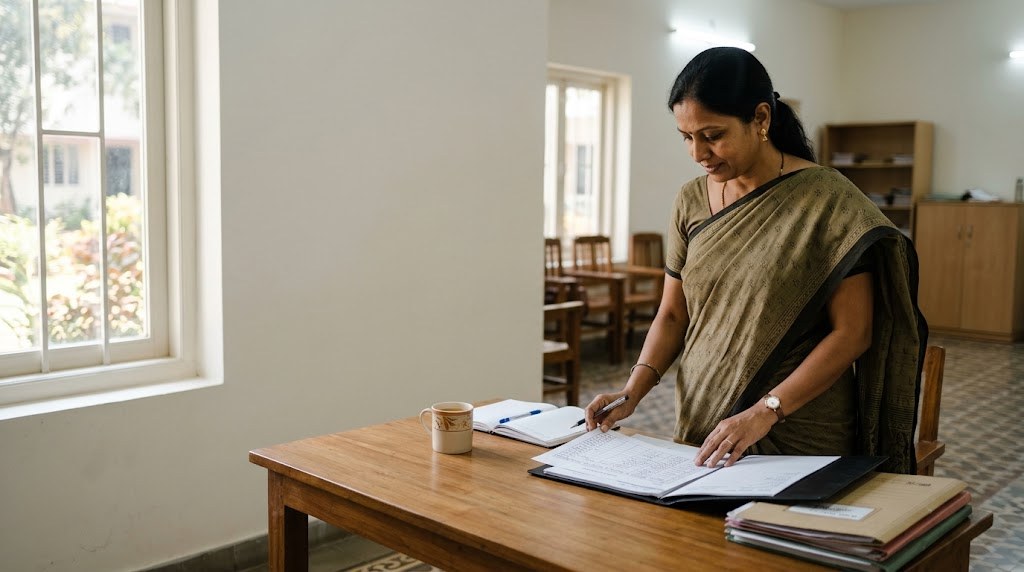
School management in India sits on three layers: a legal body (usually a trust, society or Section 8 company) with a governing board; recognition by the state under the Right of Children to Free and Compulsory Education Act, 2009 (RTE Act); and the conditions of a board such as CBSE or a State Board. A school head answers to all three, and to parents every day. Split the work into five areas, each with an owner and a weekly check.
| Area | What it covers | Weekly question |
|---|---|---|
| Leadership | Direction, priorities, decisions, the governing body | Does everyone know this week’s three priorities? |
| People | Hiring, timetables, cover, training, appraisal | Is any class without a teacher it trusts? |
| Compliance | Recognition, board affiliation, data returns, safety | Is any deadline or condition at risk this month? |
| Money | Fee collection, salaries, rent, maintenance, reserves | Will we pay every salary on time next month? |
| Parents and children | Admissions, communication, complaints, wellbeing | Which family has not heard from us in a month? |
Leadership: the weekly rhythm of a school
How to run a school successfully is mostly a question of rhythm. Schools fail slowly, through small things nobody owned: a fee reminder never sent, a complaint that waited three weeks. A fixed rhythm catches them early.
- Monday: a 20-minute staff briefing: three priorities, absences and cover, children the team is worried about.
- Every day: walk the school during lessons to see what children actually experience.
- Midweek: a short meeting on fees and accounts.
- Thursday or Friday: observe lessons; give each teacher one point to try next week.
- Every month: a written note to the governing body: enrolment, attendance, money, staffing, risks.
For CBSE schools, the Affiliation Bye-Laws state that the society, trust or company “shall safeguard the autonomy of the Principal” and must provide funds for the school’s recurring and non-recurring needs (clauses 9.1.5 and 9.1.8). Agree in writing which decisions are the principal’s and which are the board’s.
Hiring, training and keeping teachers
How many teachers the rules expect
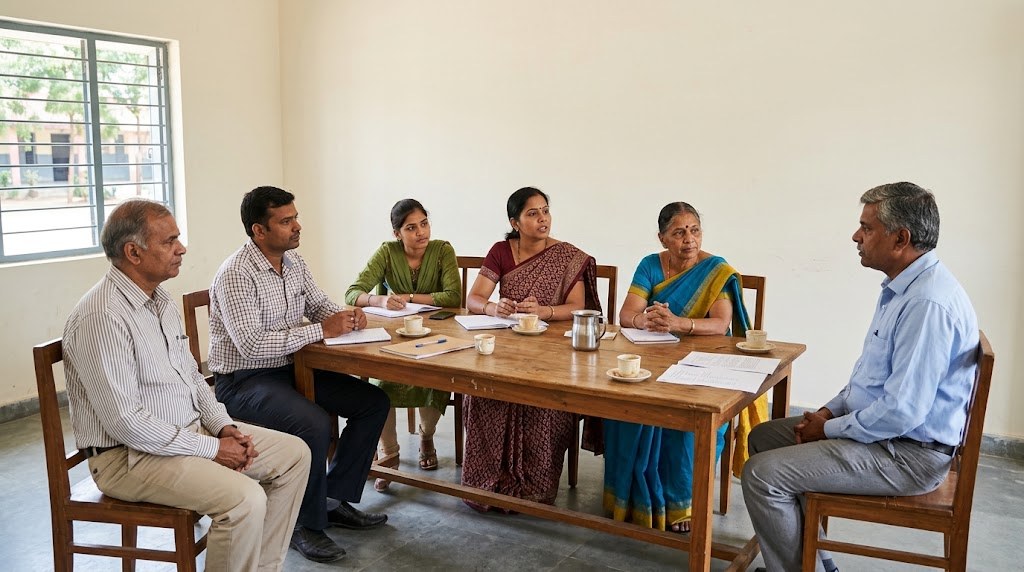
The Schedule to the RTE Act sets norms for Classes 1 to 8. For Classes 1 to 5 it starts at two teachers for up to sixty children and requires that, above two hundred children, the pupil-teacher ratio (excluding the head teacher) “shall not exceed forty”. For Classes 6 to 8 it asks for at least one teacher for every thirty-five children, subject teachers for science and mathematics, social studies and languages, and, above one hundred children, a full-time head teacher plus part-time art, health and physical education, and work education instructors. The same Schedule sets 45 working hours a week for a teacher, “teaching including preparation hours”.
Boards add more. CBSE requires a full-time special educator in every secondary and senior secondary school (clause 2.4.11), a counsellor and wellness teacher (part-time allowed below 300 students in Classes 9 to 12; clause 2.4.12), and physical education teachers at 1:500 per stage (clause 2.4.10). States set their own qualification rules.
Hiring well
Write down what a good teacher does in your school before you advertise, then test for it: a 15-minute demonstration lesson with real children, and one short note to a parent about a child’s progress. The note tells you more than the CV.
Training that actually happens
For CBSE schools, training is a written obligation: every affiliated school must run a 3-day in-house training programme for every teacher each year, plus at least 2 days of training through a CBSE Centre of Excellence or a recognised institution (including platforms such as DIKSHA or SWAYAM), and at least 2 days for the principal (clauses 16.1.1 to 16.1.3). Clause 16.4 asks schools to earmark a training budget. Treat these days as the minimum; what improves teaching is what happens between them. Teachers also leave over chaos, not only pay: pay on time, publish the timetable and cover rules, and say so when something a teacher did worked.
Compliance that keeps your school open
Recognition is not a one-time event. Under section 18(3) of the RTE Act, if a school breaks the conditions of its recognition, the prescribed authority “shall, by an order in writing, withdraw recognition”. Under section 19(5), anyone who keeps running a school after that is liable to a fine, with a further fine for each day it continues. The table lists obligations that apply while the school runs. It is not legal advice; state rules and amendments change the detail.
| Obligation | What it says | Source |
|---|---|---|
| 25% admission in Class 1 | Unaided schools admit at least 25% of the Class 1 strength from weaker sections and disadvantaged groups in the neighbourhood, and provide free education till completion of elementary education | RTE Act, s.12(1)(c) |
| No capitation fee, no screening | No capitation fee and no screening of the child or parents at admission, with fines set in the Act | RTE Act, s.13 |
| No physical punishment | “No child shall be subjected to physical punishment or mental harassment” | RTE Act, s.17 |
| Norms and standards | Teachers, building, working days (200 for Classes 1–5, 220 for Classes 6–8) and instructional hours (800 and 1,000 a year), library, play material | RTE Act, s.19 and Schedule |
| School Management Committee | Required for government, aided and specified-category schools under the Act, with three-quarters parents; CBSE requires an SMC in all its affiliated schools | RTE Act, s.21; CBSE Bye-Laws, ch. on SMC |
| Fees by state rules | For CBSE schools: no capitation or donations for admission; fees only as per the appropriate government’s regulations and under the heads the state prescribes | CBSE Bye-Laws, 7.1–7.3 |
| Public disclosure | A school website with affiliation status, infrastructure, teachers and their qualifications, number of students, and fees charged | CBSE Bye-Laws, 2.3.8 and 2.4.9 |
| Renewal of affiliation | Initial CBSE affiliation for three years; extension for five years if the school conforms fully to the norms | CBSE Bye-Laws, 2.7 and 10.3 |
| School data | Keep your school’s record on UDISE+, the Ministry of Education’s school data system (school directory and data capture); ask your district office about the yearly timeline | udiseplus.gov.in |
For the recognition process itself, see school recognition under the RTE Act. For affiliation, see how to start a CBSE school in India. For a State Board, ask its office for the current rules in writing.
Keep one compliance calendar with every deadline and its owner.
Already running a team? Lead a school that is still being built.
NIJIN is looking for a Country Head in India: one person to start and lead NIJIN Academy India as its business head and principal. Teaching experience is not required; leadership, management and business ability are.
See the Country Head role in IndiaMoney: setting fees and watching cost lines
How to manage a private school’s money comes down to one discipline: fees cover known costs and arrive on known dates. CBSE’s Affiliation Bye-Laws say schools are to be run “without any profit motive”, should “endeavor to charge fees to the extent the expenses for running the School are met”, and must charge fees only under the heads the state prescribes (Chapter 7). Many states also regulate fees; ask your state education department which rules apply before any increase. This guide gives no fee or salary figures, which differ too much by city and board. Use this structure with your own numbers.
| Cost line | What to include | How to manage it |
|---|---|---|
| Teaching staff | Salaries, statutory contributions, cover for leave | Usually the largest line; budget it first, before anything else |
| Non-teaching staff | Office, accounts, housekeeping, security, transport staff | Check each post against enrolment every year |
| Premises | Rent or loan repayments, electricity, water, repairs | Set aside a fixed share for maintenance every month |
| Learning | Books, library, labs, devices, play material | Tie to the Schedule and board norms, then to need |
| Training | Board training fees, in-house training days | Earmarked, as CBSE Bye-Laws 16.4 asks |
| Compliance | Affiliation and inspection fees, audits, legal advice, insurance | Put every renewal date on the compliance calendar |
Three numbers to look at every month. Fees collected against fees due. Salaries and fixed costs for the next three months against cash in hand. Enrolment now against enrolment budgeted.
If collections fall behind, call families early and offer a payment plan. If cash is short, act this month, not at term end.
RTE section 12(1)(c) places also affect your budget. Section 12(2) reimburses an unaided school up to the State’s per-child expenditure or the amount charged, whichever is less, “in such manner as may be prescribed”, so plan cash flow around your state’s actual practice. For a wider view of whether the numbers work at all, see is school a profitable business in India.
Working with parents
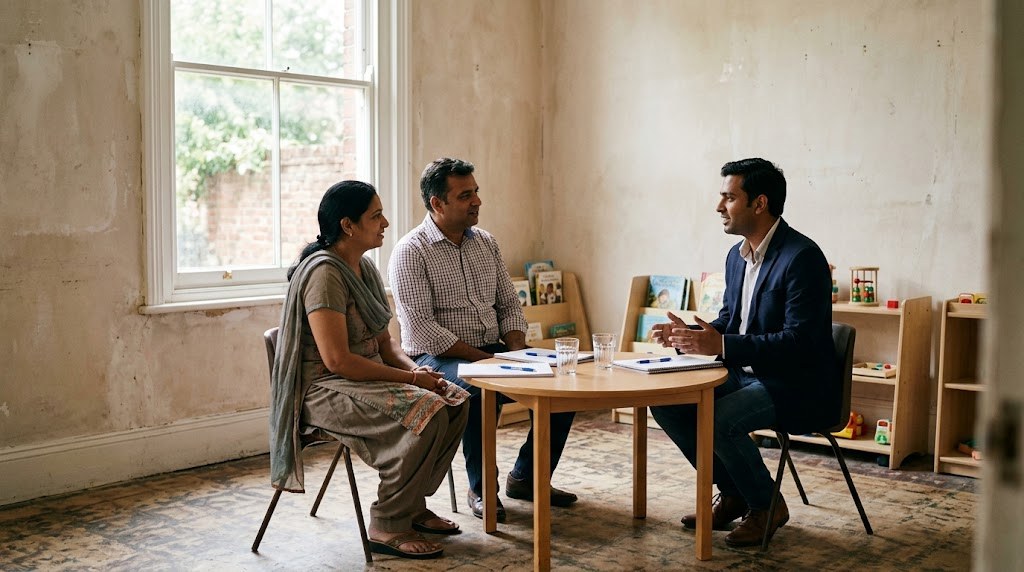
The RTE Act makes regular contact with parents part of a teacher’s duty. Section 24 lists among teachers’ duties to “hold regular meetings with parents and guardians” and inform them about attendance, ability to learn and progress. Where a School Management Committee applies, at least three-quarters of its members are parents or guardians, and half of its members are women (section 21).
Beyond the rules, parents trust a school that tells them things first:
- A calendar at the start of the year: holidays, exams, meetings, fee dates.
- One named contact per child, usually the class teacher.
- A short progress note each term that says what the child can now do, not only marks.
- A written complaints route with a reply time.
- Bad news first, from you: a fee change, a teacher leaving, an incident.
How to measure whether the school is working
Exam results arrive too late to act on. Track a few numbers that move every month, on one page.
| Measure | How often | What it tells you |
|---|---|---|
| Student attendance by class | Weekly | Which classes, and which children, are drifting |
| Teacher attendance and cover | Weekly | Where lessons are lost |
| Reading and maths checks | Each term | Whether children are learning, class by class |
| Lesson observations done | Monthly | Whether teaching is being supported |
| Parent concerns and response time | Monthly | Trust, before it shows up in withdrawals |
| Re-enrolment and withdrawals | Each term | Whether families choose you again, and why not |
| Fees collected against due | Monthly | Whether the school can keep its promises |
For national context, the Ministry of Education’s UDISE+ 2025-26 report, released in July 2026, puts the pupil-teacher ratio at 10, 12, 17 and 21 at the foundational, preparatory, middle and secondary levels, against the 30:1 ratio recommended by NEP 2020. CBSE clause 16.6 says the Board may make quality assessment mandatory; assess yourself first.
Running a school as a Country Head
Everything in this guide is the work of someone holding two jobs at once: business head and principal. That is the role NIJIN wants to fill in India. NIJIN Academy is an alternative school in Japan, online and in person, opened in September 2023. The Country Head starts and leads NIJIN Academy India: finding families, hiring and leading the team, growing revenue, and answering for what children experience. It is a role for a founder, not a franchise.
Investment is optional. You can co-own a local company set up with NIJIN (for example, you 20% and NIJIN 80%; if you invest, the guide is JPY 1 to 2 million from you and JPY 4 to 8 million from NIJIN), or begin on a service contract, even alongside your current work. Either way, the compensation guide is the same: as a guide, 10% of revenue excluding tax, up to JPY 50 million (reached at JPY 500 million of revenue). It is not a promise of income; with no revenue, the formula pays nothing. Anyone you ask to take on part of the role is paid from that 10%. Other terms are to be discussed in the interview.
Figures are those published by NIJIN. “Attendance recognition” means the school a child is registered at counts learning at NIJIN Academy as school attendance.
Teaching experience is not required; managing an organisation and hiring people carry over directly. English alone is fine.
Questions and answers
How do you run a school successfully in India?
Give five areas an owner and a weekly check: leadership, people, compliance, money and parents. Keep a compliance calendar, track a few measures monthly, and meet parents regularly.
How do you manage a private school’s fees?
Build fees from your cost lines and collect on fixed dates. Follow your state’s fee rules: CBSE schools charge only under heads the state prescribes and take no capitation fees or admission donations.
Can a school in India be run as a business?
Schools are usually run by a trust, society or Section 8 company. CBSE’s Bye-Laws require that the school is run “as a community service and not as a business”. Other models, such as tutoring or support for open schooling, follow different rules. Take legal advice for your own case.
What happens if a school loses RTE recognition?
Under section 18(3), recognition is withdrawn by written order, which names the neighbourhood school the children are to join. Under section 19(5), running a school after withdrawal brings fines, including a daily fine while it continues.
Is the Country Head role a job or a business?
Both. You lead NIJIN Academy India as its business head and principal, either as a co-owner of a local company or on a service contract to begin with. As a guide, compensation is 10% of revenue up to JPY 50 million, and it is not guaranteed. Other terms are to be discussed in the interview.
Lead a school in India, with a team behind you
NIJIN is looking for one person to start and lead NIJIN Academy India, as its business head and its principal. Teaching experience is not required. If you have led people, hired people, and want to build a school for children who do not fit school, read the role.
See the Country Head role in IndiaWhere to go next
NIJIN Academy Country Head pages are open for several countries, and the global page covers every other country.
Related guides for school leaders
- How to start a school in India: approvals, step by step
- How to become a school principal in India
- School business plan for India: a ten-section template
- School recognition under the RTE Act
- School principal jobs in India
- Country manager in education: the role and three pay models
Sources
Laws, board rules and data are quoted as published on the pages below. Please check the original for later amendments and your state’s rules.
- https://panchayatwiki.lsgkerala.gov.in/THE_RIGHT_OF_CHILDREN_TO_FREE_AND_COMPULSORY_EDUCATION_ACT,_2009
- https://www.education.gov.in/rte
- https://www.cbse.gov.in/cbsenew/aff-bye-laws.html
- https://www.cbse.gov.in/cbsenew/affiliation.html
- https://udiseplus.gov.in/
- https://www.pib.gov.in/PressReleasePage.aspx?PRID=2282141
- https://nijin.co.jp/recruit/nijin-academy-india-country-head/
- https://nijin.co.jp/recruit/en/