For education founders in India
A democratic school is a school where children share real decisions: what they learn, how their day is spent, and the rules the community lives by, usually through a regular meeting in which children and adults each have a voice. A democratic school in India is possible, but it has to work inside the RTE Act’s recognition rules for Classes 1 to 8 and choose a board, often NIOS, for the certificates that come after.
This guide is for people who want to start or lead such a school in India. Rules differ by state, so treat it as a map, not legal advice.
In this article
- What is a democratic school?
- What is democratic education, and where does it come from?
- Democratic and learner-led schools in India
- What Indian law fixes, and what it leaves open
- Boards, certificates and the NIOS route
- Why democratic schools are hard to run in India
- How a democratic school in India can be organised
- Where NIJIN Academy fits
- Questions and answers
What is a democratic school?
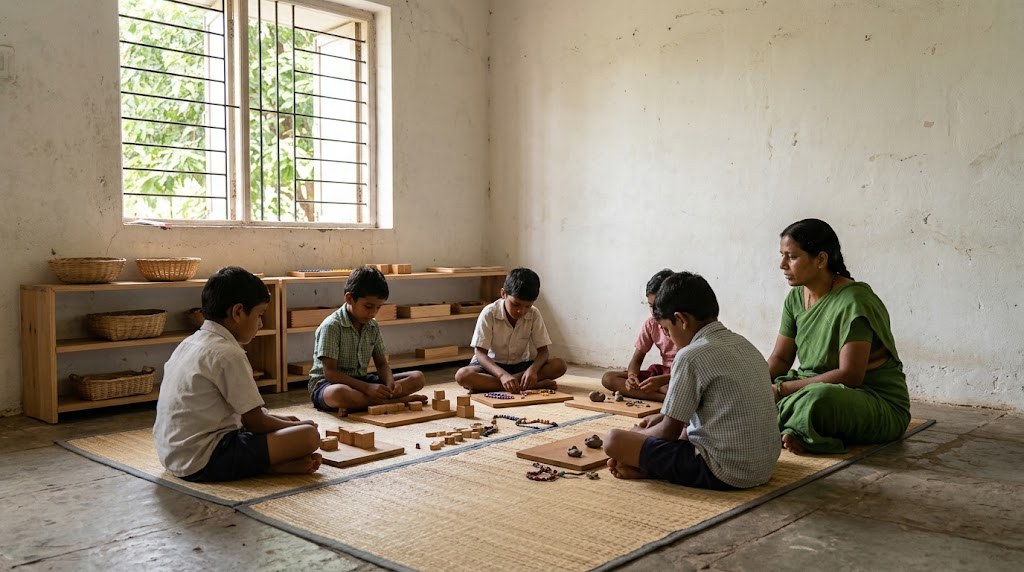
There is no legal category called “democratic school” in India. The term describes a way of running a school, not a licence. Two features appear in almost every school that uses the name:
- Self-directed learning. Children choose much of what they study and when. Adults mentor and offer lessons, but do not impose one timetable on everyone.
- Shared governance. Rules are made, and often enforced, by a meeting of the whole community, where children and staff speak and vote.
Schools mix these in different proportions. It helps to separate the decisions a school can share:
| Decision | In a conventional school | In a democratic school | The Indian constraint to plan for |
|---|---|---|---|
| What to learn today | The timetable and the board syllabus | The child, with an adult mentor | The curriculum and evaluation laid down under RTE section 29 for Classes 1 to 8 |
| How learning is shown | Tests, marks and ranks | Projects, portfolios, conversations | A regular examination in Class 5 and Class 8 (RTE section 16) |
| Everyday rules | Set by the principal and staff | Made at a school meeting | Safety and child protection stay with the adults and the management |
| How conflicts are settled | Discipline by staff | A meeting or a committee with children on it | No physical punishment or mental harassment (RTE section 17) |
| Budget, staff, admissions | The management | Sometimes shared with the meeting | The legal entity and its trustees or directors remain answerable |
The last column tells you which decisions you can hand to children, and which ones the law expects an adult to sign for.
What is democratic education, and where does it come from?
Summerhill School in Suffolk, England, says on its website that self-government has operated “since the school began in 1921”, with each person having an equal vote in school meetings, held twice a week. Sudbury Valley School in Framingham, Massachusetts, describes itself as pioneering self-directed education since 1968, and many later schools call themselves “Sudbury-model” schools.
India’s own law points the same way. The RTE Act, in section 29(2), tells the academic authority setting the elementary curriculum to consider “learning through activities, discovery and exploration in a child friendly and child-centered manner”, and “helping the child to express views freely”. Article 12 of the UN Convention on the Rights of the Child gives every child capable of forming views the right to express them in all matters affecting the child, given due weight according to age and maturity.
Democratic and learner-led schools in India
Online lists of “democratic schools in India” are hard to verify. We include only schools whose own websites we read in November 2026, described in the words those sites use. Neither calls itself a “democratic school” in the pages we read; both put the learner’s choice at the centre.
Mirambika Free Progress School, New Delhi
Founded in 1981 on the campus of Sri Aurobindo Ashram, Delhi Branch. Its site describes an experimental school up to Class VIII, recognised by the Directorate of Education, Delhi, with no pre-set curriculum or syllabus, where “the learning environment allows the learner to choose what he wants to learn”. Teachers, called diyas, act as guides and facilitators.
Shibumi, near Bengaluru
A learning centre in Ramanagara District, Karnataka, based on J. Krishnamurti’s teachings. Its site describes “adult-assisted self-learning” at each child’s own pace, mixed-age grouping to reduce comparison, and non-comparative evaluation. It is registered as a non-profit charitable trust and depends on parents’ contributions for running costs.
Mirambika shows that having no pre-set syllabus and holding recognition from a state authority can go together; how that was arranged is specific to Delhi, so ask your own state. Shibumi shows the cost side: a small trust that depends on fees.
We could not confirm, from its own site, any school in India running the full Sudbury model of equal votes on staff and budget. For the wider family of approaches (Montessori, Waldorf, Krishnamurti, Tagore), see alternative schools in India.
What Indian law fixes, and what it leaves open
The Right of Children to Free and Compulsory Education Act, 2009 covers elementary education, defined in section 2(f) as first class to eighth class. The recognition process itself is covered in school recognition under the RTE Act; here we look only at how five provisions meet a democratic model.
| RTE provision | What it says | What it means for a democratic school |
|---|---|---|
| Section 18 | No school other than a government or local-authority school may be established or function without a certificate of recognition | A full-time school for six- to fourteen-year-olds needs recognition, however it is run inside |
| Section 19 and the Schedule | Norms for teachers, buildings and hours, including 200 working days and 800 instructional hours a year for Classes 1 to 5, and 220 days and 1,000 hours for Classes 6 to 8 | Children can choose how to use the time, but the school must offer it |
| Section 16 (as substituted in 2019) | A regular examination in the fifth and eighth class every year, with re-examination; no child is to be expelled until elementary education is complete | Self-directed learning must still prepare children for these two examinations |
| Section 21 | A School Management Committee, at least three-quarters parents, for government, aided and specified-category schools; unaided schools are excluded | A private unaided school is free to design its own governance, including a school meeting |
| Section 29(2) | Curriculum to be child-centred, through activity, discovery and exploration, and to help children express views freely | The law’s own wording supports a learner-led approach |
Quoted from the Act as published by the Department of School Education and Literacy (text last updated 26 July 2021). Several states have their own amendments and rules; check the current version with your state education department.
Boards, certificates and the NIOS route
Parents in a democratic school will ask what every parent in India asks: which certificate after Class 10 and Class 12? There are three broad answers. Affiliate to a State Board, CBSE or CISCE and meet its syllabus in your own way (see how to start a CBSE school in India). Prepare older learners for the examinations of the National Institute of Open Schooling (NIOS). Or combine: a learner-led elementary stage that meets RTE requirements, then NIOS for the secondary stage.
Source: NIOS Academic Prospectus 2026–27, which states that NIOS certificates are recognised for higher education, government jobs and all other purposes. Open Basic Education is run with NGOs; check the current NIOS rules for eligibility.
NIOS suits a democratic school because learners take subjects at their own pace. The National Education Policy 2020 (paragraph 3.6) also says school requirements will be made less restrictive “to allow alternative models of education”; it is a policy, not a law. For the practical side, read how to start a NIOS study centre and open schooling in India.
Want to build a school around children’s choices in India, with a model that already runs?
NIJIN Academy is an alternative school in Japan, opened in September 2023 and run by NIJIN Inc. Children attend from home through a metaverse campus, choose from about 100 live online classes a month, and can also go to 52 physical classrooms across Japan. NIJIN is looking for one person to start and lead NIJIN Academy India, as its business head and its principal. Teaching experience is not required.
See the Country Head role in IndiaWhy democratic schools are hard to run in India
The difficulty is rarely the idea. It is daily pressure:
- Marks still decide the next step. Families who like the idea at seven may lose their nerve at thirteen. Show the route to Class 10 and 12 early.
- The Class 5 and Class 8 examinations. Section 16 provides for a regular examination in each; children still need to be ready.
- Adults who can hold back. Mentoring without directing is a skill, and staff turnover can quietly undo it.
- Small groups cost money. Shibumi says on its own site that its centre has to be small and that this makes costs high.
- Freedom and safety together. A school meeting can make rules about phones or noise. It cannot vote away child protection, fire safety or the duty of care. Write down which decisions belong to the meeting before the first one is held.
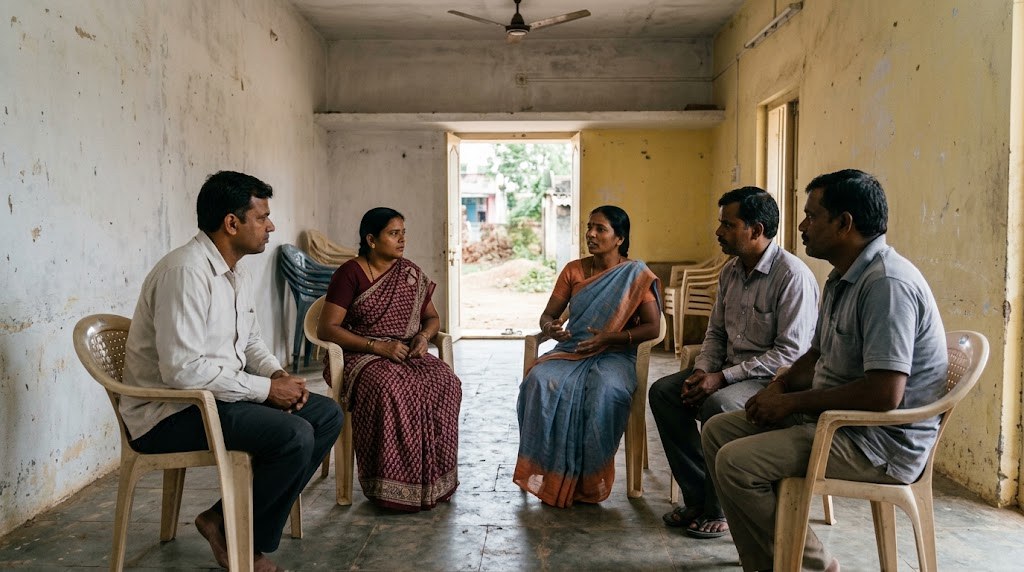
Before you rent a building, ask your state education department for written answers to these questions:
- Will a full-time setting for ages six to fourteen with no fixed daily timetable be considered for recognition, and on what conditions?
- Which academic authority’s curriculum and evaluation apply under section 29, and how much freedom in method does it allow?
- How are the Class 5 and Class 8 examinations conducted for an unaided school in this state?
- Does a part-time learning centre for children registered elsewhere need any registration?
- Which legal forms may hold a school’s recognition here?
- Can older learners at our site sit NIOS examinations, and through which study centre?
How a democratic school in India can be organised
A democratic culture can live inside several shapes, and the shape decides what you can promise families.
| Form | Who it serves | Strength | Main risk |
|---|---|---|---|
| Recognised full-time school | Children for whom this is their main school | A recognised school; the RTE route is clear | Infrastructure and staffing norms before the first child arrives |
| Learning centre for older learners on NIOS | Ages 14 and up, often children who left school | Pace and subject choice fit self-directed learning | Families must understand the open-schooling route |
| Part-time or after-school programme | Children enrolled elsewhere, or homeschooled | Low start-up cost; tests the model with real families | Not a school; cannot replace one for ages six to fourteen |
| Hybrid: online classes plus a physical site | Children choosing from a wider menu than one site can offer | More subjects and peers than a small room can hold | Where the child is legally enrolled must be settled |
The school meeting sits inside the legal entity, not above it. Shibumi is a charitable trust; whatever a meeting decides, the trustees remain answerable in law. Write a short constitution: what the meeting, the head and the trustees each decide. Families who want this kind of learning without a school are covered in homeschooling in India, and daily leadership in how to run a school in India.
Where NIJIN Academy fits
NIJIN Academy does not call itself a democratic school in the Summerhill sense. What it shares with the idea is a starting point: the child chooses. In Japan, children choose from about 100 live online classes a month, attend from home through a metaverse campus, and can also go to physical classrooms. The company’s working principle is “don’t blame people, build systems”.
Figures are those published by NIJIN. “Attendance recognition” means the child’s registered school counts learning at NIJIN Academy as school attendance.
NIJIN is looking for a Country Head to start and lead NIJIN Academy India, as business head and principal. It is not a franchise. You can start on a service contract, even as a side job, or as a co-owner of a local company set up together (for example, you 20% and NIJIN 80%). Investment is optional; if you invest, the guide is JPY 1 to 2 million from you and JPY 4 to 8 million from NIJIN, decided together. Either way, compensation is, as a guide, 10% of revenue excluding tax, up to JPY 50 million. It is not a promise of income: with no revenue, the formula pays nothing. Other terms are discussed in the interview.
Questions and answers
What is a democratic school?
A school where children share real decisions about their learning and the community’s rules, usually through a regular school meeting where children and adults speak and vote. Summerhill in England, self-governing since 1921, is the best-known example.
What is democratic education?
The idea that children learn to govern themselves by doing it, and learn best when the learning is their own. In practice it combines self-directed learning with shared governance, in different proportions.
Is there a democratic school in India?
Several Indian schools put the learner’s choice at the centre. Mirambika Free Progress School in New Delhi says it has no pre-set syllabus; Shibumi near Bengaluru describes adult-assisted self-learning. Check any school’s current practice and recognition with the school itself.
Is a democratic school legal in India?
How a school runs inside is largely its own choice, but a full-time school for Classes 1 to 8 needs a certificate of recognition under section 18 of the RTE Act and must meet the Schedule’s norms. Rules differ by state; ask your state education department in writing.
Can children from a democratic school take board exams?
Yes, through the board the school affiliates to, or through NIOS, whose Secondary course has a minimum age of 14 and lets learners pass subjects one at a time within five years.
Do I need teaching experience to start one?
Teacher qualifications for a recognised school’s staff are set by law, so check them with your state. To lead NIJIN Academy India, teaching experience is not required; managing an organisation and hiring people matter most.
Build a school in India where children choose
NIJIN is looking for one person to start and lead NIJIN Academy India, as its business head and its principal. If you want to start a company in India and solve a problem in education, read the role.
See the Country Head role in IndiaWhere to go next
NIJIN Academy Country Head pages are open for several countries, and the global page covers every other country.
Related guides for founders
- Alternative schools in India
- Microschool in India
- School recognition under the RTE Act
- How to start a NIOS study centre
- School refusal in India
- Alternative school vs traditional school
Sources
All pages were opened in November 2026. Laws, prospectuses and school pages change; please check the original for updates.
- https://www.dsel-education.gov.in/static/uploads/2025/09/ee3cf9ae4ddbc3d0582e98f050290edc.pdf
- https://www.education.gov.in/rte
- https://static.pib.gov.in/WriteReadData/userfiles/NEP_Final_English_0.pdf
- https://dq4kzxd7fbbni.cloudfront.net/static/dist/images/pdf/academic_prospectus/Academic_Prospectus_2026-27.pdf
- https://www.unicef.org/child-rights-convention/convention-text
- https://www.summerhillschool.co.uk/self-government/
- https://sudburyvalley.org/
- https://www.mirambika.org/mira-history.php
- https://shibumi.org.in/about-shibumi/educational-process/
- https://shibumi.org.in/about-shibumi/practical-matters/
- https://nijin.co.jp/recruit/nijin-academy-india-country-head/