For education founders in the Philippines
Learning poverty means being unable to read and understand a short, age-appropriate text by age 10, and the World Bank’s Philippines Learning Poverty Brief (June 2022) puts the rate in the Philippines at 91 percent (90.9%), based on Grade 5 reading data from 2019. Because only about 5 percent of primary-age children were out of school, almost all of that figure describes children who were in school but not yet reading with understanding.
Below: how the measure works, what the Philippine numbers say, what PISA 2022 adds, why the gap appears, what the law asks the Department of Education (DepEd) to do, and where founders of learning places can help. Every figure carries its year and source.
In this article
- What learning poverty means
- The learning poverty rate in the Philippines
- How to read learning poverty statistics
- What PISA 2022 shows about 15-year-olds
- Why learning poverty happens: what the data point to
- What the government is doing
- What education entrepreneurs can do
- Where NIJIN Academy fits
- Questions and answers
What learning poverty means
Learning poverty is an indicator built jointly by the World Bank and the UNESCO Institute for Statistics (UIS). It focuses on reading because reading is the gateway to every other subject and a good stand-in for foundational learning. It tracks SDG 4.1.1b: every child at the end of primary reaching at least minimum proficiency in reading.
It is not a measure of household income: “poverty” here means lacking a basic skill, not money. People searching for “education poverty in the Philippines” often mean this indicator, though income poverty and learning poverty only overlap, as the PISA data below show.
The formula the World Bank uses. LP = SD + [(1 − SD) × LD]
- LP, Learning Poverty: the result.
- SD, Schooling Deprivation: the share of primary-age children who are out of school. All of them are assumed to be below minimum proficiency.
- LD, Learning Deprivation: the share of pupils at the end of primary school who are below the minimum proficiency level in reading.
When few children are out of school, LP is close to LD.
Across low- and middle-income countries, the World Bank and its partners estimated in June 2022 that 70 percent of 10-year-olds could not read and understand a simple text.
The learning poverty rate in the Philippines
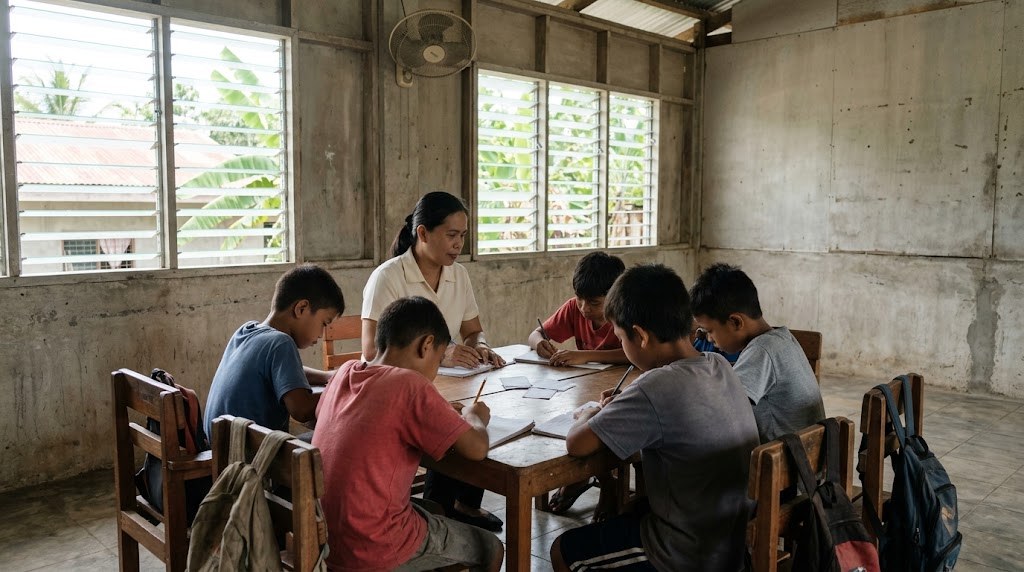
The World Bank’s Philippines Learning Poverty Brief (June 2022) uses UIS and World Bank data as of May 2021. Learning deprivation is proxied by Grade 5 results in the Southeast Asia Primary Learning Metrics (SEA-PLM) 2019, and enrolment data are for 2019.
| Indicator (Philippines) | Boys | Girls | All |
|---|---|---|---|
| Learning poverty (%) | 92.1 | 89.7 | 90.9 |
| Learning deprivation: below minimum reading proficiency at end of primary (%) | 91.7 | 89.2 | 90.4 |
| Schooling deprivation: primary-age children not enrolled (%) | 5.1 | 4.8 | 5.0 |
| Human Capital Index | 0.49 | 0.54 | 0.52 |
| Learning-adjusted years of schooling | 7.2 | 7.8 | 7.5 |
Source: World Bank, Philippines Learning Poverty Brief, June 2022 (Table 1). LP, LD and SD from UIS and World Bank as of May 2021; HCI and LAYS from EdStats/WDI.
The brief adds three comparisons:
- Learning poverty in the Philippines is 56.4 percentage points higher than the average for East Asia and the Pacific, and 30.5 points higher than the average for lower-middle-income countries.
- Boys are worse off than girls on both parts of the measure: more boys are out of school (5.1% against 4.8%) and more boys finish primary below minimum proficiency (91.7% against 89.2%).
- Public spending on primary education per child of primary age was USD 569 (PPP), which the brief says is 83.5% below the regional average and 29.5% below the average for lower-middle-income countries. That spending figure is from 2009, so treat it as old data.
How to read learning poverty statistics
Searches for “learning poverty in the Philippines statistics” turn up different percentages. The brief itself warns that its harmonised numbers may differ from official government statistics, and other publications use other assessments and years. Before you quote a figure, check five things.
- Which assessment? The 2022 brief uses SEA-PLM 2019. The Philippines also took part in TIMSS (2003, 2019) and PISA (2018), and PISA again in 2022.
- Which age? Learning poverty is about age 10; PISA tests 15-year-olds.
- Which year? A 2022 report can describe children tested in 2019, before the school closures.
- Is it adjusted for out-of-school children? Learning poverty is; a plain test result is not.
- Harmonised or national? The Philippines’ own National Large-Scale Assessment may report differently.
What PISA 2022 shows about 15-year-olds
The OECD’s PISA 2022 country note shows where the problem leads five years later. In the Philippines, 7,193 students in 188 schools took the test, representing about 1,782,900 15-year-olds, an estimated 83% of the age group. Average results in 2022 were about the same as in 2018 in all three subjects.
Source: OECD, PISA 2022 Results (Volume I and II), Country Notes: Philippines. Level 2 is the OECD’s baseline level of proficiency.
The note also describes school life:
| PISA 2022 finding | Philippines | OECD average |
|---|---|---|
| Students who feel they belong at school | 84% | 75% |
| Students who feel lonely at school | 28% | 16% |
| Students in schools where a lack of teaching staff hinders instruction | 43% | not stated in the note |
| School building closed for more than three months due to COVID-19 | 55% | 51% |
| Supported daily through live virtual classes during closures | 21% | 51% |
| Asked daily by someone from school how they were feeling | 18% | 13% |
Filipino students report a strong sense of belonging, so the gap is not a lack of care. But 36% of those tested were in the bottom international socio-economic quintile, the largest group, averaging 344 points in mathematics. Here income poverty and learning poverty meet.
Why learning poverty happens: what the data point to
No single report proves the causes, but the official sources point to the same few pressures.
- Children are in school but below the reading line. With schooling deprivation at 5% and learning deprivation at 90.4%, the main issue is inside primary classrooms.
- Resources per child are thin. The brief’s spending figure is far below the regional average, and in PISA 2022, 43% of students were in schools whose principal said a lack of teaching staff hinders instruction.
- Gaps build up instead of closing. A quarter of 15-year-olds had repeated a grade; a child who cannot read at 10 meets harder texts every year after.
- Long school closures. More than half of PISA students saw their school building closed for over three months, and few had daily live online classes during that time.
- Household disadvantage. More than a third of tested students were in the bottom international socio-economic quintile.
Some children who fall behind leave school altogether; that story is in our guide to out-of-school youth in the Philippines.
Want to build a learning place for children the system is not reaching?
NIJIN Academy is an alternative school in Japan for children who do not fit conventional school, opened in September 2023. It combines a metaverse campus, about 100 live online classes a month and 52 physical classrooms across Japan. NIJIN is looking for one person to start NIJIN Academy Philippines and lead it, as both business head and principal. Teaching experience is not required.
See the Country Head role in the PhilippinesWhat the government is doing
The clearest recent response is in law. Republic Act No. 12028, the Academic Recovery and Accessible Learning (ARAL) Program Act, was approved on 16 October 2024. It sets up a free national learning intervention programme run by DepEd.
| Question | What RA 12028 says |
|---|---|
| Who is covered? | Public school learners from Kindergarten to Grade 10 who have returned or are returning to school after a furlough, who are below minimum proficiency in reading, mathematics and science, or who are failing tests (Section 3) |
| Which subjects? | Essential learning competencies in reading and mathematics for Grades 1 to 10 and science for Grades 3 to 10, with reading and mathematics prioritised; foundational literacy and numeracy for Kindergarten (Section 5) |
| How? | Systematised tutorial sessions, one-on-one or group tutorials, intervention plans built with curriculum and reading specialists, and support for learners’ well-being (Section 4) |
| Who tutors? | Teachers (not of their own learners), para-teachers and pre-service teachers; DepEd may also engage other qualified individuals under the implementing rules (Section 7) |
| Private schools? | Similarly situated learners in qualified private schools receive the same interventions on request, with preference for Educational Service Contracting beneficiaries where slots are limited (Section 3) |
For learners outside formal school, the Alternative Learning System Act (Republic Act No. 11510) provides a parallel route, explained in our guide to the Alternative Learning System. DepEd also issues its own orders on reading and curriculum; check current versions on its website or with your Schools Division Office.
What education entrepreneurs can do
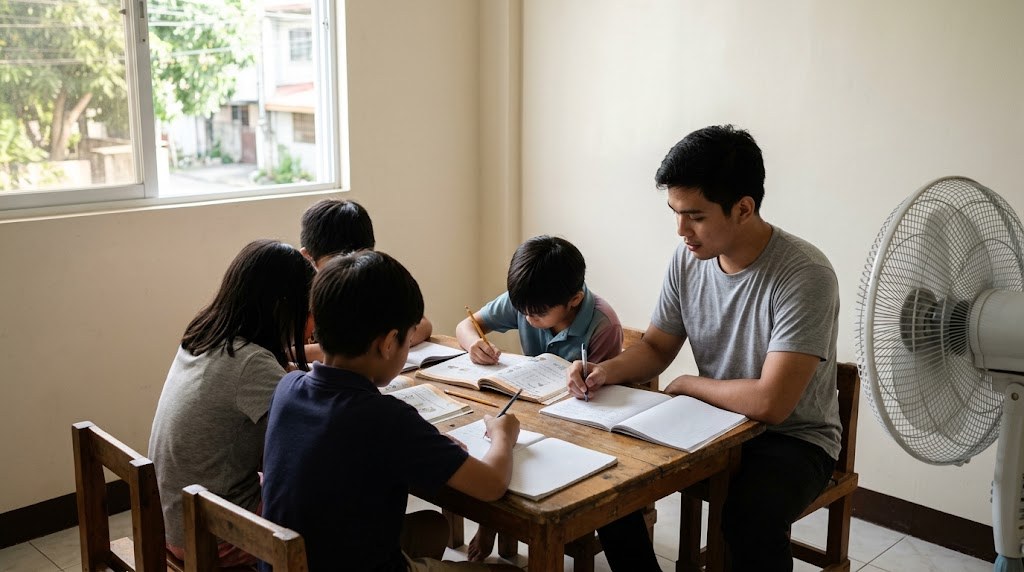
The public system carries most of the load. A founder’s job is to reach the children it struggles to reach, and to do one thing very well.
- Start with a reading check, not a curriculum. If nine in ten children finish primary below the reading line, first find where each child is, and show parents.
- Keep groups small. The ARAL Act itself relies on tutorials and small groups, after school, at weekends or in the summer break.
- Make it about belonging, too. 28% of PISA students feel lonely at school. A place where children are known and safe keeps them coming back long enough to learn.
- Use online classes to widen what a small site can offer. Live online lessons plus a physical room can give children on distant islands more teachers than one site could.
- Work alongside schools, ALS and homeschooling. Ask your Schools Division Office how a private provider can support learners enrolled elsewhere. The registration steps for a tutorial or learning center are in our guide on how to start a learning center in the Philippines.
- Measure and publish honestly. Report reading progress plainly, never promise test scores, and compare like with like.
A note on ownership. Under Article XIV, Section 4(2) of the 1987 Constitution, educational institutions other than those established by religious groups and mission boards are, as a rule, to be owned solely by Filipino citizens or by corporations or associations at least 60 percent of whose capital is owned by Filipino citizens, and their control and administration are vested in Filipino citizens. Confirm your structure with DepEd and a Philippine lawyer before you register; this is not legal advice.
Where NIJIN Academy fits
NIJIN Inc. was founded by Tatsuro Hoshino, who taught at a public elementary school in Japan for seven years. NIJIN Academy, opened in September 2023, serves children who do not fit conventional school, many of whom had stopped going. Its principle: do not blame people, build systems. It makes no promise about test scores; it is a place where children who had given up on school begin to like learning again.
Figures are those published by NIJIN. “Attendance recognition” means the school a child is registered at counts learning at NIJIN Academy as school attendance.
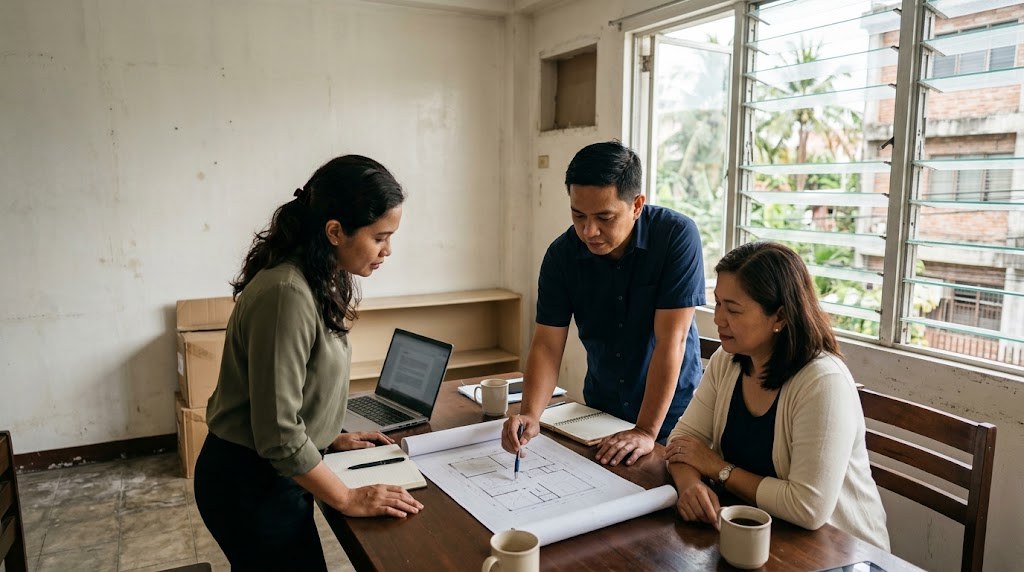
The Country Head starts NIJIN Academy Philippines and leads it as business head and principal. What matters is leadership, management, business ability and a principal’s skills.
- Compensation, as a guide: 10% of revenue (excluding tax), up to JPY 50 million. JPY 100 million of revenue gives JPY 10 million; JPY 200 million gives JPY 20 million. This is a guide, not a promise of income: with no revenue, the formula pays nothing.
- Investment is optional. You can start on a service contract, even alongside your current work, or as a co-owner of a local company.
- Ownership in the Philippines: NIJIN’s role pages give “20% of the shares for the Country Head, 80% for NIJIN” only as an example. In the Philippines, because of the constitutional rule above, the form would be designed to comply with Philippine law, decided in the interview and with professional advice.
- Not a franchise. You do not buy a format; you build and lead the school with NIJIN.
Questions and answers
What is learning poverty in the Philippines?
The share of children who cannot read and understand a short, age-appropriate text by age 10, adjusted for out-of-school children, as calculated by the World Bank and UIS.
What is the learning poverty rate in the Philippines?
The World Bank’s Philippines Learning Poverty Brief (June 2022) gives 91 percent, rounded from 90.9%: 92.1% for boys and 89.7% for girls. It is based on SEA-PLM Grade 5 data from 2019, so it describes the situation before the pandemic school closures.
Where can I find the Philippines learning poverty brief?
It is a two-page PDF on the World Bank’s documents site, linked in the sources below.
Are the World Bank numbers the official government statistics?
Not necessarily. The brief states that its numbers come from harmonisation by UIS and the World Bank for comparison across countries, and may differ from official statistics reported by governments. For national results, look to DepEd’s own assessments.
Is learning poverty the same as education poverty?
“Education poverty” is used loosely. Learning poverty is one precise indicator about reading by age 10, not an income measure.
What is the government doing about learning poverty?
Republic Act No. 12028 (ARAL Program Act, 16 October 2024) creates free tutoring in reading, mathematics and science for public school learners from Kindergarten to Grade 10. The ALS Act covers learners outside formal school.
Is the NIJIN Country Head a job or a business?
It is closer to starting a business. The Country Head leads NIJIN Academy Philippines as business head and principal, with compensation tied to revenue as a guide, not a fixed salary. You can start on a service contract or as a co-owner. Contract type, location and timing are discussed in the interview.
Start NIJIN Academy Philippines, and lead it
If these numbers make you want to build something, and you have led and hired a team, read the role. Teaching experience is not required.
See the Country Head role in the PhilippinesWhere to go next
Country Head pages are open for several countries, and the global page covers every other country.
Related guides for founders
- Out-of-school youth in the Philippines: the numbers and the reasons
- The Alternative Learning System (ALS) in the Philippines
- How to start a learning center in the Philippines
- How to start a school in the Philippines
- Social entrepreneurship in education
Sources
All figures in this article are quoted with the year they refer to. Please check the original for later updates.
- https://documents1.worldbank.org/curated/en/099000207152223103/pdf/IDU002b5536c0db4104ec3087d809906ec2eae56.pdf
- https://www.worldbank.org/en/news/press-release/2022/06/23/70-of-10-year-olds-now-in-learning-poverty-unable-to-read-and-understand-a-simple-text
- https://www.oecd.org/en/publications/pisa-2022-results-volume-i-and-ii-country-notes_ed6fbcc5-en/philippines_a0882a2d-en.html
- https://lawphil.net/statutes/repacts/ra2024/ra_12028_2024.html
- https://lawphil.net/statutes/repacts/ra2020/ra_11510_2020.html
- https://lawphil.net/consti/cons1987.html
- https://www.deped.gov.ph/
- https://nijin.co.jp/recruit/nijin-academy-philippines-country-head/
- https://nijin.co.jp/recruit/en/