For education founders in the US
To start a hybrid school, decide first who is legally responsible for the child’s education on the days the child is at home, because that one answer tells you whether you are building a private school or a program that serves homeschooling families; only then design the week, the staffing and the tuition around it. Most hybrid programs that struggle got the order the other way round.
A hybrid school, in the sense most American parents mean when they search for one, is a program where children come to a campus on some days of the week and learn at home, with a parent or online, on the others. This guide covers the models, sample weekly schedules, staffing, tuition and the state-by-state legal question. If you are still choosing a format, read our comparison of homeschooling, online school and alternative school first.
In this article
- What a hybrid school is: three common models
- Why families are looking for hybrid programs
- Step 1: Decide who teaches on home days
- Step 2: Design the hybrid school schedule
- Step 3: Staff the campus days and support the home days
- Step 4: Choose your legal route, state by state
- Step 5: Set tuition from your own numbers
- Step 6: A twelve-month launch plan
- On your own, or as NIJIN Academy US
- Questions and answers
What a hybrid school is: three common models
There is no single legal definition of a hybrid school in the United States. The word covers several programs that share one feature: the child’s week is split between a place you run and the child’s home. What differs is who does the teaching at home, and that difference drives everything else.
| Model | Campus days | Home days | Who carries the home days |
|---|---|---|---|
| Homeschool hybrid (part-time campus) | Two or three days of core classes taught by your staff | Assignments set by your teachers, completed at home | Parents, following your plan |
| Enrichment or co-op hybrid | One or two days of electives, labs, arts, sport and social time | The family’s own homeschool curriculum | Parents, with their own plan |
| Online-plus-campus hybrid | One to three days of in-person projects and community | Live online classes taught by your teachers | Your online teachers, with a parent nearby |
The first model behaves most like a school, the second like a service to homeschoolers. The third takes the most work off parents and costs the most to staff.
Why families are looking for hybrid programs
Learning outside a conventional school building is no longer rare. The National Center for Education Statistics (NCES) reported in September 2024 that parents said about 5.2% of children aged 5 to 17 received academic instruction at home in the 2022–23 school year, up from about 3.7% in 2018–19. In the same release, the NCES Commissioner described more students pursuing education outside the brick-and-mortar school through virtual programs, microschools and other home-based models.
A hybrid program serves two of these families: homeschoolers who want structure and classmates, and families leaving a conventional school. Decide which you are building for.
Step 1: Decide who teaches on home days
Write one sentence that answers this question: on a home day, who is responsible for what this child learns? There are only three honest answers.
- The parent. The family is homeschooling, and your program supports them. The state’s homeschool rules apply to the parent.
- Your school, through the parent. The child is enrolled with you, your teachers set the work, and the parent supervises it at home. You are likely acting as a private school.
- Your school, through your own teachers online. The child is enrolled with you and taught live by your staff on home days. You are almost certainly a school.
What you promise parents, how you keep records and which office you talk to all follow from this sentence. If unsure, start with the first answer: it is the lightest to launch.
Step 2: Design the hybrid school schedule
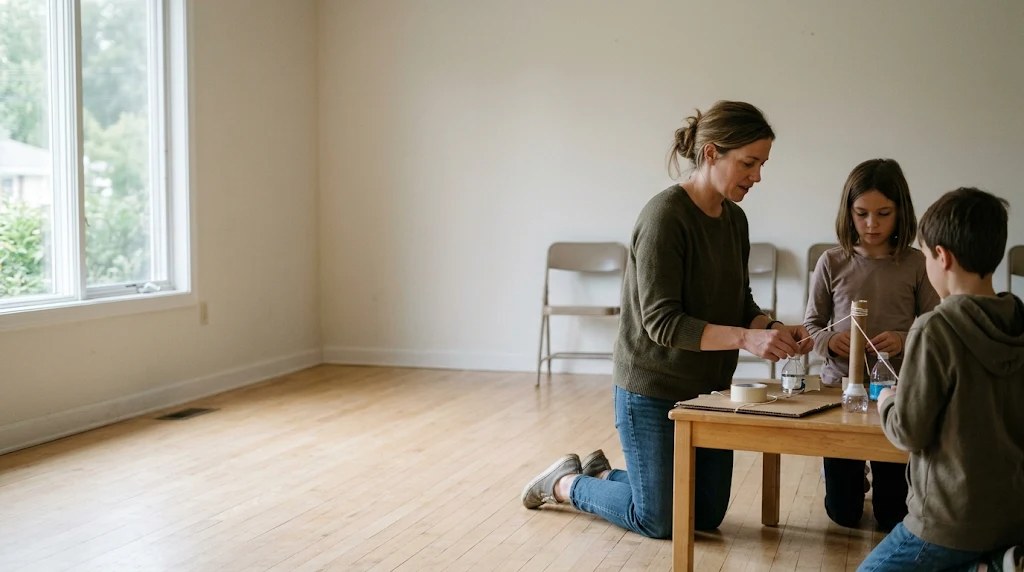
Parents want to see the week on one page. Three patterns cover most programs.
| Pattern | Mon | Tue | Wed | Thu | Fri |
|---|---|---|---|---|---|
| 2-day campus | Campus: core classes | Home: assigned work | Campus: core classes | Home: assigned work | Home or field trip |
| 3-day campus | Campus | Home | Campus | Home | Campus: projects and assessment |
| Online plus campus | Online live classes | Campus: projects | Online live classes | Campus: projects | Online, or open studio |
Three rules make any pattern work. Put work that needs a teacher (new concepts, discussion, labs, feedback) on campus and practice at home. Give parents a written plan for each home day, with the time it should take. And keep campus days fixed: families build jobs and transport around them.
Step 3: Staff the campus days and support the home days
Map the roles before you hire. In year one, expect one person to hold two or three of them.
| Role | What it covers | Often filled by |
|---|---|---|
| Director (head of school) | Admissions, parents, compliance, budget, hiring | The founder |
| Lead teacher per age group | Campus-day teaching, home-day plans, progress reports | Part-time or full-time teachers |
| Subject specialists | Maths, science, languages, arts for older grades | Part-time instructors or live online teachers |
| Campus coordinator | Arrivals, safety, supplies, the room itself | A part-time staff member or volunteer |
| Parent as home teacher | Running the home days to your plan | Each family, with your guidance |
Whether your teachers need a state teaching certificate depends on your legal route and your state, and the answer is not the same everywhere; ask your state’s office in writing. Whatever the law requires, build background checks, a safeguarding procedure and first aid into hiring from day one. For parents, a short orientation and a fixed weekly time when a teacher answers questions do more for retention than a long handbook.
Want to found a hybrid school in the United States with a model that already runs?
NIJIN Academy is an alternative school in Japan, opened in September 2023 and run by NIJIN Inc. Its model is hybrid: children join from home through a metaverse campus, choose from about 100 live online classes a month, and can also go to 52 physical classrooms across Japan. NIJIN is looking for one founder to launch and lead NIJIN Academy US, as both its business head and its principal. Teaching experience is not required.
See the Country Head role in the United StatesStep 4: Choose your legal route, state by state
In the United States, private schools and homeschooling are regulated by each state, not by one national rule. In practice, hybrid programs usually take one of two routes. This section describes them in general terms; it is not legal advice, and the rules change.
Route A: a private school
Your program is the school. Children are enrolled with you, you meet your state’s private school requirements, and the home days are part of your program. Suits the first and third models. See how to start a private school in the US.
Route B: a service to homeschoolers
Each family homeschools under the state’s homeschool law, and you provide classes, a co-op or tutoring on some days. Suits the second model. The family, not you, holds the homeschool duties.
Two states, from their own official pages:
| State | What the official page says | What it means for a hybrid founder |
|---|---|---|
| Texas | The Texas Education Agency (TEA) states that it does not have oversight of private schools, that home schools can legally operate as private schools under the Leeper ruling, and that home schools must use a written curriculum including reading, spelling, grammar, math and good citizenship. TEA does not regulate, register or accredit homeschool programs. | Both routes exist, with light state oversight. Read our Texas microschool guide for the detail, including child-care licensing questions. |
| North Carolina | The Division of Non-Public Education (DNPE) requires parents to file a Notice of Intent before operating a home school, plus instruction for at least nine calendar months, attendance and immunization records and an annual standardized test. It states that an online program does not replace the family’s duty to establish a home school, that families may use tutors and other instructors, and that a home school may include students from up to two households under conditions set by law. | Under Route B, each family files its own home school with DNPE, and your program is one of the instructors they use. Your program does not become the families’ home school. |
For every other state, including California, Florida and Arizona, start with your state department of education or the office it names for private schools and home education, and ask the questions below. We could not confirm those states’ current rules on official pages when writing, so we do not summarize them.
- If children attend our program two or three days a week, are we a private school, a homeschool support service, tutoring or child care?
- On home days, who is legally responsible for the child’s education: the parent or us?
- Do we, or each family, have to file a notice, affidavit or registration, and when?
- What records must be kept (attendance, tests, immunization), and who keeps them?
- Do our teachers need a certificate or a background check, and which one?
- Which building, fire, health and zoning rules apply to our address, and does the number of days we operate change that?
- Can families use any state education savings account, scholarship or public program toward our fees, and on what conditions?
Step 5: Set tuition from your own numbers
We do not quote a typical tuition: prices vary by city and model, and we found no official source for averages. Here is how to reason about it.
- Price by campus day, then by package. Work out what one campus day costs you per child, then build 2-day and 3-day packages.
- Count what the home days cost you. Plans, feedback, online classes and parent support are teacher time.
- Run the break-even number. Children needed = fixed monthly costs ÷ (monthly fee per child − variable cost per child). Then test it at 60% of the enrolment you expect.
- Decide the payment terms. Registration fee, payment schedule, sibling discounts and refunds, in writing before families sign.
- Check any public funding rules. If your state has an education savings account or scholarship program, read its rules on the official site before planning around it.
A hybrid school has a hidden advantage on cost. Because each child is on campus only some days, one room can serve two groups: a Monday–Wednesday cohort and a Tuesday–Thursday cohort. That can lower your rent per child. It also doubles the number of families you must recruit, so plan both together.
On funding, see how to raise funds for a school.
Step 6: A twelve-month launch plan
- Months 1 to 2: thirty conversations. Ask homeschooling and departing families which days they could attend.
- Months 2 to 3: the written legal answer. Take the step 4 questions to your state’s office.
- Months 3 to 5: the week on paper. Fix campus days, home-day plans and space. Hold information evenings.
- Months 5 to 7: staff and enrolment. Hire lead teachers. Open registration with written terms.
- Months 7 to 9: pilot days. Run trial days. Watch which children come back.
- Months 9 to 12: open, then review. Start small. Ask every family that leaves why.
If your hybrid program is really a small full-time school with one or two home days, the general steps in how to start a microschool will also apply.
On your own, or as NIJIN Academy US
Many founders build alone. If your strength is leading an organisation, a second route is to launch the US arm of a hybrid model that already runs.
| Starting a hybrid school on your own | As Country Head of NIJIN Academy US | |
|---|---|---|
| Learning model | You design it from nothing | A running hybrid model from Japan: metaverse campus, about 100 live online classes a month, physical classrooms; you adapt it to American families |
| Online layer | You build or buy it | Draws on NIJIN’s experience of running school from home since 2023 |
| Your role | Founder, often also lead teacher | Business head and principal; teaching experience not required |
| Legal route and state | Yours to choose | Not fixed; location and form are discussed in the interview |
| Money you put in | Usually your own savings or funders | Investment is optional: start on a service contract, even as a side job, or co-own a local company (for example 20% you, 80% NIJIN; if you invest, a guide of JPY 1 to 2 million from you and JPY 4 to 8 million from NIJIN) |
| How you are paid | Whatever the school can afford after costs | As a guide, 10% of revenue excluding tax, capped at JPY 50 million; no revenue means nothing under this formula, and no income is guaranteed |
| Freedom | Full | Wide, within a shared mission; it is not a franchise, and you do not buy a package |
Figures are those published by NIJIN. “Attendance recognition” means the child’s registered school in Japan counts learning at NIJIN Academy as attendance. Compensation figures are a guide, not a forecast, in Japanese yen only. Other terms are discussed in the interview.
Questions and answers
How do I start a homeschool hybrid school?
Decide whether families homeschool and use your program (Route B) or enroll with you as a private school (Route A). Then fix the weekly schedule, find committed families, hire lead teachers and confirm your state’s rules in writing.
What is a hybrid school program?
Children attend a campus on some days and learn at home on the others, with a parent or in live online classes. Its legal status depends on the state.
What is a hybrid school schedule?
Most programs use two or three fixed campus days a week, with home days in between. Some replace home days with live online classes. See the three patterns in step 2.
How do I start a hybrid school in California?
Ask the California Department of Education, or a lawyer who knows California education law, how a part-time program like yours is classified and what filings apply to you and to the families.
Is a hybrid school a private school?
Sometimes. If children are enrolled with you, you are usually acting as a private school; if families homeschool and use your classes, usually not. Your state’s office decides.
Is the NIJIN Academy US Country Head role a job or a business?
It is a founder’s role. You lead NIJIN Academy US as its business head and principal, and as a guide you receive 10% of revenue, capped at JPY 50 million. You can start on a service contract or as a co-owner of a local company; investment is optional. The details are discussed in the interview.
Found NIJIN Academy in the United States
NIJIN is looking for one founder to start and lead a hybrid school for American children who do not fit conventional school. If you have built teams and owned a budget, and you want to solve a problem in education, read the role.
See the Country Head role in the United StatesWhere to go next
NIJIN Academy Country Head pages are open for several countries, and the global page covers every other country. Our English careers page lists everything else we are working on.
Related guides for founders
- How to start a private school in the US
- How to start a microschool: seven steps for founders
- How to start a microschool in Texas
- How to start a microschool in Florida
- How to start a microschool in Arizona
- Homeschooling vs online school vs alternative school
- How to start an online school
Sources
State rules are quoted from the official pages as read in November 2026. Please check the original for later changes.
- https://ies.ed.gov/learn/press-release/higher-percentage-k-12-students-are-receiving-academic-instruction-home
- https://tea.texas.gov/families-and-students/finding-school-your-child/alternative-schooling
- https://tea.texas.gov/families-and-students/finding-school-your-child/home-schooling
- https://www.doa.nc.gov/divisions/non-public-education
- https://www.doa.nc.gov/divisions/non-public-education/home-schools/requirements-recommendations
- https://nijin.co.jp/recruit/nijin-academy-us-country-head/
- https://nijin.co.jp/recruit/en/