
Thailand guide
Yes, homeschooling in Thailand is legal: it is called family-based basic education (home school), it rests on Section 12 of the National Education Act and a 2004 Ministerial Regulation, and it works by permission. The family agrees an education plan with its Educational Service Area Office, applies, hears the Provincial Education Committee’s decision within 30 days, then assesses the child and reports to the office at least once a year.
This guide follows the Office of the Basic Education Commission (OBEC) guideline on family-based basic education, plus UNESCO, UNICEF and World Bank data. It is general information, not legal advice; confirm each step with your own office. Online schools are compared in our guide to online school in Thailand; this article stays with home school.
In this article
- Is homeschooling legal in Thailand?
- Is education free in Thailand, and is home school funded?
- How to apply: offices, forms and the 30-day decision
- Writing the education plan
- Assessment, grades and the annual report
- Transcripts, moving house, returning to school, stopping
- Homeschooling in Thailand for foreigners
- Home school, online school or alternative school?
- NIJIN Academy Thailand: a school you could lead
- Questions and answers
Is homeschooling legal in Thailand?
Yes. UNESCO’s education profile of Thailand states that homeschooling is legal under the Ministerial Regulation on the Right of the Family to Provide Basic Education B.E. 2547 (2004).
| Document | What it does for home school |
|---|---|
| Constitution B.E. 2560 (2017), Section 54 | 12 years of free, quality education for every child, from pre-school to the end of compulsory education. |
| National Education Act B.E. 2542 (1999), Section 12 | Families, among others, have the right to provide basic education, as set out in ministerial regulations. |
| National Education Act, Section 15 | Three forms of education: formal, non-formal and informal. Home school is non-formal or informal. |
| Ministerial Regulation B.E. 2547 (2004) | The legal basis for family-based basic education and its application. |
| NCPO Order 19/2560 (3 April 2017) | The Provincial Education Committee now grants permission. |
| Ministry announcement of 25 February 2012 | Rules for adapting the Basic Education Core Curriculum B.E. 2551 (2008) for specific target groups, including home-schooled learners. |
“Family” means the parents, or the parent or guardian holding parental authority; the “educator” is the family or a person it assigns. Basic education runs from kindergarten (from age three) through Prathom 1 to 6 and Mathayom 1 to 6.
So the honest answer to “is homeschooling allowed in Thailand” is: allowed, but not unregistered.
Is education free in Thailand, and is home school funded?
Public education is free. The Constitution guarantees 12 years free of charge, and in practice the state goes further: UNESCO’s profile notes that the state provides 15 years of free basic education, while compulsory education is nine years, from age 7 to 16. UNICEF Thailand, citing the 1999 Education for All policy and a 2005 Cabinet resolution, says every child is entitled to 15 years of free education regardless of legal status or nationality.
Home school is not left outside that promise. Under a Cabinet resolution of 9 January 2007, the Ministry of Education pays a per-head subsidy for family-based learners at the same rate the state gives private schools. A Cabinet resolution of 26 July 2022 adjusted the rate, because families had been carrying the whole cost. The office reports learner numbers to OBEC each semester and pays the family’s bank account. Ask your office for the current amount.
Sources: UNESCO PEER profile of Thailand; UNICEF Thailand; World Bank indicators SE.PRM.UNER, SE.PRM.UNER.ZS and SE.XPD.TOTL.GD.ZS (most recent values, opened November 2026).
How to apply: offices, forms and the 30-day decision
You apply to the Educational Service Area Office (ESA office) for the family’s domicile: the address in the house registration, or the current main residence under the Civil and Commercial Code. Which office depends on the level:
- Pre-primary and primary: the Primary Educational Service Area Office (SPP, สพป.).
- Lower secondary: the Primary or the Secondary Educational Service Area Office (SPM, สพม.).
- Upper secondary: the Secondary Educational Service Area Office.
Forms are numbered “Kor Ror” (คร.); each can be submitted in person, by post or by email.
- Declare your intention (Kor Ror 1). Write to the office that you wish to prepare a home-school plan. Attach a status letter from your child’s current school, or the transcript (Por Por 1) if moving from another school.
- Agree the plan. A working group at the office advises on your draft; you resubmit any agreed changes.
- Apply for permission (Kor Ror 2). Submit when ready, with the documents below.
- Document check and date stamp. The office checks the file (Kor Ror 3.1) and lists anything missing (Kor Ror 3.2). When it is complete, the date of receipt is stamped and the clock starts.
- Provincial decision. The Provincial Education Committee decides. You get the result (Kor Ror 4) within 30 days of the stamped date; a refusal states your legal rights.
- After approval. The learner is registered, gets a learner ID card and the subsidy. Upper-secondary learners may apply for Territorial Defence (Ror Dor) training.
The application (Kor Ror 2) must contain:
- Full names of the family and of the learner
- A copy of the house registration of the family and the learner
- The location and a floor plan of the place where learning will happen
- Proof that the educator holds at least an upper-secondary qualification or equivalent; without it, the educator asks to be assessed (form Tor 1) and the office reports the result (Tor 2)
- The level and type of education
- The education plan agreed with the office
Writing the education plan
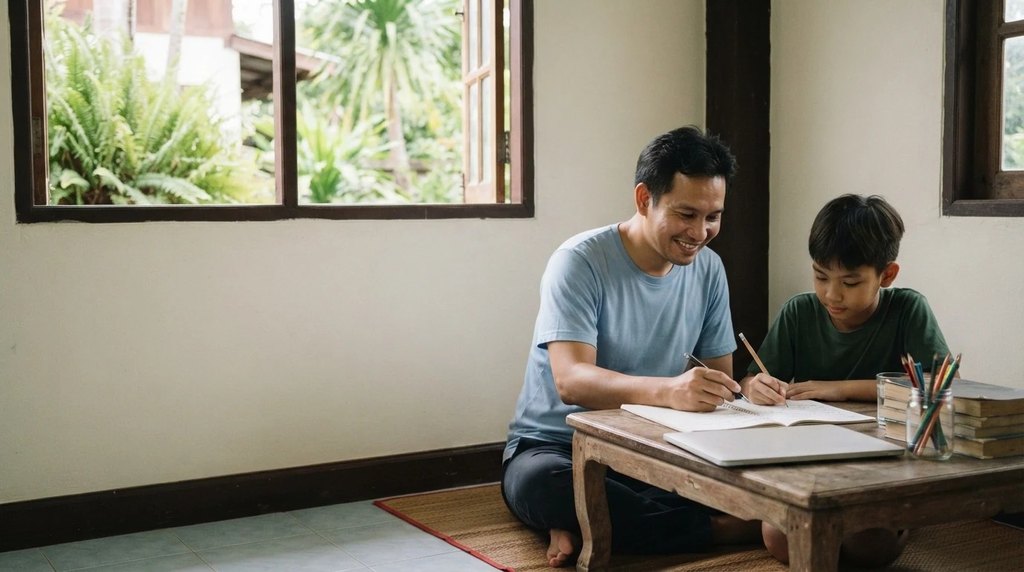
The plan adapts the national curriculum to one child rather than copying a school timetable.
Pre-primary (ages 3 to 6). The plan follows the Early Childhood Curriculum B.E. 2560 (2017) and covers physical, emotional, social and intellectual development, through daily life and play rather than subjects.
Primary and secondary. The plan works from the Basic Education Core Curriculum B.E. 2551 (2008) and its eight learning areas. The family can:
- Choose or adapt indicators and teach them by grade, by key stage or in integrated units.
- Organise learning by subject or by “experience groups”, such as nature, self and society, or the child’s own interests.
- Fold the three learner development activities (student activities, guidance, public service) into daily learning.
- Set the time structure per year or semester, in hours or credit weights.
- Teach at any time and in any place,
That flexibility also leaves room for families to share the teaching of an experience group. Our guide on how to start a homeschool co-op covers how groups like that are run.
Assessment, grades and the annual report
Assessment both helps the child improve (observation, portfolios, practical tasks) and decides results at the end of a subject or experience group. Pre-primary children should not be tested; they are assessed by observation, records and their work.
For primary and secondary learners, the family chooses one grading system and must keep it for the whole level. For upper secondary, the guideline recommends the eight-level numeric scale.
| Numeric | Letter | Percentage |
|---|---|---|
| 4 | A | 80 to 100 |
| 3.5 | B+ | 75 to 79 |
| 3 | B | 70 to 74 |
| 2.5 | C+ | 65 to 69 |
| 2 | C | 60 to 64 |
| 1.5 | D+ | 55 to 59 |
| 1 | D | 50 to 54 |
| 0 | F | 0 to 49 |
A fourth option uses key words that reflect the standards, on a five-, four- or two-level scale (for example excellent, good, pass, not pass). Source: OBEC guideline, chapter 4.
Moving up a grade. At the end of the school year the child moves up if they pass every subject or experience group in the plan, and pass reading, analytical thinking and writing, desirable characteristics and learner development activities, against criteria agreed with the office. The same conditions apply to completing each level.
The annual report. At least once a year the family assesses the child (Kor Ror 6) and reports results, teaching and problems. The office checks the evidence and certifies the results; if the child does not pass, remedial learning and a reassessment follow.
National tests are voluntary. The Reading Test (Prathom 1), the National Test (Prathom 3) and O-NET (Prathom 6, Mathayom 3 and Mathayom 6) are the learner’s right, not a duty. Your ESA office arranges RT and NT; for O-NET the family registers directly with the National Institute of Educational Testing Service (NIETS).
Want to build what these families are missing?
Home-schooling families in Thailand carry the plan, the teaching and the yearly report themselves. NIJIN Academy in Japan, opened in September 2023, offers children who learn outside school a homeroom, about 100 live online classes a month and 50+ physical classrooms. NIJIN is looking for one founder to start and lead NIJIN Academy Thailand.
See the Country Head role in ThailandTranscripts, moving house, returning to school, stopping
The ESA office issues official Ministry documents:
| Document | What it is |
|---|---|
| Por Por 1/Chor (ปพ.1/ฉ) | The transcript for specific target groups (primary, lower and upper secondary versions), issued at the end of a level or when the learner leaves. |
| Por Por 2 | The certificate for completing compulsory education and basic education. |
| Por Por 3 | The yearly report approving graduates at Prathom 6, Mathayom 3 and Mathayom 6. |
Returning to school. Results can be transferred between forms of education. The receiving school reviews the transcript and portfolio, assesses the child, or both, and places the child in a suitable grade.
Moving house. Changes to address, educator or plan go on form Kor Ror 5. If you move to another office’s area, your file passes to the new office.
Stopping. A family can end home school in writing (Kor Ror 7) and receives a transcript. The Provincial Education Committee can also end permission if a family does not follow its plan, but only after the office has advised it (Kor Ror 10) and given time to improve; the family may appeal.
Homeschooling in Thailand for foreigners
Some commercial guides say only Thai nationals can register; others say expatriates are outside the rules. Neither claim appears in the official documents opened for this article.
| Question | What the official text says |
|---|---|
| Who is “the family”? | Parents or the guardian with parental authority under the Civil and Commercial Code. Nationality is not mentioned in the definition. |
| Which office is mine? | The one for the family’s domicile: the house-registration address or the current main residence. |
| What documents prove residence? | The application asks for a copy of the house registration of the family and the learner. Whether other documents are accepted is not stated. |
| Can a non-Thai person teach? | Yes. An educator assigned by the family may be without Thai nationality. |
| Can a foreign family register? | Not stated either way in the guideline. Ask the office in writing. |
Questions to send your ESA office, in writing. (1) Does the office accept applications from non-Thai parents, and with which documents in place of a Thai house registration? (2) Will the child receive a Por Por 1/Chor transcript and the per-head subsidy? (3) Can a foreign curriculum or online course be part of the plan? Keep the reply.
For an online school based abroad, see our online school Thailand guide. Neighbouring countries compared: homeschooling in Vietnam, homeschooling in Malaysia and homeschooling in Singapore.
Home school, online school or alternative school?
In Thailand, home school is a legal status: the family is the educator under an approved plan. An online school is a provider whose standing depends on where it is licensed; an alternative school gives a child a class in a different shape. An online course may fit inside an approved plan if the office agrees. See homeschooling vs online school vs alternative school.
NIJIN Academy Thailand: a school you could lead
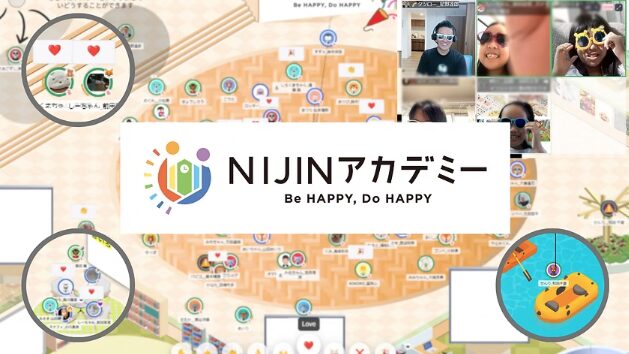
NIJIN Academy, run by NIJIN Inc., is an alternative school in Japan for children who do not fit conventional school. They join from home through a metaverse campus, choose from about 100 small, discussion-based live online classes a month, and can go to physical classrooms. NIJIN describes it as one of the largest alternative schools in Japan.
Figures are those published on NIJIN’s official websites. “Attendance recognition” means the child’s registered school counts learning at NIJIN Academy as school attendance.
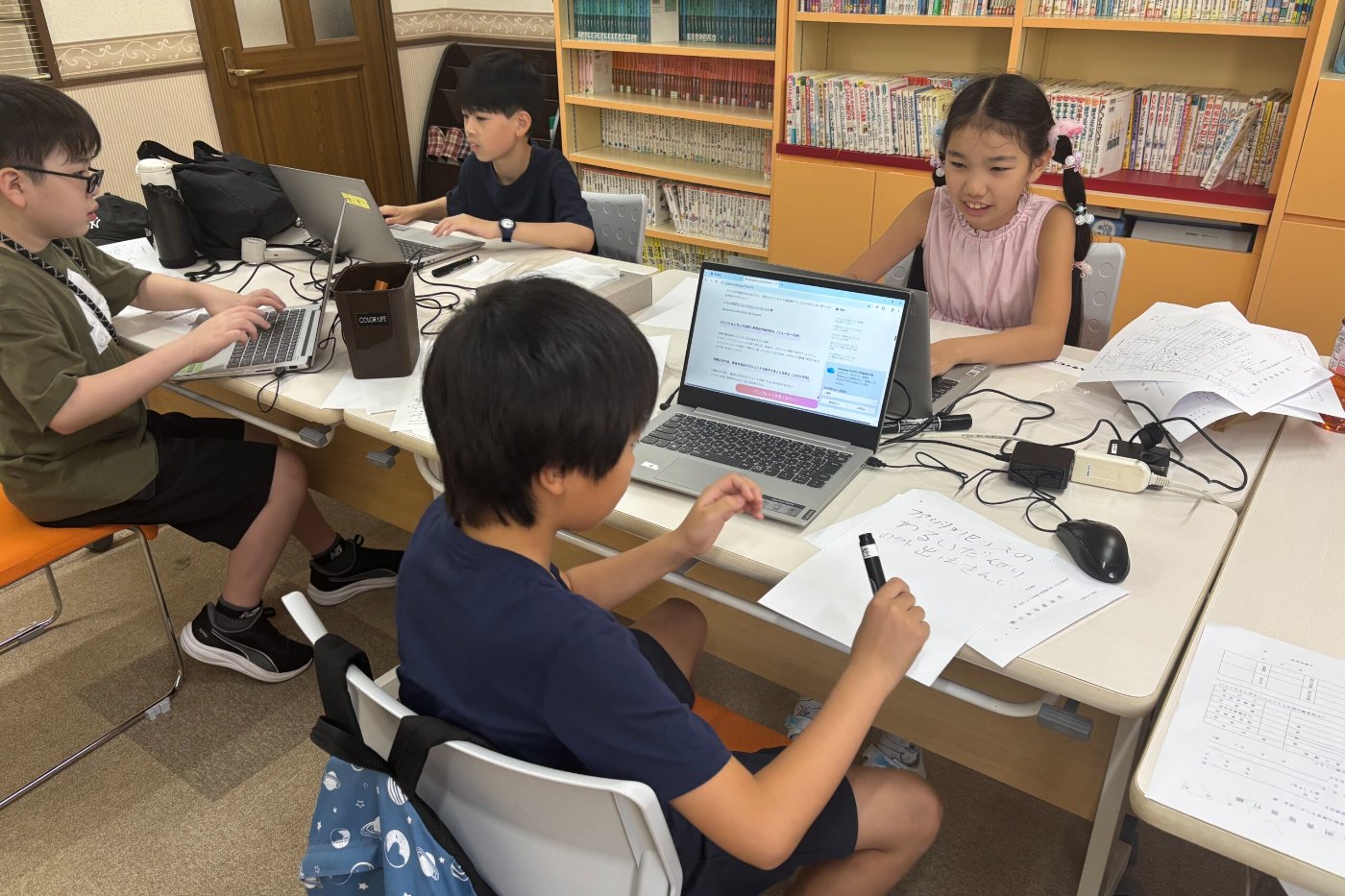
NIJIN is looking for a Country Head: one person who starts NIJIN Academy Thailand and leads it as business head and principal. How it fits Thai rules is not decided; working that out is part of the role.
It is not a franchise: you do not buy into a ready-made package; you build the school with NIJIN. Investment is optional. You can start on a service contract, even as a side job alongside your current work, or set up a local company together as a co-owner (for example 20% of the shares for you and 80% for NIJIN; if you invest, the guide is JPY 1 to 2 million from you and JPY 4 to 8 million from NIJIN, decided together). Either way, compensation is a guideline of 10% of revenue excluding tax, capped at JPY 50 million: JPY 100 million of revenue gives JPY 10 million. It is not a promise of income; with no revenue, the formula pays nothing, and anyone you hand part of the role to is paid from your 10%.
NIJIN looks for leadership, management, business ability and the skills of a principal. Teaching experience is not required; experience of managing an organisation and hiring people carries over directly. Thai, English and Japanese are ideal, but English alone is enough. Other terms are discussed in the interview.
Questions and answers
Is homeschooling legal in Thailand?
Yes, with permission. Section 12 of the National Education Act and the 2004 Ministerial Regulation allow it; the Provincial Education Committee decides.
Is homeschooling allowed in Thailand for foreigners?
A non-Thai person may teach, but the guideline does not say whether a foreign family can register. Ask your ESA office in writing.
Is education free in Thailand?
Yes, in public schools. The Constitution guarantees 12 years free, and the state provides 15 years of free basic education. Approved home-school learners receive a per-head subsidy.
Do parents need a teaching qualification to home school in Thailand?
No. The educator needs at least an upper-secondary qualification or equivalent, or must pass the office’s assessment of their knowledge and experience.
Does a home-schooled child get a Thai diploma?
Yes. The ESA office issues the Por Por 1/Chor transcript and the Por Por 2 certificate.
Can a home-schooled child take O-NET or go back to school?
Yes. O-NET is voluntary and booked with NIETS. A receiving school reviews records or assesses the child.
Is the Country Head role a job or a business?
It is closer to founding a business. You lead NIJIN Academy Thailand on a service contract or as a co-owner; compensation is a guideline of 10% of revenue, not a salary.
Build a school in Thailand for children who learn at home
If you have led and hired a team and want to give Thai home-learning families a class to belong to, apply. You can start on a service contract, even as a side job.
Where to go next
Related guides
- Online school Thailand: law, homeschooling and how to choose
- Homeschooling vs online school vs alternative school
- Homeschooling in Vietnam
- Homeschooling in Malaysia
- Homeschooling in Indonesia
- How to start a homeschool co-op
Sources
Figures are quoted with the year they refer to. Thai legal texts are summarised from OBEC’s official guideline, which reproduces them; the Thai original is authoritative. Please check the originals for later changes.
- OBEC, Guideline on family-based basic education (Home School), published by the Rayong Primary Educational Service Area Office 2 (Thai)
- UNESCO PEER, Thailand: non-state actors in education
- UNICEF Thailand, Removing barriers to migrant children’s education
- World Bank, Children out of school, primary: Thailand (SE.PRM.UNER)
- World Bank, Children out of school, % of primary school age: Thailand (SE.PRM.UNER.ZS)
- World Bank, Government expenditure on education, % of GDP: Thailand (SE.XPD.TOTL.GD.ZS)
- Office of the Basic Education Commission (OBEC)
- NIJIN Academy Thailand: Country Head
- NIJIN Academy (Japanese)