For education founders in the Philippines
To be a homeschool provider in the Philippines, you need to run a private school that already holds Government Recognition from DepEd, and then apply to the DepEd Regional Office, through your Schools Division Office, for a Permit to Offer the Homeschooling Program, which is valid for two years. A tutor, a consultant or a learning center can support homeschooling families, but under DepEd Order No. 001, s. 2022 it cannot enroll homeschool learners on its own.
This guide is based on the text of DepEd Order No. 001, s. 2022 and on regional memoranda that repeat it. It is not legal advice. Each Regional Office applies the rules, so confirm every point in writing with yours.
In this article
- What a homeschool provider is in the Philippines
- Homeschooling in the Philippines: the DepEd rules at a glance
- Who can enroll in a homeschool program
- How families enroll with a provider
- How to become a homeschool provider, step by step
- Permit to Offer: the documents DepEd asks for
- What a provider has to run every year
- How much is homeschooling in the Philippines?
- Not a school? Other ways to work in homeschooling
- Building a school for children who do not fit school
- Questions and answers
What a homeschool provider is in the Philippines
In everyday Filipino usage, a “homeschool provider” is the school a homeschooling family enrolls with. DepEd’s own term is different. DepEd Order No. 001, s. 2022, the Revised Policy Guidelines on Homeschooling Program, signed on 21 January 2022 and in force from School Year 2022-2023, defines the Homeschooling Program as one of the Alternative Delivery Modes (ADMs) of public and private elementary and secondary schools, “where the learner’s education is managed by parents/guardians and happens primarily at home”.
That has three consequences for a would-be provider:
- The provider is a school. A homeschool learner is officially enrolled in a public or private school but does not attend its regular classes, and has a Learner Reference Number (LRN) in DepEd’s Learner Information System (LIS).
- Parents teach; the school supervises. Parents or guardians are “the primary agent of the teaching-learning process, including its design and execution”. The school enrolls, coaches, assesses and keeps records.
- The curriculum is DepEd’s. The K to 12 Curriculum is the minimum for every school offering the program. Content may be contextualized and reordered within a quarter.
The order repealed DECS Memorandum No. 216, s. 1997 and the home school section of Annex 3 of DepEd Order No. 021, s. 2019. Articles that quote those older rules are out of date.
Homeschooling in the Philippines: the DepEd rules at a glance
| Question | What DepEd Order No. 001, s. 2022 says |
|---|---|
| Who may offer homeschooling? | Any public or private school, as an Alternative Delivery Mode |
| Which private schools? | Only private schools with Government Recognition |
| What authority do they need? | Private schools: a Permit to Offer from the Regional Office, applied for through the Schools Division Office. Public schools: authorization from the Regional Office |
| How long does it last? | Two years. The Regional Office may revoke it for valid grounds, after due process |
| Which grades? | Kindergarten to Senior High School |
| Who may enroll? | Only learners residing in the Philippines. A family that moves abroad during the year may finish that school year |
| Who teaches? | Parents or guardians, who may also hire a tutor |
| Who assesses? | Parents run formative assessment; summative assessments are taken at the school; learners take the NCAE and NAT with other learners |
Figures are taken from DepEd Order No. 001, s. 2022 and DepEd NCR Regional Memorandum No. 570, s. 2025, which reiterates it.
Who can enroll in a homeschool program
The order lists eight groups of learners, “including, but not limited to”:
- learners at risk of dropping out
- learners with special educational needs
- learners who cannot report to school regularly because of a medical condition
- learners in emergency situations, a national emergency, or conflict areas
- learners who had unpleasant experiences in regular school that affect their health and well-being
- learners who dropped out for personal reasons
- learners whose parents or guardians have jobs that require constant travel
- learners whose studies were interrupted by the relocation of parents, within the Philippines or as Overseas Filipino Workers (OFWs)
It also serves learners “whose parents opt them to be educated at home by themselves”. Learners out of school for a year or more may take the Philippine Educational Placement Test (PEPT) to find their grade level.
How families enroll with a provider
This is what your school will handle for every family.
- Letter of Intent. The parent writes to the school head and fills in the Homeschooling Form (Annexes 3 and 2 of the order).
- Enrollment in the LIS. A new learner receives an LRN; a learner switching from regular classes keeps it and is tagged as a homeschool learner.
- Homeschooling Program Agreement. Learner, parents and school sign it (Annex 4).
- Orientation and the Learning Plan. Parents are oriented, then write a weekly, monthly or quarterly plan of learning areas, competencies and tasks (Annex 1).
- Learning at home, assessed at school. Parents run formative assessment; the learner submits a quarterly portfolio and takes summative tests at the school.
- Quarterly conferences. Parents meet the homeschool coordinators; learners may join PE and school activities.
How to become a homeschool provider, step by step
Becoming a provider is a two-stage project: first a recognized school, then a homeschool program inside it.
- Set up the legal entity. Private schools register with the Securities and Exchange Commission (SEC). When DepEd gave some schools a two-year transitional period in 2023 (DepEd Order No. 26, s. 2023), SEC registration was expressly excluded from that relief.
- Secure the site and the building. Under DepEd Order No. 41, s. 2022, which amended Section 160 of DepEd Order No. 88, s. 2010, a private school must own its site, or show a deed of sale, a deed of donation, or a usufruct or lease of at least 15 years. An occupancy permit from the local government unit is also mandatory.
- Get a Government Permit to operate. Under DepEd Order No. 88, s. 2010, the 2010 Revised Manual of Regulations for Private Schools in Basic Education, authority is of two kinds: a permit, per year level, and recognition. The Regional Director approves new private schools.
- Earn Government Recognition. Recognition is for an indefinite period while the school keeps meeting the standards. It is the condition for offering homeschooling.
- Apply for the Permit to Offer the Homeschooling Program. Send a Letter of Intent to the Regional Director through the Schools Division Superintendent, with the documents below. In NCR this runs through the QUADPRO system.
- Run, report and renew. Apply for renewal on or before January 2 of the permit’s second year.
Steps 1 to 4 are the same as for any private school and take most of the time and money; see how to start a school in the Philippines. Steps 5 and 6 are specific to homeschooling.
Permit to Offer: the documents DepEd asks for
Section VI, item 15 of DepEd Order No. 001, s. 2022 lists what a recognized private school submits with its Letter of Intent:
- An original copy of the Board Resolution to offer the Homeschooling Program as an ADM
- A Homeschooling Program Manual covering at least the program standards, program management, curriculum, instruction and assessment
- A homeschool organizational chart, including the homeschool coordinator, with each member’s roles and responsibilities
- A certification that learning resources aligned with the K to 12 Curriculum are available
- An orientation and training plan for parents and guardians
- An annual Homeschooling Program calendar
- A schedule of tuition and other school fees for the Homeschooling Program
The application also follows Section 30.5 of DepEd Order No. 88, s. 2010: schools file with the Regional Office on or before January 2 preceding the opening of the school year. Public schools send a letter of intent with an implementation plan and a parent training plan.
Ask your Regional Office before you write anything. Regions use their own checking committees and sometimes run orientations for private schools. Ask for the current regional memorandum and filing date.
Want to build a school for children who do not fit school?
NIJIN Academy is an alternative school in Japan for children who do not fit conventional school, opened in September 2023. It combines a metaverse campus, about 100 live online classes a month and 52 physical classrooms across Japan. NIJIN is looking for one person to start and lead NIJIN Academy Philippines, as both business head and principal. Teaching experience is not required.
See the Country Head role in the PhilippinesWhat a provider has to run every year
These are the roles your organizational chart and manual must describe.
| Role | Main duties under the order |
|---|---|
| Parents or guardians | Enroll the child; follow the K to 12 Curriculum; prepare the learning plan and yearly schedule; provide resources; run formative assessment; report progress |
| Homeschool Coordinator (a teacher designated by the school head) | Keep the learner in the LIS; monitor progress; coach parents; give summative assessments; make home visits when necessary |
| Teacher-Adviser and learning area teachers | Prepare assessments; keep accurate records of each learner |
| The school | Provide materials; agree a coordination plan; hold quarterly conferences; help learners transfer if the permit is revoked |
| Schools Division Office | Monitor every school offering the program and report violations to the Regional Office |
| Regional Office | Issue and revoke permits; send an updated list of schools offering the program to DepEd’s Bureau of Learning Delivery every January |
All homeschool learners take the National Career Assessment Examination (NCAE) and the National Achievement Test (NAT) at the school where they are enrolled, on the official list of test-takers. Parents must follow DepEd’s Child Protection Policy (DepEd Order No. 40, s. 2012).
How much is homeschooling in the Philippines?
There is no official national fee. DepEd does not publish a price for homeschooling. What it does is require each private school to submit a schedule of tuition and other school fees for its Homeschooling Program as part of the Permit to Offer application, so each provider sets and declares its own fees.
For a founder, the fee must cover what the order makes you provide: coordinators’ time, assessments, records, learning materials, conferences and parent training, on top of running a recognized school. We quote no typical fees, because we found no official figure.
Not a school? Other ways to work in homeschooling
If you want to work with homeschooling families without running a school, the order leaves room: parents may “hire a tutor”, and learning may happen in other suitable environments.
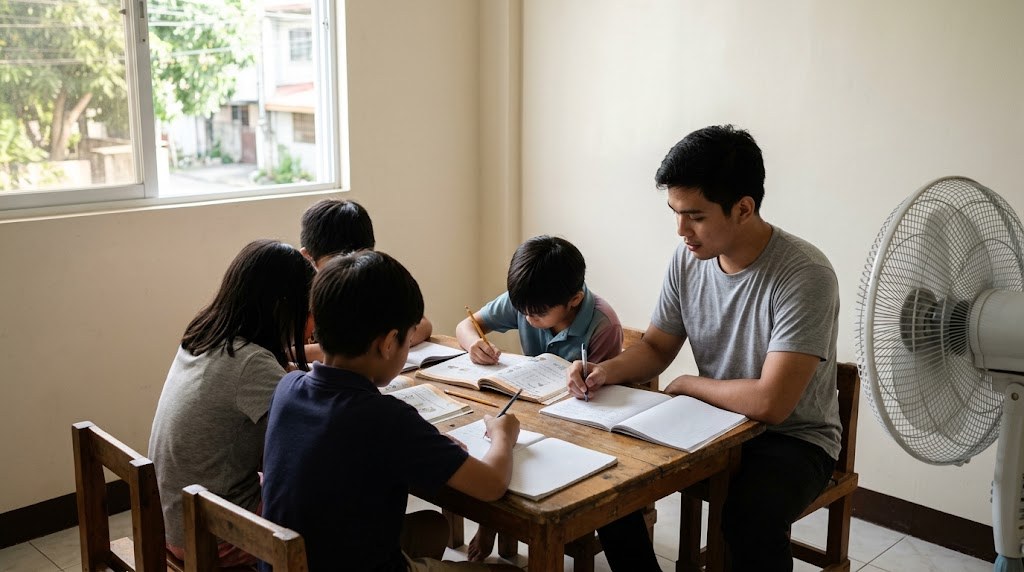
| Role | Can it enroll homeschool learners? | What it can do | Main approval |
|---|---|---|---|
| Recognized private school with a Permit to Offer | Yes | Enroll, coordinate, assess and report learners | DepEd Regional Office |
| Public school with authorization | Yes | The same, for its own learners | DepEd Regional Office through the SDO |
| Tutor or homeschool consultant | No | Teach or advise families on behalf of the parent | Ordinary business registration |
| Learning or tutorial center | No | Offer a place, small groups and support alongside a provider school | Business registration; ask DepEd how it is classified |
We found no DepEd rule creating a “homeschool certification” for individuals. For the center route, see how to start a learning center in the Philippines.
Building a school for children who do not fit school
DepEd’s list includes children at risk of dropping out and children who had unpleasant experiences in regular school. Those are the children NIJIN Academy was built for in Japan: a hybrid school with a metaverse campus, live online classes and physical classrooms, now running through to high school age.
Figures are those published on NIJIN’s official websites. “Attendance recognition” means the child’s registered school counts learning at NIJIN Academy as school attendance.
NIJIN is looking for a Country Head to start and lead NIJIN Academy Philippines, as business head and principal. What form fits the Philippines is a question for the interview. It is not a franchise. You can start on a service contract, even alongside your current work, or co-own a local company with NIJIN (for example 20% for you, 80% for NIJIN). Investment is optional. As a guide, compensation is 10% of revenue excluding tax, up to JPY 50 million; JPY 100 million of revenue gives JPY 10 million. It is not a promise of income: with no revenue, the formula pays nothing.
Questions and answers
What are the requirements for homeschooling in the Philippines?
Families must reside in the Philippines, enroll with an authorized school, submit a Letter of Intent and the Homeschooling Form, follow the K to 12 Curriculum with a learning plan, and have the child take summative tests, the NCAE and the NAT at the school. Parents must be able to teach or hire a tutor.
Is homeschooling in the Philippines recognized by DepEd?
Yes, when it runs through a school authorized to offer DepEd’s Homeschooling Program. It is an Alternative Delivery Mode, and the learner is officially enrolled, with an LRN.
Is there a list of homeschool providers in the Philippines?
Each Regional Office sends DepEd an updated list every January, but we found no published national list. Ask your Regional or Schools Division Office which schools hold a current permit.
How much is homeschooling in the Philippines?
DepEd sets no national price. Each private provider files its own fee schedule with its permit application, so ask each school for it.
How do I become a homeschool consultant?
The order creates no consultant license. A consultant or tutor works for the family, while enrollment, assessment and records stay with an authorized school. Be clear with families that you are not their school.
Can a learning center become a homeschool provider?
Not on its own. Only recognized private schools can obtain a Permit to Offer. A center can work alongside a provider school, or become a recognized school first.
Is this a job or a business?
Becoming a homeschool provider means running a school, so it is a business. The NIJIN Academy Country Head role is also closer to founding a business than to a salaried job: pay follows revenue, as a guide 10% up to JPY 50 million. You can start on a service contract, even as a side job. Details are discussed in the interview.
Will you start NIJIN Academy Philippines?
If you want to build a school for children who do not fit school, and you have led and hired a team, read the role. Teaching experience is not required, investment is optional, and English alone is enough to apply.
See the Country Head role in the PhilippinesWhere to go next
NIJIN Academy Country Head pages are open for several countries, and the global page covers every other country.
Related guides for founders
- How to start a school in the Philippines: permits, recognition and the calendar
- How to start a learning center in the Philippines
- Homeschooling vs online school vs alternative school
- How to start a microschool
- Out-of-school children: causes and solutions
- How to start a CBSE school in India
Sources
The text of DepEd Order No. 001, s. 2022 was read in the copy enclosed with the Muntinlupa City division memorandum below, because deped.gov.ph could not be opened. Please check DepEd for later updates.
- https://deped-muntinlupa.com/wp-content/uploads/2025/07/NUM-2025-341.pdf (SDO Muntinlupa City memorandum, July 2025, enclosing DepEd NCR Regional Memorandum No. 570, s. 2025 and DepEd Order No. 001, s. 2022)
- https://www.depeddasma.edu.ph/dm-no-075-s-2024-reiteration-of-deped-order-no-1-s-2022-or-the-revised-policy-guidelines-on-homeschooling-program/
- https://www.depeddasma.edu.ph/dm-no-047-s-2023-reorientation-on-policy-guidelines-on-homeschooling-program-for-private-schools-and-introduction-to-other-alternative-delivery-mode-adm/
- https://www.depeddasma.edu.ph/dm-no-596-s-2023-amendment-to-deped-order-no-88-s-2010-as-amended-by-deped-no-11-s-2011-and-deped-order-no-041-s-2022/
- https://deped-muntinlupa.com/wp-content/uploads/2025/06/NUM-2025-290.pdf (DepEd NCR Regional Memorandum No. 520, s. 2025 on DepEd Order No. 41, s. 2022)
- https://depedtagbilaran.org/wp-content/uploads/2017/10/DM-No-385-s-2016-REMINDERS-ON-THE-TIMELINES-FOR-THE-ISSUANCE-OF-TEMPORARY-GOVERNMENT-PERMIT-RENEWAL-AND-GOVERNMENT-RECOGNITION.pdf (quotes Sections 28 and 29 of DepEd Order No. 88, s. 2010)
- https://nijin.co.jp/recruit/nijin-academy-philippines-country-head/
- https://nijin.co.jp/recruit/en/