
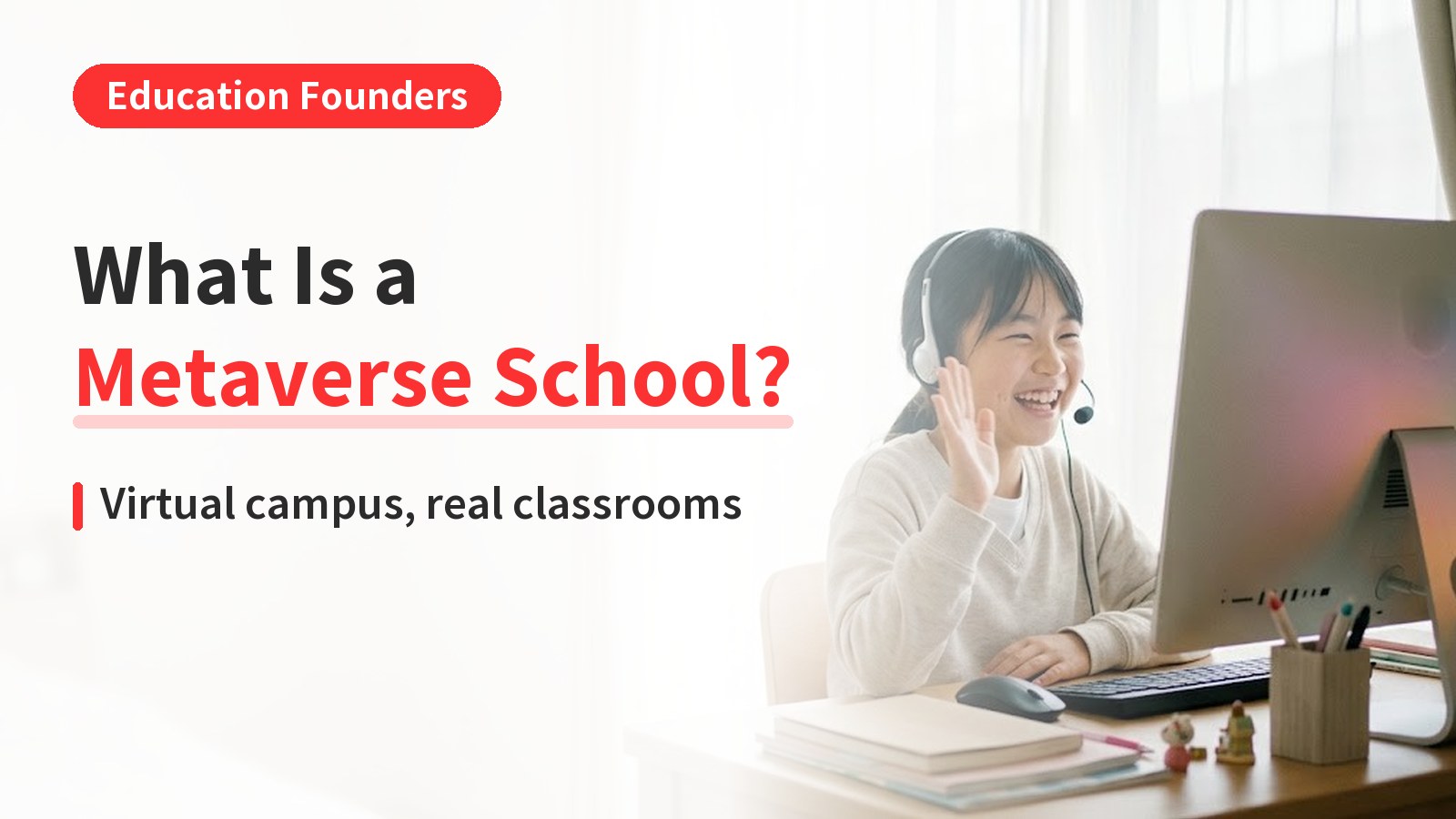
A metaverse school is a school whose campus is a shared virtual space: students arrive as avatars, walk into classrooms, sit with friends and join live lessons from home. The virtual campus is not the lessons themselves. It is the place around them, the corridors and common rooms that an ordinary video call does not have. A hybrid school goes one step further and pairs that virtual campus with physical classrooms, so a child can belong online every day and meet people in person when they are ready. This article explains how the model works, using NIJIN Academy in Japan as a documented example, and what it takes to run one.
In this article
What “metaverse school” actually means
The word “metaverse” has been used for everything from games to marketing campaigns, so it helps to be plain. In a school, it means three things.
- A persistent place. The campus is there whether or not a lesson is running. A student can log in early, wander, and find out who else is around.
- Presence without exposure. A student appears as an avatar. Others can see that they have arrived and where they are, without seeing their face or their bedroom.
- Movement and choice. Students move between rooms themselves: to a class, a club, a quiet corner, a teacher’s desk. Choosing where to be is part of belonging somewhere.
It does not have to mean a headset. Many metaverse schools run in a browser on an ordinary computer, in two dimensions or simple three dimensions. NIJIN Academy, for example, describes its campus as a virtual school a child can enter from a PC with one click.
It also does not mean that software teaches. Lessons are taught live by people. The virtual campus is the building, and a building does not teach anyone.
What is a hybrid school?
A hybrid school combines learning in a physical place with learning away from it. The word is used for more than one model, so check which one a school means.
| Model | How the week works | Where it is common |
|---|---|---|
| Part-time campus | The school sets the curriculum; students attend in person on some days and learn at home on the others | Often what “hybrid school” means in the United States |
| Blended school | Students attend in person and also do part of their lessons and assignments online | Used widely, including by public school systems |
| Virtual campus plus classrooms | The school day happens on a shared virtual campus, and students can also go to physical classrooms nearby | The model this article describes, with NIJIN Academy as the example |
What they share: a child does not have to choose between “school building every day” and “alone at home”. To build a hybrid school in your own country, see NIJIN Academy Country Head.
What counts as a virtual school, and where hybrid schools fit
Official statistics draw the line by how much of the teaching is online. In the United States, the National Center for Education Statistics (NCES) sorts public schools into these groups:
| NCES category | What it means |
|---|---|
| Fully virtual | All instruction offered by the school is virtual. Students and teachers may still meet in person, for example for field trips, social events or assessments |
| Primarily virtual | The school provides virtual instruction, and some traditional classroom instruction as well; most students receive all their instruction virtually |
| Supplemental virtual | Teachers direct instruction in a traditional classroom, and virtual instruction supplements it |
In school year 2019–20, the year covered by this NCES table, 691 public schools in the United States were fully virtual, with 293,717 students, or 0.6% of total state enrollment. A metaverse school with physical classrooms sits between the first two groups: most of the school day is online, and in-person time is there for children who want it. To build one, see how to start a hybrid school.
Source: NCES, Common Core of Data, virtual schools table 3, school year 2019–20.
How it differs from online classes and from a physical school
| Video-call classes | Metaverse school | Hybrid school | Physical school | |
|---|---|---|---|---|
| Where students are | Home | Home, inside a shared virtual campus | Home on the virtual campus, and physical classrooms | A school building |
| Between lessons | The call ends; everyone disappears | Students stay, move around, talk | As metaverse, plus time together in person | Corridors, playground, lunch |
| How visible a student must be | Usually camera on or off | Avatar; camera and microphone can be optional | Student’s choice online; in person at the classroom | Fully present |
| Reach | Anywhere with a connection | Anywhere with a connection | Anywhere online; in person near a classroom | Within travelling distance |
| Hands-on and physical activity | Limited | Limited; done at home | Available at classrooms and events | Built in |
| What the school must run | A timetable of calls | A campus, a timetable and an online community | All of that plus premises and local staff | Premises and staff |
The row that matters most is the second. Much of what makes a school feel like a place happens between lessons. Video-call classes delete that time. A virtual campus puts some of it back, and physical classrooms put back more.

The parts of a hybrid school
A hybrid school is easier to understand as four layers that sit on top of each other.
- Virtual campusThe daily place: homeroom, classrooms, clubs, staff room. Open to every student, wherever they live.
- Live classesTaught by teachers in real time, in small groups. Recorded lessons fill the gaps.
- Physical classroomsLocal rooms where students meet, make things and move. Attended as often as suits the child.
- Adults who know the childStaff who notice who has gone quiet, talk with parents, and work with the child’s registered school.
The fourth layer is the one outsiders overlook and the one that decides whether the school works. A platform can be licensed and a room can be rented. Noticing that a twelve-year-old has not spoken for three days, and knowing what to do about it, takes people.
A documented example: NIJIN Academy
NIJIN Academy is an alternative school in Japan for children who do not fit conventional school, many of whom had stopped going to school altogether. It opened in September 2023, is run by NIJIN Inc., and now runs through to high school age. Its founder, Tatsuro Hoshino, taught at a public elementary school for seven years before leaving to build what he calls another piece of educational infrastructure that stands alongside school. The facts below are those published on NIJIN’s official websites.
“Attendance recognition” means the school where the child is registered counts learning at NIJIN Academy as school attendance. The decision belongs to that school.
How the virtual campus is used
Children enter the metaverse campus from home on a PC. The day runs from a morning meeting through classes to after-school time, and there are whole-school homeroom gatherings. Classes are small, with 8 to 10 students, and mix ages and grades. Cameras and microphones are optional, so a child who is not ready to be seen or heard can still take part.
What a child needs to join a metaverse campus
Less than people expect. NIJIN Academy’s official guidance asks for a PC or tablet and a stable internet connection; it does not publish minimum specifications such as processor or memory. A child can start with the camera and microphone off and take part by chat only, with an avatar standing in for them, and classes can be watched later as recordings.
Source: NIJIN Academy official website (in Japanese).
What children choose from
About 100 live classes are offered each month, and there is an archive of more than 500 recorded lessons for learning at a child’s own pace. Beyond lessons, the academy lists 11 clubs formed around students’ interests, special classes taught by professionals, projects with companies and local governments, and events and trips through the year.
Where the physical classrooms come in
Families can choose online only, or a hybrid of online and in person. The physical classrooms, 52 across Japan (including classrooms due to open), are where children meet face to face. NIJIN describes the academy as one of the largest alternative schools in Japan.
The idea behind it
The school’s motto is “Be HAPPY, Do HAPPY”: everyone has the power to become happy and the power to make others happy. The company’s working principle is “don’t blame people, build systems.” A child who stops attending is not the problem, and neither are parents or teachers. The form of school is what has to widen.
Who the model fits, and who it does not
It tends to fit
Children who want to learn and to have friends but cannot, for now, be in a large classroom. Children who live far from any school that suits them. Families who want a school, with teachers and a timetable, and not to teach at home themselves.
It is a poor fit when
There is no reliable device or connection at home. No adult can be nearby for a young child. The child most needs physical activity and hands-on work every day, and no classroom is within reach.
Scale matters here. In England, the Department for Education counted 126,000 children in elective home education on census day in autumn 2025, with mental health the most common recorded reason. In the United States, the National Center for Education Statistics found 5.2% of students aged 5 to 17 receiving instruction at home in 2022–23, through homeschooling or full-time virtual education. Globally, UNESCO counts 273 million children and youth out of school in 2024. These are different groups with different needs, and a metaverse school will not serve all of them: a virtual campus presupposes electricity, a device and a connection. For a comparison of the options families weigh, see homeschooling vs online school vs alternative school.
What it takes to run one
If you are considering building a school like this, the technology is the smaller part. Here is what the model asks of an operator.
| Area | What you have to get right |
|---|---|
| People | Teachers who can hold a small group online, and staff who follow each child. Hiring and training them is the main work. |
| Timetable | Enough live classes that a child always has something to choose, at hours that suit families. |
| Community | Homeroom, clubs and events. Without them a virtual campus is an empty building. |
| Physical sites | Local leaders, premises and safety. Each classroom is a small school of its own. |
| Recognition | A working relationship with each child’s registered school and the education authority. |
| Safeguarding and data | Rules for conduct online, for recordings, and for children’s personal data. |
| Economics | Fees a family can sustain against the cost of small classes and two kinds of campus. |
On rules. Whether a metaverse or hybrid school counts as a school, whether time there counts as attendance, who may teach, and how children’s data must be handled differ by country and often by state. The Japanese arrangement described above is specific to Japan. Ask your own education authority and data protection regulator before you design a programme.
NIJIN does not assume its Japanese model will work unchanged elsewhere, which is why it is looking for founders who will decide what fits their own country.
Now recruiting: NIJIN Academy Country Head. NIJIN wants an academy in every country and is looking for one person per country to start and lead it, as business head and principal. The plan is to set up a local company in that country and give the Country Head shares in it. Investment is optional; you can also start on a service contract, even as a side job. As a guide, compensation is 10% of revenue (excluding consumption tax), capped at JPY 50 million once revenue reaches JPY 500 million or more. It is a guide only: as the person leading the company you decide it as the business grows, and no income is guaranteed. Teaching experience is not required. The country’s official language plus English and Japanese is ideal; English alone is acceptable.

Questions and answers
What is the metaverse in education?
In education, the metaverse usually means a shared online campus: a persistent place where students appear as avatars, move between rooms themselves and meet teachers and classmates in real time. It does not require a VR headset; many campuses run in a browser on an ordinary computer, in two dimensions or simple three dimensions. Lessons are still taught live by people. For how this looks in a working school, see the NIJIN Academy example.
What is a virtual school?
A virtual school is a school whose lessons and school life happen online, so students learn from home or anywhere with an internet connection. Many virtual schools use live video lessons and recorded courses. A metaverse school is one kind of virtual school: it adds a shared online campus where students can see each other and spend time together outside lessons. Whether a virtual school counts as registered schooling depends on the country; for India, see how to start an online school in India.
What is a hybrid school?
A hybrid school combines days on a physical campus with learning at home or online. In many hybrid schools, students attend in person two or three days a week and complete the rest of their work at home, often with live online lessons. NIJIN Academy follows a similar idea: children join live online classes and can also go to one of 52 physical classrooms across Japan (including classrooms due to open) when they are ready to learn face to face. If you would like to build this kind of school in your own country, read about the NIJIN Academy Country Head role.
Do students need a VR headset?
Not necessarily. Many virtual campuses run on an ordinary computer. NIJIN Academy describes its campus as accessible from a PC with one click. Ask any school what device it requires.
Is a metaverse school a real school?
That is a legal question with a local answer. Some are registered schools; others, like many alternative schools, work alongside the school where a child is enrolled. Ask the school how it is registered and ask your education authority how attendance there is treated.
How is it different from online classes on a video call?
A video call exists only during the lesson. A virtual campus is a place that stays open, where students can see who is around, move between rooms and spend time together outside lessons.
Do children make friends in a virtual campus?
The design is meant to make that possible through homerooms, clubs and shared projects, and a hybrid school adds in-person time. How well it works depends on the adults running it, so ask to join a trial session.
Does a child have to show their face or speak?
It depends on the school. At NIJIN Academy cameras and microphones are optional.
What does a metaverse school cost?
Fees vary by school and country, and they change, so we do not quote any here. Check the school’s own tuition page.
Can I start a metaverse school in my country?
In principle yes, subject to local law. You can build one yourself, or lead one with an organisation that already runs the model. NIJIN’s Country Head role is one such route. The steps are in how to start an online school.
What is the difference between a virtual school and a hybrid school?
A fully virtual school offers all of its instruction online. A hybrid school combines online learning with time in a physical place. In the United States, NCES separates fully virtual schools from schools that are primarily virtual or that use virtual instruction to supplement classrooms; see what counts as a virtual school.
Does NIJIN run an online school in English?
NIJIN GLOBAL ACADEMY is an online international school for ages 6 to 18 across Asia and Oceania, planned to open in September 2027. It is looking for founding teachers and mentors. See careers at NIJIN for the roles in English.
Bring this model to your country
If you want to start a company in your own country and build a school for children who do not fit school, read the Country Head role and apply. We talk first.
Apply now → Want to know more first? Read the Country Head role, or see all open roles.Roles and related reading
- Homeschooling vs online school vs alternative school
- How to start an education business
- Out-of-school children: the global numbers, the causes, and what founders can do
- How to start an online school that children keep attending
- School refusal: what Japan’s futoko teaches school founders
- How to start a microschool: a step-by-step guide for founders
- Alternative school vs traditional school: what actually differs
- Microschool franchise: cost, contracts and alternatives
Sources:
- https://academy.nijin.co.jp/
- https://nijin.co.jp/
- https://nijin.co.jp/recruit/nijin-academy-country-head/
- https://explore-education-statistics.service.gov.uk/find-statistics/elective-home-education
- https://ies.ed.gov/learn/press-release/higher-percentage-k-12-students-are-receiving-academic-instruction-home
- https://www.unesco.org/en/articles/more-children-out-school-7th-year-row-273-million