For education founders in India
A microschool can work in India, but not as a copy of the American model: Indian law has no “microschool” category, and under the RTE Act every private school teaching Class 1 to 8 needs a certificate of recognition, so a founder first chooses a legal form: a small recognised school, a centre built on NIOS open schooling, or a part-time learning centre. Small groups, mixed ages and adult guides fit inside any of them. The paperwork, the cost and the child’s certificate do not.
This guide does not repeat our general how to start a microschool guide. It asks which Indian form fits the small-school idea and what each asks of you. It quotes official texts and is not legal advice; your state education department has the last word.
In this article
- What a microschool means in India
- The RTE Act question comes first
- Four forms a microschool can take in India
- The open-schooling route: NIOS OBE and Secondary
- Learning centres and homeschool support
- Cost lines for a microschool in India
- How to start a microschool in India, step by step
- Who this model suits, and who it does not
- Starting alone or with a model that already runs
- Questions and answers
What a microschool means in India
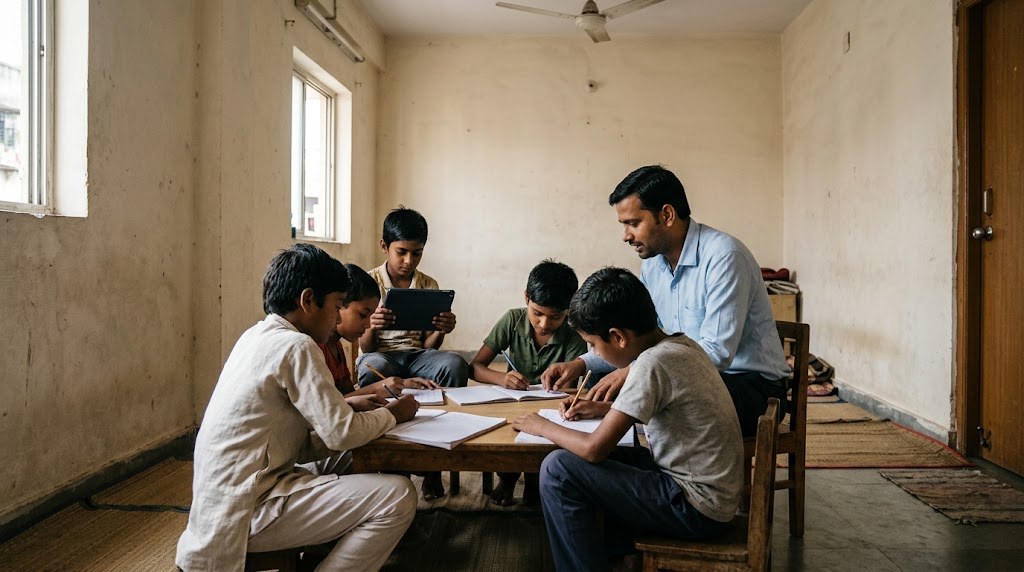
“Microschool” is a word used most in the United States for a deliberately small learning community: a handful to a few dozen children, usually of mixed ages, an adult who guides more than lectures, and a founder who runs the place. What does not travel is the legal setting. American rules are made state by state, and India’s questions are set by Indian law and each Indian state.
| Microschool feature | The Indian question | Where the answer sits |
|---|---|---|
| Full-time, replaces school | Is this a school for Class 1 to 8 that needs recognition? | RTE Act, Sections 18 and 19; state RTE rules |
| Mixed ages, own pace | Which certificate will the child hold at Class 8, 10 and 12? | A Board (State Board, CBSE, CISCE) or NIOS |
| Fifteen children, two adults | Does staffing meet the Schedule and teacher qualification rules? | RTE Schedule; Section 23 |
| Part-time sessions | Are we a school, a coaching centre or a support group for families? | Your state education department |
For Montessori, Waldorf and other approaches, see alternative schools in India.
The RTE Act question comes first
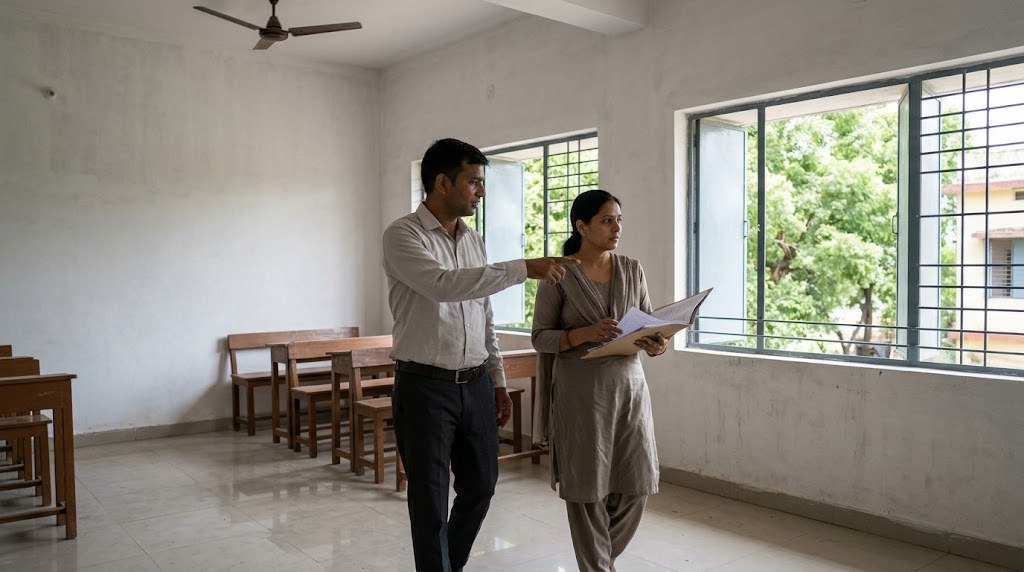
The Right of Children to Free and Compulsory Education Act, 2009 covers elementary education, defined in Section 2(f) as first class to eighth class. Section 18(1) says no school other than one run by the government or a local authority may be established or function without a certificate of recognition, and Section 18(2) says recognition is granted only if the school meets the norms in the Schedule. Under Section 18(5), running a school without recognition can bring a fine of up to one lakh rupees, and up to ten thousand rupees a day while it continues. A full-time “school” for six- to fourteen-year-olds without recognition is the one form not to drift into.
Some Schedule lines weigh heavily on a small school:
| Schedule item | What it says | What it means for a microschool |
|---|---|---|
| Teachers, Class 1 to 5 | Up to 60 children: two teachers | Even 12 children mean two salaries |
| Teachers, Class 6 to 8 | One teacher per class, with at least one each for science and maths, social studies and languages | Mixed-age upper years still need subject cover |
| Building | All-weather building, a classroom per teacher, a head teacher’s room, barrier-free access, separate toilets, drinking water, a mid-day meal kitchen, a playground, a boundary wall or fencing | A flat or single room is unlikely to qualify; ask how your state applies each line |
| Days and hours | Class 1 to 5: 200 days, 800 hours a year. Class 6 to 8: 220 days, 1,000 hours | A three-day week does not fit |
Summarised from the Act as published by the Department of School Education and Literacy. States add conditions through their rules. Detail: school recognition under the RTE Act.
Four forms a microschool can take in India
Seen through Indian law, the idea splits into four forms. None is better in general.
| Form | Who it fits | What you need | Child’s certificate |
|---|---|---|---|
| 1. Small recognised school | Families wanting a full-time school, Class 1 to 8 | State RTE recognition; later, Board affiliation for Class 9 to 12 | School records, then the Board |
| 2. Open-schooling centre | Out-of-school children; teenagers aiming at Class 10 and 12 | NIOS (or State Open School) accreditation, which needs an established registered body | NIOS OBE Levels A to C, then Secondary |
| 3. Part-time learning centre | Home-educated children, or school pupils who need a different place some days | Whatever registration your state asks of a tuition or coaching centre; a safe space | None from you |
| 4. Hybrid inside a network | Families wanting live online classes plus in-person days | Clear answers on where each child is registered | The child’s registered school or open-school route |
One possible path is to start in form 3, learn which children return, and move to form 1 or 2 once you have the families, the building and the legal body. Whatever you choose, describe it to parents in exactly those terms.
The open-schooling route: NIOS OBE and Secondary
National policy makes room for this. The National Education Policy 2020 (paragraph 3.5) speaks of “multiple pathways to learning” and says NIOS and State Open Schools will offer A, B and C levels equivalent to Grades 3, 5 and 8. Paragraph 3.6 says school requirements will be made less restrictive, partly to allow alternative models of education.
The NIOS bye-laws (revised up to January 2024) set out Open Basic Education (OBE):
The catch is eligibility. An OBE Accredited Agency must be run by a registered society or trust (or a Section 8 company) at least three years old, with land owned or leased in its name, classrooms of at least 300 sq ft, at least two qualified teachers, a library and digital learning facilities. A brand-new microschool cannot apply on day one; it can work with an existing accredited body, or grow towards accreditation.
For older children, the NIOS Academic Prospectus 2026–27 sets the minimum age for the Secondary course at 14 and accepts a Class 8 certificate or a self certificate for entry, a realistic route to Class 10 for a home-educated teenager. Accreditation detail: how to start a NIOS study centre.
Want to build a small school in India with a model that already runs?
NIJIN Academy is an alternative school in Japan for children who do not fit conventional school, opened in September 2023. Children join from home through a metaverse campus, choose from about 100 live online classes a month, and can go to 52 physical classrooms across Japan. NIJIN is looking for one person to start and lead NIJIN Academy India as its business head and principal. It is not a franchise, and teaching experience is not required.
See the Country Head role in IndiaLearning centres and homeschool support
The lightest form is a centre that does not replace school: children come a few mornings a week while their education stays with their family or registered school. The RTE Act gives every child aged six to fourteen a right to education in a neighbourhood school and names home-based education only for children with severe or multiple disabilities; the Ministry’s clarification note says the Act does not intend to compel parents who do not wish to use free schooling. More in homeschooling in India.
In February 2024 the Ministry of Education said it had sent Guidelines for Regulation of Coaching Centres, covering registration, fees and infrastructure, to States and Union Territories to consider through their own laws. Whether your centre counts as coaching in your state is a question to ask in writing.
The honest line. A part-time centre should not call itself a school, issue its own “Class 5 certificate”, or suggest attendance meets a legal duty. Say what it is: a place to learn alongside the child’s own route to a certificate.
Cost lines for a microschool in India
Rents and salaries differ too much between cities for one honest figure, so numbers appear only where an official document states them.
| Cost line | Form | Official figure |
|---|---|---|
| Teachers (two minimum for Class 1 to 5) | 1 | None; local market |
| Building that meets the Schedule and local rules | 1 | None |
| Recognition application | 1 | Set by each state |
| NIOS OBE accreditation processing fee | 2 | Rs 10,000 + Rs 20,000 (bye-laws, January 2024) |
| NIOS OBE charge per learner | 2 | Level A Rs 300, B Rs 500, C Rs 800; study material extra |
| Society, trust or company registration; audit | 1, 2 | Varies by state |
| Space, insurance, background checks, materials | All | None |
Then run the break-even arithmetic from our microschool guide. The two-teacher rule makes that number higher for a recognised school than for a learning centre. Fuller lines: cost to start a school in India.
How to start a microschool in India, step by step
- Name the children. Age range, language, what is not working now, and what the family does instead.
- Choose the form. Write down which of the four you are, and what you will not call yourself.
- Ask the state in writing. Recognition, coaching registration, or nothing? Keep the reply.
- Fix the certificate route. State Board, CBSE, CISCE or NIOS, and whether you will work with an accredited body.
- Choose the legal body. Society, trust, Section 8 company or company, with a lawyer or chartered accountant.
- Run trial days. Borrow a room and watch which children return.
- Open small and keep records. Fewer days and children than you could take, with records parents and schools can read.
Who this model suits, and who it does not
- You know one group of children and families well, in one city and one language
- You can be patient with paperwork that comes before the first class
- You can explain plainly which certificate each child will end with
It is harder if you want fast scale, need a full salary in year one, or would rather not deal with a state department. An online model, covered in starting an online school in India, or joining an existing organisation may fit better.
Starting alone or with a model that already runs
| Route | What you get | What you give up |
|---|---|---|
| Alone, from zero | Full control | Every system is yours to build |
| Franchise | A ready format and brand | You pay to copy a format. See education franchise in India |
| Co-founding with NIJIN | A running hybrid model, online classes and a team, while you decide what fits India | Shared ownership and one model |
NIJIN Academy India would be built the third way, with the Country Head as business head and principal. You can start as a co-owner of a local company (for example, you 20%, NIJIN 80%) or on a service contract, even as a side job. Investment is optional; if you invest, the guide is JPY 1 to 2 million from you and JPY 4 to 8 million from NIJIN, decided together. As a guide, compensation is 10% of revenue excluding tax: JPY 100 million of revenue gives JPY 10 million, capped at JPY 50 million. With no revenue the formula pays nothing. Location, contract and timing are discussed in the interview.
Figures published by NIJIN. “Attendance recognition” means the child’s registered school counts learning at NIJIN Academy as attendance. How the model fits Indian rules is worked out with the Country Head.
Questions and answers
Are microschools legal in India?
There is no “microschool” category. A small setting can operate as a recognised school, an open-schooling centre or a learning centre that does not replace school. Running a Class 1 to 8 school without recognition under Section 18 of the RTE Act is not allowed.
Is a micro school in India recognised by the government?
Only if it receives recognition under your state’s RTE rules by meeting the Schedule. A UDISE+ listing does not confer recognition, the Ministry’s UDISE+ 2024–25 report states.
Can a microschool in India follow NIOS?
Children can study through NIOS OBE and, from 14, the Secondary course. Becoming an accredited centre yourself needs a registered body at least three years old, so new founders often begin by working with an existing one.
How much does it cost to start a microschool in India?
No single figure is honest. Teachers and space are the largest lines. Official figures exist for some, such as the NIOS OBE processing fee of Rs 10,000 + Rs 20,000.
Do I need to be a teacher to start one?
The founder need not be, but a recognised school’s teachers must hold the qualifications notified under Section 23 of the RTE Act. For the NIJIN Country Head role, teaching experience is not required.
Is the Country Head role a job or a business?
Closer to founding a business: you lead NIJIN Academy India as co-owner or on a service contract, with compensation of, as a guide, 10% of revenue and no guaranteed income.
Build a small school in India, with a team behind you
If you have led and hired people, and want to build a place for children who do not fit school, read the role and apply.
See the Country Head role in IndiaWhere to go next
Related guides for founders
- How to start a microschool
- School recognition under the RTE Act
- How to start a NIOS study centre
- Homeschooling in India
- Alternative schools in India
- How to start a homeschool co-op
- How to start a hybrid school
Sources
Official texts at the time of writing. Rules change; check the original and your state’s rules.
- https://www.dsel-education.gov.in/static/uploads/2025/09/ee3cf9ae4ddbc3d0582e98f050290edc.pdf
- https://www.dsel-education.gov.in/static/uploads/2025/09/f4086862d2c61e5224c8039e97b53d19.pdf
- https://static.pib.gov.in/WriteReadData/userfiles/NEP_Final_English_0.pdf
- https://d14hh92uxuh5es.cloudfront.net/accreditation/static/dist/images/pdf/accreditation-system/Bye_Laws_Updated.pdf
- https://dq4kzxd7fbbni.cloudfront.net/static/dist/images/pdf/academic_prospectus/Academic_Prospectus_2026-27.pdf
- https://dashboard.udiseplus.gov.in/report-new-v.6-demo2025/static/media/UDISE%2B2024_25_Booklet_existing.118ba29d4773e6372f72.pdf
- https://www.pib.gov.in/PressReleasePage.aspx?PRID=2003661
- https://www.education.gov.in/rte
- https://nijin.co.jp/recruit/nijin-academy-india-country-head/