For founders and parents
The real difference between an alternative school and a traditional school is not the furniture or the philosophy on the website. It is who makes five decisions: what is learned, at what pace, in which group, how progress is judged, and what happens when a child does not fit. In a traditional school most of these are decided in advance, for everyone, by the system. In an alternative school at least some are decided closer to the child. Everything else you can see, from mixed-age rooms to the absence of bells, follows from that.
This alternative school vs traditional school comparison uses models that are documented by the organisations that run them, not stereotypes. It is not an argument that one is better. Traditional schools educate most of the world’s children and do many things that small schools cannot. The useful question, for a parent choosing or a founder building, is which decisions should sit where for a particular child.
In this article
- First, what “alternative school” means depends on where you are
- Four documented models, and what each one moves
- The comparison, decision by decision
- What traditional schools do well
- Why the difference matters more than it used to
- For parents: seven questions that show the real difference
- For founders: what changes when you build the alternative
- It does not have to be either-or
- Questions and answers
First, what “alternative school” means depends on where you are
The term has no single international meaning, and that causes real confusion.
- In much of Europe it usually means an independent school built on a named pedagogy, such as Montessori or Waldorf (Steiner).
- In United States public education it often refers to programmes for students whose needs are not being met in a regular school, sometimes after exclusion. Independent progressive schools there are more often called by their own names.
- In Japan the closest terms are “free school” and “alternative school”: places, mostly outside the legal category of school, where children who are not attending their registered school learn and spend the day.
So before comparing, ask what the school in front of you is in law (a registered school, or a setting outside the school system) and what it is in practice (a pedagogy, a second chance, or a different structure altogether).
Four documented models, and what each one moves
Montessori
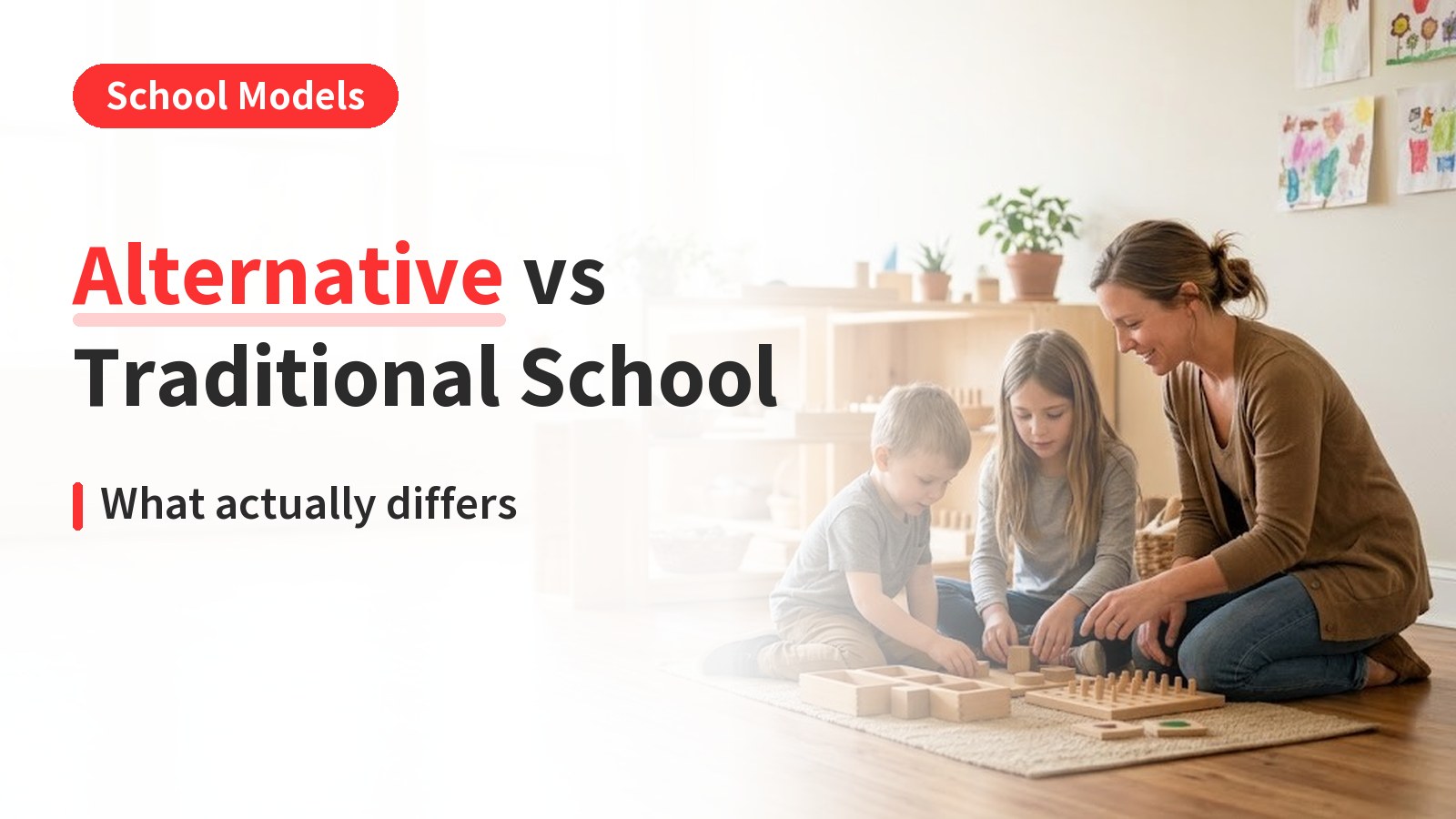
Maria Montessori opened her first Casa dei Bambini in Rome in 1907. Children work in mixed-age groups, choosing from prepared materials in long uninterrupted work periods; the adult observes and guides. It moves pace and choice of activity to the child, inside a carefully designed environment.
Waldorf (Steiner)
The first Waldorf school opened in Stuttgart in 1919. A class teacher often stays with the same class for several years, with arts, crafts and movement woven through academic work. It moves the timing of formal academics and the teacher relationship, less the child’s individual choice.
Democratic and Sudbury schools
Summerhill was founded by A. S. Neill in 1921; Sudbury Valley School opened in Massachusetts in 1968. Lessons are optional or absent, and a school meeting of students and staff makes the rules. They move almost every decision, including governance, to the community.
Hybrid alternative schools
A newer form combines live online classes, an online community and physical classrooms. NIJIN Academy in Japan, opened in 2023, is one example. It moves where and when a child attends, and lets children choose classes, while working with the school the child is registered at.
Descriptions follow each organisation’s own published account. Individual schools using these names vary widely, and the names are not protected in every country.
The comparison, decision by decision
| Decision | Traditional school (typical) | Alternative school (typical range) |
|---|---|---|
| What is learned | National or state curriculum, set by subject and year | From the same curriculum taught differently, to content chosen with or by the child |
| Pace | The class moves together through the year | Individual pace; mastery before moving on |
| Grouping | By birth year, in classes with one teacher at a time | Mixed ages; small groups; sometimes no fixed class |
| How progress is judged | Tests, grades, standardised examinations | Observation, portfolios, narrative reports, self-assessment; exams where families want the qualification |
| Timetable | Fixed periods and a fixed school day | Long work blocks, chosen classes, or an open day |
| Adult’s role | Instructor and assessor | Guide, mentor, facilitator; sometimes an equal vote in a meeting |
| Rules | Set by the school and the authority | Often made with students |
| When a child does not fit | Support within the school, referral, or absence | The programme is adjusted around the child, within what a small team can do |
| Scale | Hundreds of pupils; specialist staff and facilities | Tens of pupils; few specialists on site |
| Funding | Mostly public | Mostly family fees, unless the country funds independent or non-formal settings |
| Recognition | Built into the system | Depends on legal status; may need an arrangement with a registered school or an exam board |
Read the last three rows as carefully as the first eight. The freedoms on the upper rows are paid for on the lower ones.
What traditional schools do well
A fair comparison says this clearly. A traditional school offers a guaranteed place for every child, usually free of charge. It offers trained specialists, laboratories, sports fields and libraries that no thirty-pupil school can match. It offers a recognised route to examinations and the next stage of education. And it offers a wide social world, with enough peers that most children find their people.
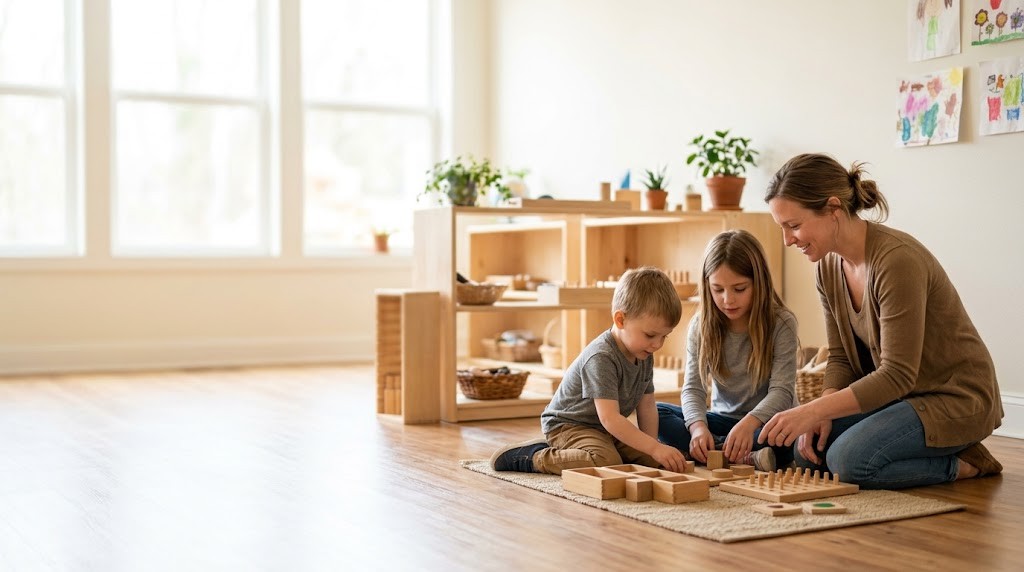
Teachers in these schools did not design the constraints they work within. When a child stops fitting, it is rarely because of one teacher. It is because a structure built for a class of many has limited room to bend for one.
Why the difference matters more than it used to
For most children the traditional model works. The official numbers show how many it currently does not hold.
| Country | Measure (official definition) | Figure | Year |
|---|---|---|---|
| Japan | Futoko: 30 or more days absent in the year, excluding illness and economic reasons (elementary and junior high) | 353,970 pupils; 38.6 per 1,000 | Fiscal year 2024 (MEXT) |
| England | Persistent absence: missed 10% or more of possible sessions | 20.0% of pupils | 2023/24 (Department for Education) |
| England | Severe absence: missed 50% or more of possible sessions | 2.3% of pupil enrolments | 2023/24 (Department for Education) |
| United States | Chronic absenteeism: commonly, missing 10% or more of school days | About 31% of students | 2021–22 (U.S. Department of Education) |
These measures are defined differently and must not be ranked against each other. Each is shown only against its own definition.
These are the children for whom “which decisions sit where” stops being a theoretical question. Japan’s education ministry recognised this in its notice of 25 October 2019: support for non-attending pupils should not aim only at the result of returning to school, but at the child’s eventual social independence, and learning outside school can be counted as attendance by the child’s principal under set conditions.
Want to build this in your own country, with a model that already runs?
If you read the comparison as a founder, you may already be asking which model you would build. NIJIN Academy is an alternative school in Japan, opened in September 2023 and run by NIJIN Inc. It is a hybrid: children join from home through a metaverse campus, choose from about 100 live online classes a month, and can also go to 48 physical classrooms across Japan. NIJIN is now looking for a Country Head in each country: one founder who will start and lead NIJIN Academy there, as both its business head and its principal.
See the Country Head role
For parents: seven questions that show the real difference
Brochures of both kinds of school use the same words: individual, holistic, child-centred. These questions get past the words.
- What is this school in law, and where will my child be officially enrolled?
- Who decides what my child does on an ordinary Tuesday morning?
- How will I know, in three months, whether my child is learning? What will I be shown?
- What happens on a day when my child refuses to come, or comes and does nothing?
- How do children move on from here, to examinations or the next school, and what did last year’s leavers do?
- Who are the adults, how long have they stayed, and who covers when one is away?
- What does it cost in total, and what happens if we need to leave mid-year?
A good school of either kind answers all seven without discomfort.
For founders: what changes when you build the alternative
Each freedom you give children becomes a job for your organisation.
| If you offer | You must build |
|---|---|
| Individual pace | A record of where every child is, updated weekly, that a new adult could pick up |
| Choice of classes or projects | Enough options for the choice to be real, which usually means online classes or partners |
| No grades | Another way of showing progress that parents, the next school and the authority will accept |
| Flexible attendance | A reason to come: relationships, events, a community that notices when someone is missing |
| A voice for students | A meeting structure, and adults trained to lose a vote gracefully |
| Recognition by the mainstream system | A working relationship with registered schools, exam boards or the education authority |
| A fee families can sustain | A cost base that breaks even at small numbers |
The legal side differs by country and often by state. Whether a setting must register as a school, who may teach in it and how it is inspected are questions for the official authority where you live, such as the Department for Education in England or a state department of education in the United States. Ask before you enrol the first child.
The model itself can be learned. NIJIN describes NIJIN Academy as one of the largest alternative schools in Japan, and these are its published figures.
Figures are those published by NIJIN. “Attendance recognition” means that the school a child is registered at counts learning at NIJIN Academy as school attendance; the decision is made by each school’s principal.
It does not have to be either-or
The comparison is often presented as a choice between two camps. In practice the two are moving towards each other. Traditional schools adopt project work, flexible grouping and support rooms. Alternative schools arrange for their pupils’ learning to be recognised by registered schools and prepare them for the same examinations.
For a child, the realistic options are usually three: stay and adjust within the traditional school; move fully to an alternative; or combine the two, remaining on the roll of one while learning mainly in the other. Which is right depends on the child, the family and what the law allows locally.
Questions and answers
Is an alternative school better than a traditional school?
Not in general. Research on outcomes is difficult to compare because families who choose alternative schools differ from those who do not. The useful question is which arrangement fits this child now, and whether the school can show how it will know.
Are alternative schools only for children with problems?
No. Some serve children who have struggled in mainstream school, and in some countries the term is used mainly that way. Others, such as Montessori and Waldorf schools, are chosen from the start by families who prefer the approach.
Can a child go from an alternative school to university?
That depends on whether the school is a registered school that awards or prepares for recognised qualifications, or a setting outside the system whose pupils take examinations by another route. Ask the school what its leavers have done, and check the entry rules of your own country.
Do alternative schools follow the national curriculum?
Some do, some follow it loosely, and some do not. What is required depends on the school’s legal status and the country. The education authority can tell you what applies.
Are alternative schools more expensive?
They often charge fees because they receive little or no public funding, and small scale makes each place costly to provide. Some countries fund independent schools or offer support to families; the rules are national or local.
What is the difference between an alternative school and a microschool?
“Alternative” describes how decisions are made about learning. “Microschool” describes size. A microschool can be quite traditional in method, and an alternative school can be large. Our guide on how to start a microschool covers the practical steps.
Can someone without a teaching background start an alternative school?
In many places, yes, though the people who teach may need qualifications depending on the legal category. Running a school draws heavily on leadership, hiring and management. NIJIN does not require teaching experience for its Country Head role.
Build the alternative in your own country
NIJIN is looking for one founder per country to start and lead NIJIN Academy there, as business head and principal. If you want to start a company in your own country and solve a problem in education, read the role.
Read the Country Head role and applyWhere to go next
NIJIN Academy Country Head pages are open for several countries, and the global page covers every other country. Our English careers page lists everything else we are working on.
Related guides for founders
- Homeschooling vs online school vs alternative school
- How to start a microschool: a step-by-step guide for founders
- School refusal: what Japan’s futoko teaches school founders
- What is a metaverse school? How hybrid schools work
Sources
All figures in this article are quoted with the year they refer to. Please check the original for later updates.
- https://montessori-ami.org/
- https://www.waldorfschule.de/
- https://www.summerhillschool.co.uk/
- https://sudburyvalley.org/
- https://www.mext.go.jp/content/20260305-mxt_jidou02-100002753_3.pdf
- https://www.mext.go.jp/a_menu/shotou/seitoshidou/1422155.htm
- https://explore-education-statistics.service.gov.uk/find-statistics/pupil-absence-in-schools-in-england/2023-24
- https://www.ed.gov/teaching-and-administration/supporting-students/chronic-absenteeism
- https://www.gov.uk/government/publications/independent-school-registration
- https://nijin.co.jp/recruit/nijin-academy-country-head/
- https://nijin.co.jp/recruit/en/