
For school founders and education leaders
School refusal describes a child who is enrolled in school, and whose family wants them to attend, but who does not or cannot go, usually with real distress. It is not a diagnosis and it is not the same as truancy. No two countries name or count it the same way: Japan counts futoko (30 or more days absent in a year), England counts persistent and severe absence, the United States counts chronic absenteeism. Japan has counted it for decades, and its education ministry recorded 353,970 futoko pupils in elementary and junior high school in fiscal year 2024. What Japan learned along the way is directly useful to anyone building a school for children the mainstream is not holding.
In this article
What school refusal is, in plain terms
The phrase comes from psychology and child psychiatry. It is used for a pattern, not a cause: a child has great difficulty going to school or staying there; the difficulty comes with anxiety, low mood, physical complaints or exhaustion; the child is at home with the parents’ knowledge during school hours; and the parents have tried to get the child to attend.
Those last two points separate it from other kinds of absence.
| Term | What it usually describes | Where the child is |
|---|---|---|
| School refusal | Difficulty attending, with emotional distress; parents know and want attendance | Mostly at home |
| Truancy | Absence without the parents’ knowledge or consent, usually without distress about school itself | Away from home and school |
| School withdrawal | A parent keeps the child at home, for the family’s reasons | At home |
| School exclusion | The school sends the child away or does not accommodate them | Wherever the family can arrange |
| Out of school | Not enrolled at all (the UNESCO measure) | Outside the system |
Real children do not sort neatly into these rows, and many people now prefer wider terms such as “school attendance problems” or, in England, “emotionally based school avoidance”. The word “refusal” itself is criticised, because it suggests a choice. Many of these children say they want to go and cannot. Japan dropped its own equivalent word for exactly that reason, as we will see.
If you are a parent reading this about your own child: this article is about how systems respond, not medical advice. A doctor, a school counsellor or your local education authority is the right first contact.
How countries name and count it
You cannot compare countries by looking for “school refusal statistics”, because almost no government collects a statistic under that name. Each counts absence by its own rule.
| Country | Official term | Threshold | Latest figure quoted here | Source and year |
|---|---|---|---|---|
| Japan | Futoko (non-attendance) | 30 or more days absent in the school year, excluding illness and economic reasons | 353,970 pupils in elementary and junior high school; 38.6 per 1,000 | MEXT, fiscal year 2024 |
| England | Persistent absence | Missed 10% or more of possible sessions, for any reason | 20.0% of pupils | Department for Education, 2023/24 |
| England | Severe absence | Missed 50% or more of possible sessions | 2.3% of pupil enrolments | Department for Education, 2023/24 |
| United States | Chronic absenteeism | Commonly, missing 10% or more of school days, for any reason | About 31% of students; over 14 million | U.S. Department of Education, 2021–22 |
| Worldwide | Out of school | Not enrolled | 272 million children and youth | UNESCO UIS and GEM Report, data for 2023 |
These rows cannot be ranked against each other. England and the United States include absence for illness; Japan’s futoko figure excludes it. A threshold of 10% of sessions and a threshold of 30 days capture different children.
Three things follow for a founder. First, check which measure your own country uses before quoting a number to funders or officials. Second, a country without a figure does not lack the problem; it lacks the count. Third, the stricter the threshold, the closer the number is to the children an alternative school actually serves. England’s severe absence rate and Japan’s futoko rate are nearer to that group than broad chronic absenteeism figures are.
Japan’s futoko: the definition and the numbers
Japan’s Ministry of Education, Culture, Sports, Science and Technology (MEXT) surveys every school each year. It defines a futoko pupil as one who was absent for 30 days or more in the year because, owing to some psychological, emotional, physical or social factor or background, they did not attend or could not attend even though they wanted to, excluding absence due to illness or economic reasons.
The results for fiscal year 2024 (April 2024 to March 2025), published on 29 October 2025, were as follows.
The total was a record and the twelfth consecutive annual rise. Elementary schools show how far the picture has changed: 25,864 futoko pupils in fiscal year 2014, and 137,704 ten years later.
The same survey also contains the first signs of a slowdown. Growth in the total fell to 2.2%, from 15.9% the year before. The number of pupils newly counted as futoko fell in both elementary school (70,419, down from 74,447) and junior high school (83,409, down from 90,853). And the share of the previous year’s futoko pupils who were still futoko a year later fell to 71.7% in elementary school and 77.1% in junior high. MEXT’s own summary is careful: the growth rate has dropped, but the number has not yet reached the point of falling.
How Japan’s response changed
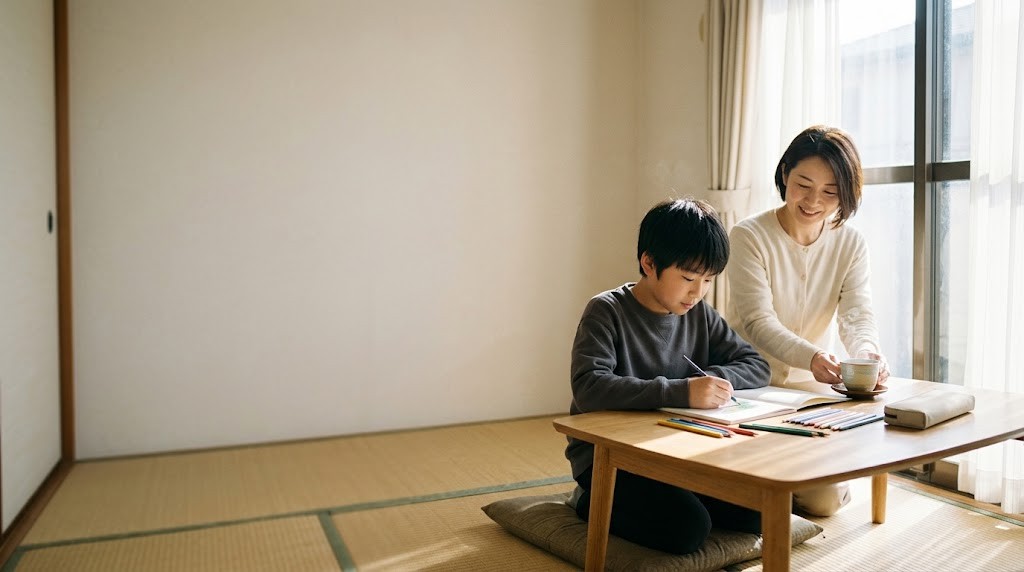
The numbers are one half of Japan’s experience. The other half is how official thinking moved, and it moved a long way.
- From “refusal” to “non-attendance”. Earlier Japanese terms framed the child as refusing or disliking school. The official word is now futoko, which simply means “not attending” and makes no claim about why.
- A law that names the need for rest (2016). The Act on Securing Educational Opportunities was promulgated in December 2016. MEXT’s summary of the fiscal 2024 survey describes it as the law that made explicit a child’s need for rest, and lists the spread of that law’s intent as one background to the rise in recorded numbers.
- Return to school is no longer the only goal (2019). MEXT’s notice of 25 October 2019 says support should not aim only at the result of going back to school. The aim is that the child comes to see their own path and moves towards social independence. It also notes that a period away can have a positive meaning, as rest and as time to reconsider oneself.
- Learning outside school can count (2019). Under the same notice, a principal may treat a child’s learning at an outside facility, or at home using ICT, as attendance when set conditions are met, including cooperation between the school and the family or facility.
None of this means Japan has solved the problem; the figures above say otherwise. It means a large, centralised school system concluded, in writing, that a child who is not at school is still owed an education, and that places other than school may provide it.
Want to build this in your own country, with a model that already runs?
Japan’s shift in policy is what made room for a new kind of school. NIJIN Academy is an alternative school in Japan, opened in September 2023 and run by NIJIN Inc. It is a hybrid: children join from home through a metaverse campus, choose from about 100 live online classes a month, and can also go to 48 physical classrooms across Japan. NIJIN is now looking for a Country Head in each country: one founder who will start and lead NIJIN Academy there, as both its business head and its principal.
See the Country Head roleSix lessons for school founders
1. Count with a definition, or nobody will fund you
Japan can talk about futoko because it has counted it the same way, every year, in every school. Find your country’s nearest official measure and use it precisely, with its year and its threshold. If none exists, say so, and use the closest attendance data from your ministry or statistics office.
2. Do not look for someone to blame
Japan’s wording moved away from the child’s “refusal”. The reasons a child stops attending are usually several at once, and blaming the child, the parents or the teacher helps none of them. NIJIN’s working principle puts it this way: don’t blame people, build systems.
3. Design for rest first, then for reconnection
A child who has stopped attending is often exhausted. A setting that demands full days from the first week repeats the problem. Start with short, low-pressure contact, online or in person, and widen it as the child’s energy returns.
4. Make your records readable by the mainstream school
Attendance recognition in Japan depends on the principal of the child’s registered school. That works only when the outside setting reports what the child did in a form the school can use. Wherever you are, build the reporting before you need it. Whether and how such recognition exists in your country is a question for your education authority.
5. Offer more than one way in
Some children can join an online class from their bedroom long before they can enter a room of peers. Others need a physical place and an adult. A hybrid gives a child steps instead of a single threshold. NIJIN Academy pairs a metaverse campus and about 100 live online classes a month with 48 physical classrooms across Japan.
6. Serve the parents too
By definition, in school refusal the parents know and are worried. They are often isolated, and often the ones who must negotiate with the school. A founder who gives parents a clear monthly picture of their child, and a community of other parents, removes much of the weight.
Figures are those published by NIJIN. “Attendance recognition” means that the school a child is registered at counts learning at NIJIN Academy as school attendance; the decision is made by each school’s principal.
Is this only a Japanese issue?
No. The word is Japanese; the pattern is not. England’s 2.3% of pupil enrolments missing half or more of school in 2023/24, and the United States’ chronic absenteeism rate of about 31% in 2021–22, describe systems in which a large number of enrolled children are not reliably there. In countries where the larger problem is children who were never enrolled, the 272 million counted by UNESCO for 2023, the same design ideas apply from the other direction: small settings, close to home, flexible in time, connected to the formal system.
What Japan adds is a long, consistent record and a documented change of official mind. If you are studying attendance, measurement or the use of AI in this field, NIJIN’s research arm, Ranius, welcomes collaboration: see Ranius research collaboration.
Questions and answers
What does futoko mean?
Futoko (不登校) is the Japanese term for school non-attendance. In MEXT’s statistics it means a pupil absent for 30 days or more in the school year for psychological, emotional, physical or social reasons, excluding illness and economic reasons.
Is school refusal a mental illness?
No. It is a description of a pattern of non-attendance, not a diagnosis. It can occur together with anxiety or other conditions, which is why a child’s doctor should be involved where there are health concerns.
How is school refusal different from truancy?
In the usual definitions, a truant child hides the absence from parents and is not especially distressed about school. A child with school refusal is at home with the parents’ knowledge, and attendance itself causes distress.
How many children in Japan are futoko?
MEXT counted 353,970 in elementary and junior high school in fiscal year 2024, or 38.6 per 1,000 pupils. Check MEXT’s survey page for later years.
Which country has the most school refusal?
It cannot be said. Countries use different terms and thresholds, and some include illness while others exclude it. Any ranking built from these numbers would be misleading.
Does a futoko child in Japan have to return to their school?
MEXT’s 2019 notice says support should not aim only at returning to school, but at the child’s social independence. What is right for an individual child is decided by the family together with the school and other supporters.
Can I start a school for these children in my country?
Often yes, but the legal form, registration and recognition rules differ by country and by state. Take your plan to the official education authority first. NIJIN is recruiting Country Heads to build NIJIN Academy in their own countries, and teaching experience is not required. Practical starting points: how to start a microschool and how to start an online school.
Build a place for the children school is not holding
NIJIN is looking for one founder per country to start and lead NIJIN Academy there. If you want to start a company in your own country and solve this problem in education, read the role.
Read the Country Head role and applyWhere to go next
NIJIN Academy Country Head pages are open for several countries, and the global page covers every other country. Our English careers page lists everything else we are working on.
Related guides for founders
- Out-of-school children: the numbers, the causes and what founders can build
- Alternative school vs traditional school: what actually differs
- What is a metaverse school? How hybrid schools work
- Homeschooling vs online school vs alternative school
- How to start a microschool: a step-by-step guide for founders
Sources
All figures in this article are quoted with the year they refer to. Please check the original for later updates.
- https://www.mext.go.jp/a_menu/shotou/seitoshidou/1302902.htm
- https://www.mext.go.jp/content/20260305-mxt_jidou02-100002753_3.pdf
- https://www.mext.go.jp/a_menu/shotou/seitoshidou/1422155.htm
- https://www.mext.go.jp/a_menu/shotou/seitoshidou/1380960.htm
- https://explore-education-statistics.service.gov.uk/find-statistics/pupil-absence-in-schools-in-england/2023-24
- https://www.ed.gov/teaching-and-administration/supporting-students/chronic-absenteeism
- https://www.unesco.org/gem-report/en/publication/2025sdg4scorecard
- https://nijin.co.jp/recruit/nijin-academy-country-head/
- https://nijin.co.jp/recruit/ranius-research-collaboration-pro-bono/
- https://nijin.co.jp/recruit/en/