
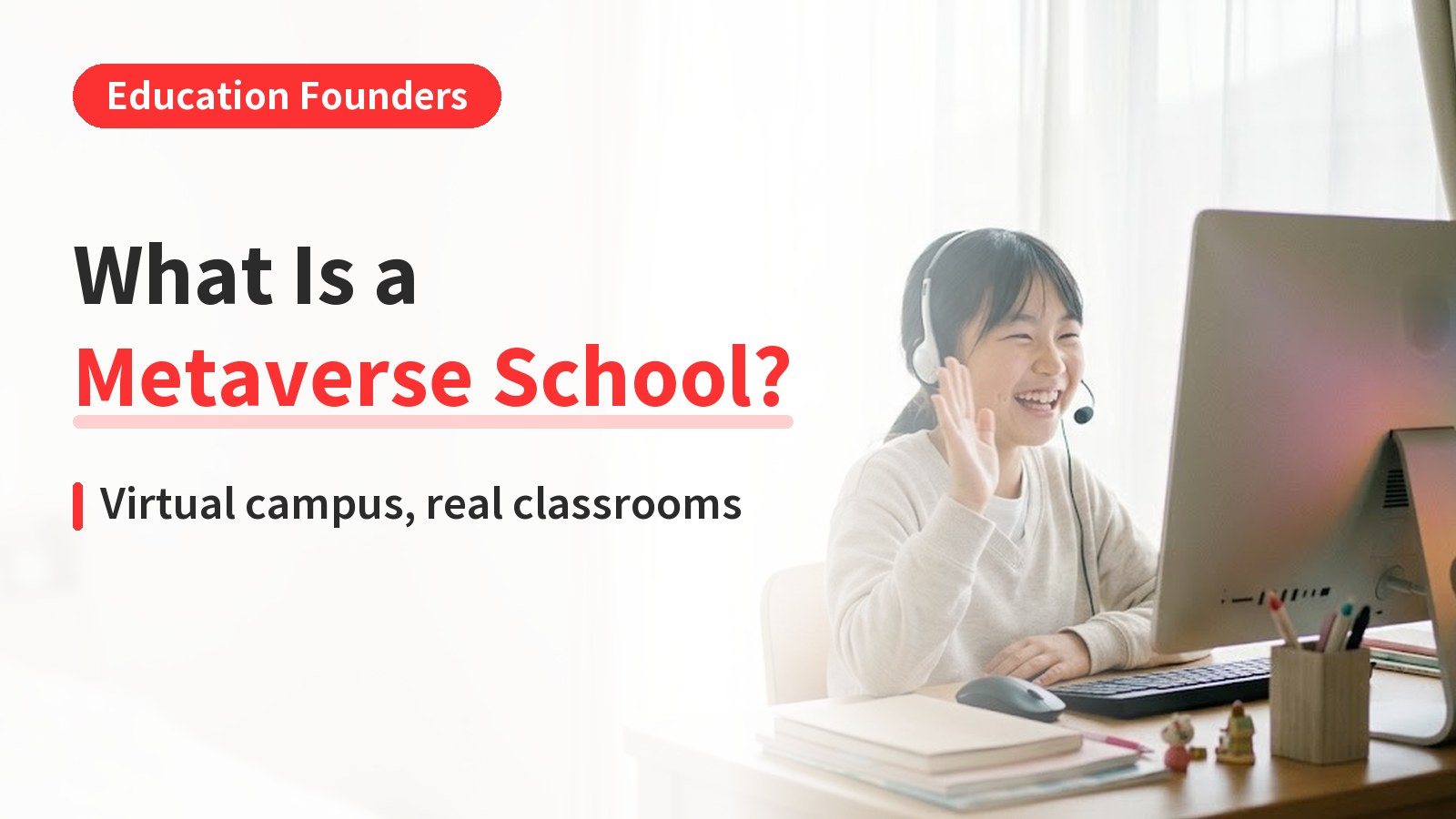
A metaverse school is a school whose campus is a shared virtual space: students arrive as avatars, walk into classrooms, sit with friends and join live lessons from home. The virtual campus is not the lessons themselves. It is the place around them, the corridors and common rooms that an ordinary video call does not have. A hybrid school goes one step further and pairs that virtual campus with physical classrooms, so a child can belong online every day and meet people in person when they are ready. This article explains how the model works, using NIJIN Academy in Japan as a documented example, and what it takes to run one.
In this article
What “metaverse school” actually means
The word “metaverse” has been used for everything from games to marketing campaigns, so it helps to be plain. In a school, it means three things.
- A persistent place. The campus is there whether or not a lesson is running. A student can log in early, wander, and find out who else is around.
- Presence without exposure. A student appears as an avatar. Others can see that they have arrived and where they are, without seeing their face or their bedroom.
- Movement and choice. Students move between rooms themselves: to a class, a club, a quiet corner, a teacher’s desk. Choosing where to be is part of belonging somewhere.
It does not have to mean a headset. Many metaverse schools run in a browser on an ordinary computer, in two dimensions or simple three dimensions. NIJIN Academy, for example, describes its campus as a virtual school a child can enter from a PC with one click.
It also does not mean that software teaches. Lessons are taught live by people. The virtual campus is the building, and a building does not teach anyone.
How it differs from online classes and from a physical school
| Video-call classes | Metaverse school | Hybrid school | Physical school | |
|---|---|---|---|---|
| Where students are | Home | Home, inside a shared virtual campus | Home on the virtual campus, and physical classrooms | A school building |
| Between lessons | The call ends; everyone disappears | Students stay, move around, talk | As metaverse, plus time together in person | Corridors, playground, lunch |
| How visible a student must be | Usually camera on or off | Avatar; camera and microphone can be optional | Student’s choice online; in person at the classroom | Fully present |
| Reach | Anywhere with a connection | Anywhere with a connection | Anywhere online; in person near a classroom | Within travelling distance |
| Hands-on and physical activity | Limited | Limited; done at home | Available at classrooms and events | Built in |
| What the school must run | A timetable of calls | A campus, a timetable and an online community | All of that plus premises and local staff | Premises and staff |
The row that matters most is the second. Much of what makes a school feel like a place happens between lessons. Video-call classes delete that time. A virtual campus puts some of it back, and physical classrooms put back more.

The parts of a hybrid school
A hybrid school is easier to understand as four layers that sit on top of each other.
- Virtual campusThe daily place: homeroom, classrooms, clubs, staff room. Open to every student, wherever they live.
- Live classesTaught by teachers in real time, in small groups. Recorded lessons fill the gaps.
- Physical classroomsLocal rooms where students meet, make things and move. Attended as often as suits the child.
- Adults who know the childStaff who notice who has gone quiet, talk with parents, and work with the child’s registered school.
The fourth layer is the one outsiders overlook and the one that decides whether the school works. A platform can be licensed and a room can be rented. Noticing that a twelve-year-old has not spoken for three days, and knowing what to do about it, takes people.
A documented example: NIJIN Academy
NIJIN Academy is an alternative school in Japan for children who do not fit conventional school, many of whom had stopped going to school altogether. It opened in September 2023, is run by NIJIN Inc., and now runs through to high school age. Its founder, Tatsuro Hoshino, taught at a public elementary school for seven years before leaving to build what he calls another piece of educational infrastructure that stands alongside school. The facts below are those published on NIJIN’s official websites.
“Attendance recognition” means the school where the child is registered counts learning at NIJIN Academy as school attendance. The decision belongs to that school.
How the virtual campus is used
Children enter the metaverse campus from home on a PC. The day runs from a morning meeting through classes to after-school time, and there are whole-school homeroom gatherings. Classes are small, with 8 to 10 students, and mix ages and grades. Cameras and microphones are optional, so a child who is not ready to be seen or heard can still take part.
What children choose from
About 100 live classes are offered each month, and there is an archive of more than 500 recorded lessons for learning at a child’s own pace. Beyond lessons, the academy lists 11 clubs formed around students’ interests, special classes taught by professionals, projects with companies and local governments, and events and trips through the year.
Where the physical classrooms come in
Families can choose online only, or a hybrid of online and in person. The physical classrooms, 48 across Japan, are where children meet face to face. NIJIN describes the academy as one of the largest alternative schools in Japan.
The idea behind it
The school’s motto is “Be HAPPY, Do HAPPY”: everyone has the power to become happy and the power to make others happy. The company’s working principle is “don’t blame people, build systems.” A child who stops attending is not the problem, and neither are parents or teachers. The form of school is what has to widen.

Who the model fits, and who it does not
It tends to fit
Children who want to learn and to have friends but cannot, for now, be in a large classroom. Children who live far from any school that suits them. Families who want a school, with teachers and a timetable, and not to teach at home themselves.
It is a poor fit when
There is no reliable device or connection at home. No adult can be nearby for a young child. The child most needs physical activity and hands-on work every day, and no classroom is within reach.
Scale matters here. In England, the Department for Education counted 126,000 children in elective home education on census day in autumn 2025, with mental health the most common recorded reason. In the United States, the National Center for Education Statistics found 5.2% of students aged 5 to 17 receiving instruction at home in 2022–23, through homeschooling or full-time virtual education. Globally, UNESCO counts 273 million children and youth out of school in 2024. These are different groups with different needs, and a metaverse school will not serve all of them: a virtual campus presupposes electricity, a device and a connection. For a comparison of the options families weigh, see homeschooling vs online school vs alternative school.
What it takes to run one
If you are considering building a school like this, the technology is the smaller part. Here is what the model asks of an operator.
| Area | What you have to get right |
|---|---|
| People | Teachers who can hold a small group online, and staff who follow each child. Hiring and training them is the main work. |
| Timetable | Enough live classes that a child always has something to choose, at hours that suit families. |
| Community | Homeroom, clubs and events. Without them a virtual campus is an empty building. |
| Physical sites | Local leaders, premises and safety. Each classroom is a small school of its own. |
| Recognition | A working relationship with each child’s registered school and the education authority. |
| Safeguarding and data | Rules for conduct online, for recordings, and for children’s personal data. |
| Economics | Fees a family can sustain against the cost of small classes and two kinds of campus. |
On rules. Whether a metaverse or hybrid school counts as a school, whether time there counts as attendance, who may teach, and how children’s data must be handled differ by country and often by state. The Japanese arrangement described above is specific to Japan. Ask your own education authority and data protection regulator before you design a programme.
NIJIN does not assume its Japanese model will work unchanged elsewhere, which is why it is looking for founders who will decide what fits their own country.
Now recruiting: NIJIN Academy Country Head. NIJIN wants an academy in every country and is looking for one person per country to start and lead it, as business head and principal. The plan is to set up a local company in that country and give the Country Head shares in it. As a guide, compensation is 10% of revenue (excluding consumption tax), capped at JPY 50 million once revenue reaches JPY 500 million or more. It is a guide only: as the person leading the company you decide it as the business grows, and no income is guaranteed. Teaching experience is not required. The country’s official language plus English and Japanese is ideal; English alone is acceptable.

Questions and answers
Do students need a VR headset?
Not necessarily. Many virtual campuses run on an ordinary computer. NIJIN Academy describes its campus as accessible from a PC with one click. Ask any school what device it requires.
Is a metaverse school a real school?
That is a legal question with a local answer. Some are registered schools; others, like many alternative schools, work alongside the school where a child is enrolled. Ask the school how it is registered and ask your education authority how attendance there is treated.
How is it different from online classes on a video call?
A video call exists only during the lesson. A virtual campus is a place that stays open, where students can see who is around, move between rooms and spend time together outside lessons.
Do children make friends in a virtual campus?
The design is meant to make that possible through homerooms, clubs and shared projects, and a hybrid school adds in-person time. How well it works depends on the adults running it, so ask to join a trial session.
Does a child have to show their face or speak?
It depends on the school. At NIJIN Academy cameras and microphones are optional.
What does a metaverse school cost?
Fees vary by school and country, and they change, so we do not quote any here. Check the school’s own tuition page.
Can I start a metaverse school in my country?
In principle yes, subject to local law. You can build one yourself, or lead one with an organisation that already runs the model. NIJIN’s Country Head role is one such route. The steps are in how to start an online school.
Bring this model to your country
If you want to start a company in your own country and build a school for children who do not fit school, read the Country Head role and apply. We talk first.
ApplyRoles and related reading
- Homeschooling vs online school vs alternative school
- How to start an education business
- Out-of-school children: the global numbers, the causes, and what founders can do
- How to start an online school that children keep attending
- School refusal: what Japan’s futoko teaches school founders
- How to start a microschool: a step-by-step guide for founders
- Alternative school vs traditional school: what actually differs
Sources:
- https://academy.nijin.co.jp/
- https://nijin.co.jp/
- https://nijin.co.jp/recruit/nijin-academy-country-head/
- https://explore-education-statistics.service.gov.uk/find-statistics/elective-home-education
- https://ies.ed.gov/learn/press-release/higher-percentage-k-12-students-are-receiving-academic-instruction-home
- https://www.unesco.org/en/articles/more-children-out-school-7th-year-row-273-million